Engineer News Network The ultimate online news and information resource for today's engineer
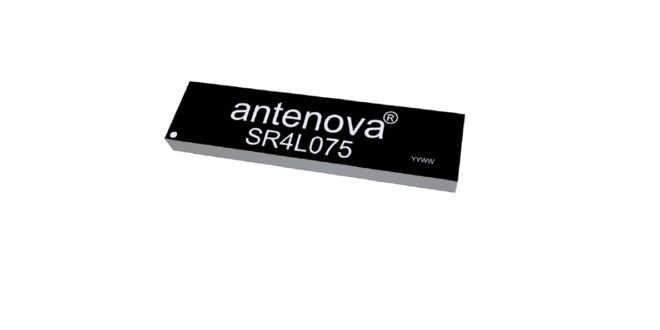
Antenova Ltd announces a new and smaller SMD antenna for 5G and 4G frequencies. The antenna is named Minima, part number SR4L075.
At 40 x 10 x 3.3mm, Minima is the smallest 5G antenna that Antenova has brought to market so far. Its small volume and low weight, below three grammes, suit it to small, lightweight designs for 4G and 5G frequencies, and designs that use both frequencies.
Minima is a multi-band cellular antenna covering the common 4G and 5G frequencies used globally, including the popular Band 71, 617- 698 MHz, used by T-Mobile in the USA. It can therefore be used in designs that will be marketed globally.
Says Antenova’s Product Marketing Manager Michael Castle: “As the name suggests, Minima uses minimum space in a design. It is a very small antenna that operates with a small clearance beneath, making it a winner for 4G and 5G cellular designs where space is tight on the PCB. In tests, Minima achieved efficiencies up to 60%, which will help designers to achieve certification for their 5G designs.”
Antenova announces Minima to help designers future-proof their designs as operators move away from 3G and roll out 5G services. The Global Mobile Suppliers Association reports an increase in super-fast 5G networks and 5G devices, identifying 493 operators in 150 countries that have invested in 5G, and 205 operators in in 80 countries have launched 5G mobile services and 5G devices. The number of devices available for the 5G networks has grown by more than 60% in the last 12 months.
Bloomberg reports demand for high bandwidth entertainment services, such as 4K video streaming and remote AR/VR gaming driving the growth, while oil, gas, mining, and energy utilities are investing 5G networks to connect millions of industrial IoT (IIoT) devices. Emergency healthcare, transport, smart cities, V2X and drones will also use 5G.
References: https://gsacom.com/technology/5g/