Engineer News Network The ultimate online news and information resource for today's engineer
Asia is set to lead the global polyethylene industry capacity additions with a share of 42% by 2027, as it gains capacities from new-build and expansion projects between 2023 and 2027, says GlobalData, the data and analytics company.
GlobalData’s latest report Polyethylene Industry Installed Capacity and Capital Expenditure (CapEx) Forecast by Region and Countries including details of All Active Plants, Planned and Announced Projects, 2023-2027, reveals that the total polyethylene capacity of new-build and expansion projects in Asia is expected to reach 24.8 million tonnes per annum (mtpa) by 2027.
Nivedita Roy, Oil and Gas Analyst at GlobalData, comments: “In the upcoming new-build projects category, Asia is expected to see a capacity addition of 24.63 mtpa from 60 planned and announced projects, whereas from the expansion projects, it is anticipated to add a capacity of 0.21 mtpa from two planned projects.”
Polyethylene Chart (002).png
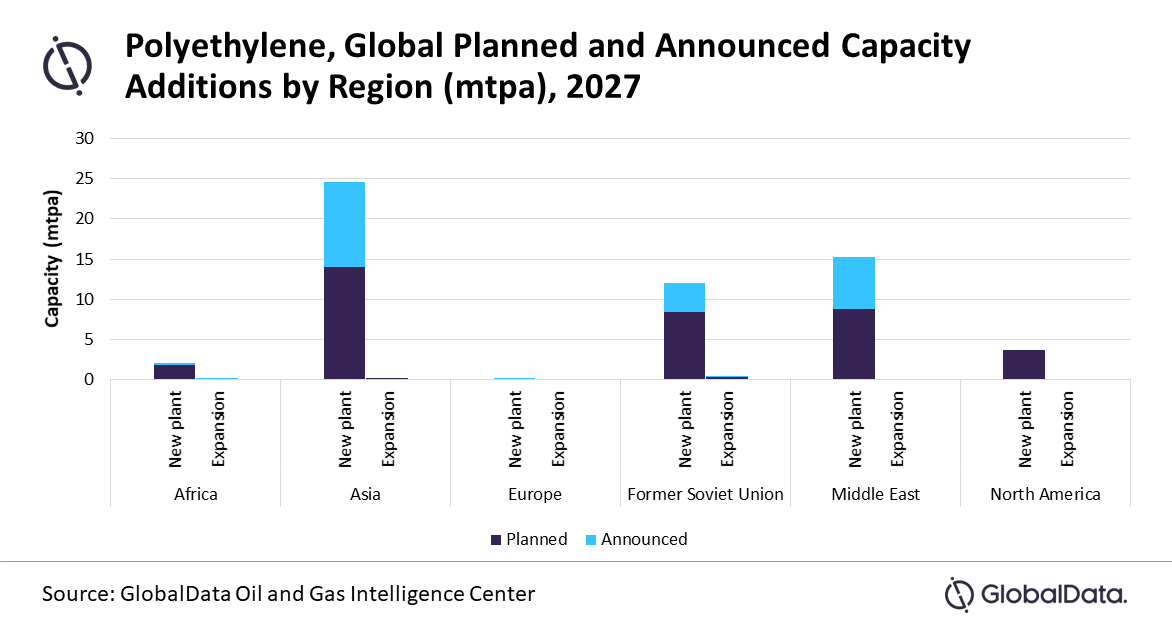
China and India are the major countries in Asia in terms of polyethylene capacity additions. In China, the main capacity addition would be from three planned and two announced projects, with a capacity of 0.5 mtpa each. The five plants are Exxon Mobil Corporation Huizhou Polyethylene Plant, Oriental Energy Maoming Polyethylene Plant 1, Oriental Energy Maoming Polyethylene Plant 2, Sinopec and Ineos JV Tianjin Polyethylene Plant 1, and Tangshan Xu Yang Petrochemical Tangshan Polyethylene Plant 1.
Nivedita concludes: “In India, the major capacity addition will be from an announced project, Haldia Petrochemicals Balasore Polyethylene Plant, which is expected to come online in 2026 with a capacity of 1.08 mtpa.”