Engineer News Network The ultimate online news and information resource for today’s engineer
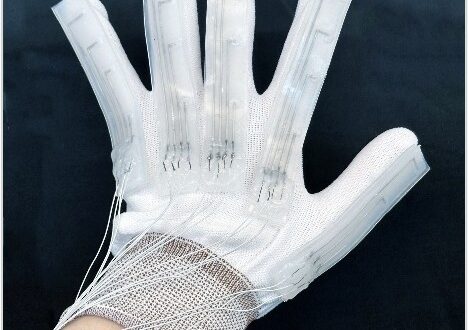
Scientists have developed new sensor glove technology that could help robots use their hands in more human-like ways, a study suggests.
The low-cost gloves detect hand gestures and subtle movements more accurately than existing technologies, researchers say.
Data collected using the gloves – which cost around £50 to make – could be used to teach robots to use their hands in similar ways to humans, the team says.
Developing robots with greater dexterity could improve their ability to be used in challenging applications, such as remote surgery, virtual reality and carrying out tasks in space.
Each glove is equipped with a range of sensors that can detect subtle movements, such as finger bending and changes in the spacing between fingers – a feature that similar, existing technologies tend to lack.
The sensors, housed in silicone and composed of electrodes made of liquid metal, detect movement by measuring changes in the amount of electrical charge – known as capacitance – stored by their electrodes. Changes to capacitance are produced when the fingers of the glove bend or the distance between them changes.
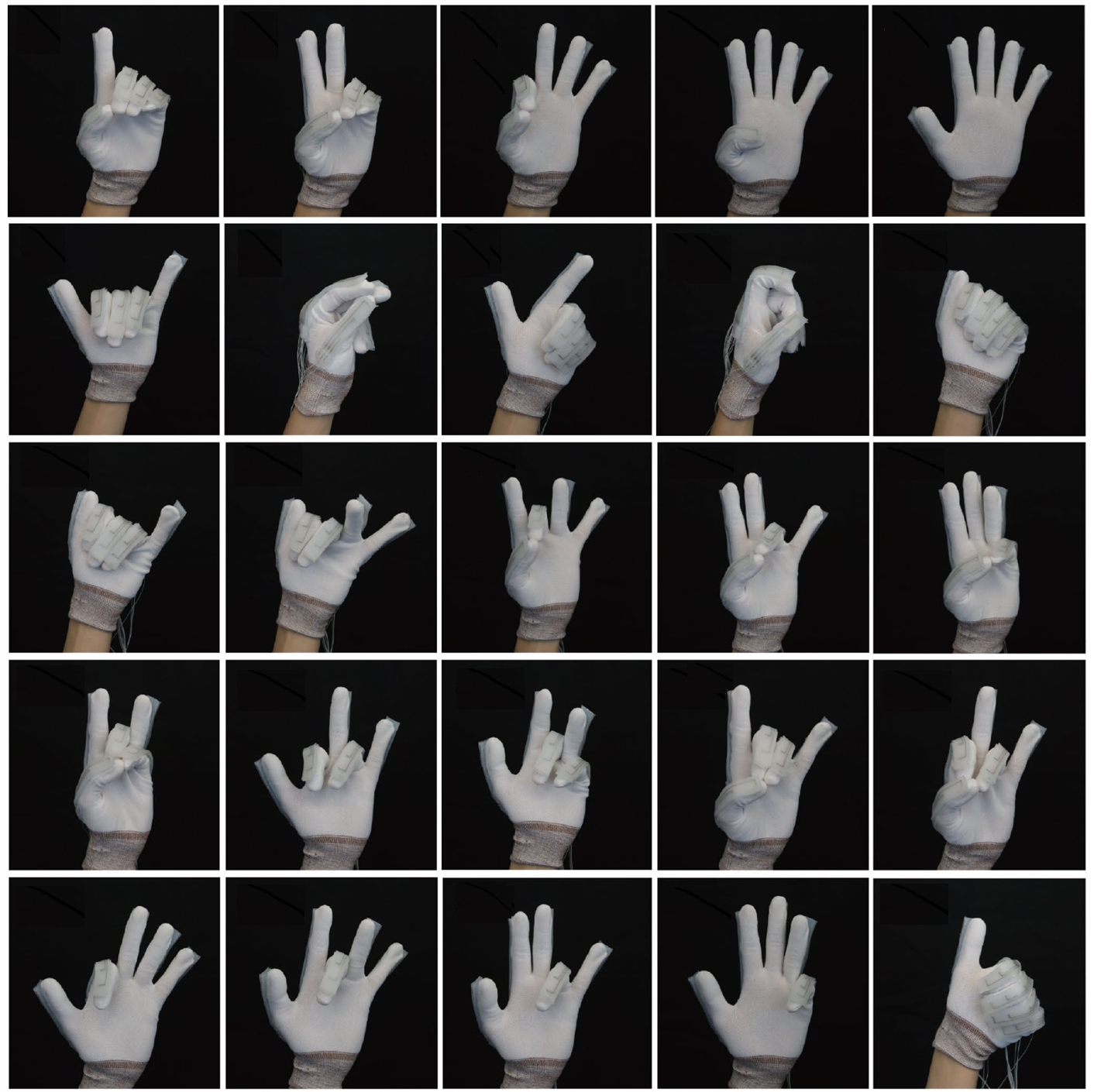
Researchers from the University of Edinburgh tested their design by collecting hand gesture data from six participants. While wearing the glove, each participant performed 30 different hand gestures, which the sensors detected with more than 99% accuracy.
To investigate the sensors’ ability to track even more complex hand motion, researchers tasked participants with performing random movements whilst wearing the glove.
The team used cameras to track the hand at the same time, producing a comparison dataset to test the glove’s accuracy. Their results show that the sensors can accurately reconstruct hand shape and movements that closely match the comparison data, outperforming current technologies by almost 10%.
Following on from this study, researchers are seeking to improve the glove’s sensing capabilities by integrating technology to mimic the human hand’s sense of touch across the whole palm.
The research was presented at the 2025 IEEE/RSJ International Conference of Intelligent Robots and Systems in Hangzhou, China – one of the largest and most impacting robotics research conferences worldwide. The work was supported by the European Research Council, which has also recently awarded the research team a Proof of Concept grant to commercialise its related, flexible electronic skin technology.
The team is working with Edinburgh Innovations, the University’s commercialisation service, to translate these proprietary technologies into real-world impact. The focus is on next-generation robotics, particularly dexterous and humanoid robots, where rich whole-body sensing is critical for safe, intelligent interaction with the physical world. Target applications also span a range of use cases from health care, such as surgical robotics and compliant protheses, to virtual and augmented reality and wearable technologies.
Dr Yunjie Yang, of the University of Edinburgh’s School of Engineering, who led the study, said: “By using highly stretchable liquid metal electrodes, we can capture the continuous, fluid transition of a hand in motion. This high-fidelity gesture data is the missing link needed to teach robots not just how to hold an object, but how to manipulate it with human-like agility and grace.”