Engineer News Network The ultimate online news and information resource for today's engineer
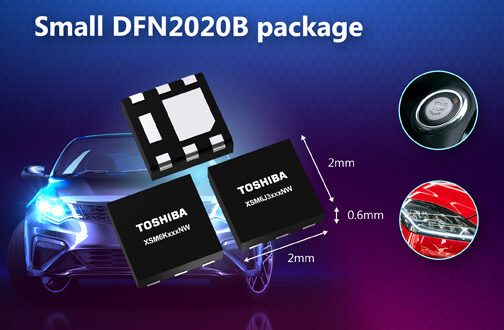
Toshiba announces the launch of five new automotive MOSFET products, designed to offer a combination of space-saving benefits and easy mounting. These N-channel (XSM6K361NW, XSM6K519NW, XSM6K376NW, and XSM6K336NW) and P-channel (XSM6J372NW) MOSFETs are housed in the DFN2020B(WF) package, which features a wettable flank structure.
The DFN2020B(WF) package represents a significant advancement in automotive electronics, offering multiple benefits. The wettable flank structure improves solder wettability compared to Toshiba’s existing UDFN6B package. Crucially, it also improves the visibility of the solder fillet, which enables confirmation of solder joint quality using Automated Optical Inspection (AOI) equipment. Furthermore, in solder joint mounting shear strength tests, the new package demonstrates approximately 23% greater strength compared to Toshiba’s existing SOT-23F package, contributing to the enhanced reliability.
With a typical package size of 2.0mm x 2.0mm x 0.6mm, the DFN2020B(WF) package reduces the mounting area by approximately 43% and the package height by approximately 25% when compared to the SOT-23F package (2.4mm x 2.9mm x 0.8mm typ.). This reduction in size is crucial for the miniaturisation of modern automotive equipment.
Despite its compact size, the new package features high power dissipation capability. For instance, the XSM6K361NW boasts a maximum power dissipation rating of 1.84W, which is approximately 1.5 times higher than the 1.2W of Toshiba’s existing SSM3K361R product with an SOT-23F package. This high power dissipation capability supports the development of compact automotive equipment requiring high-power MOSFETs, such as DC-DC converters for ECUs and load switches for LED headlamps.
These new products comply with AEC-Q101, the automotive industry standard reliability test specification. Additionally, the Production Part Approval Process (PPAP) of IATF16949, the international standard for quality management systems specific to the automotive industry, is available.