Engineer News Network The ultimate online news and information resource for today's engineer
China is witnessing a sweeping energy transformation as rapidly rising electricity demand, aging coal infrastructure, and international climate commitments converge. Renewables, led by solar PV, wind, and storage, along with nuclear power, are increasingly central to China’s electricity future through 2030. Without strengthened grid flexibility, upgraded transmission capacity, and tighter regulatory coherence, China risks bottlenecks, curtailment, and reliability challenges, according to GlobalData.
GlobalData’s latest report, China Power Market Trends and Analysis by Capacity, Generation, Transmission, Distribution, Regulations, Key Players and Forecast to 2035,says that clean power capacity pipelines are expanding aggressively in the country, while coal’s role is being repositioned from baseload toward backup. Solar and wind investment now dominate new construction and permitting, and ultra-high-voltage lines and storage. Grid constraints, however, persist without faster deployment of system-wide flexibility solutions.
Attaurrahman Ojindaram Saibasan, Power Analyst at GlobalData, comments: “China is at a critical juncture: as the emissions peak approaches and demand surges across industrial, residential, and transport sectors, the structure of its power market, especially how it handles seasonal variation, long-distance transmission, and system balancing, will determine whether clean energy targets are met without compromising supply security.”
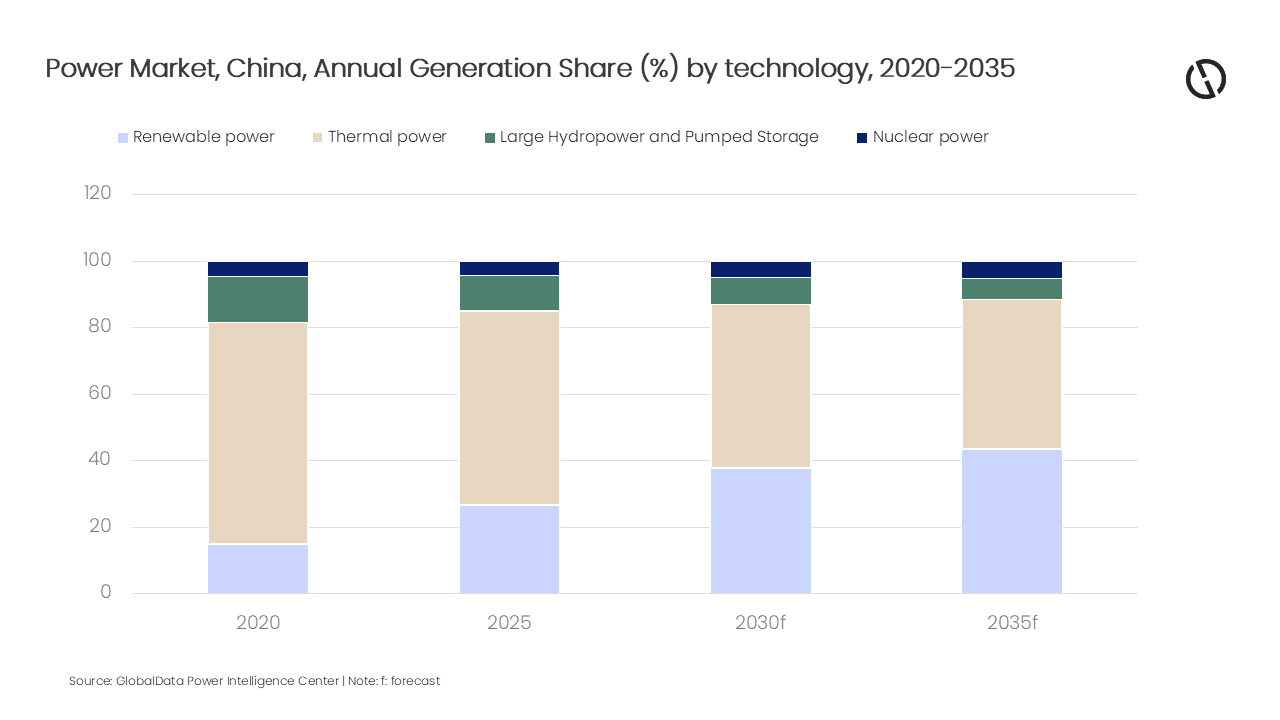
China has embedded ambitious non-fossil energy and emissions peaking targets within its national climate strategy, accelerating regulatory approvals and subsidy programmes for renewable generation, energy storage, and efficient clean manufacturing. Under its Five-Year Plans, many newly approved renewable projects are now required to include co-located storage. Research and development (R&D) and production standards for solar, wind, and battery systems are tightening, emphasizing efficiency and sustainability.
Saibasan adds: “Electricity demand is projected to grow strongly through 2030, driven by expanding industrial electrification, rising residential cooling/heating loads, EV adoption, and burgeoning digital infrastructure.”
Grid congestion and renewable curtailment are becoming recurring issues, particularly in resource-rich western provinces where transmission capacity to demand centers lags behind the construction of solar and wind farms.
Saibasan concludes: “Regulatory fragmentation across national and provincial levels, overlapping authority, and inconsistent cost‐recovery treatment for transmission and ancillary services create uncertainty for investors and slow the roll‐out. Coal-fired plants continue to play essential backup roles during low‐renewable or adverse weather periods, but many plants are under-utilized or inflexible, making them ill-suited for the fast adjustments needed in a low-carbon energy system.”