Engineer News Network The ultimate online news and information resource for today's engineer
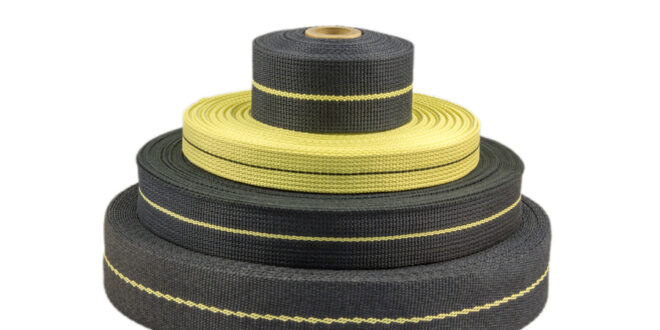
Bally Ribbon Mills (BRM) highlights its harness webbing for safety applications. BRM’s safety harness webbing and tapes provide fall protection and are appropriate for firefighting and law-enforcement use, as well as fire, industrial, military, and commercial applications.
Harness webbing is an essential component in safety equipment designed to help secure and support the wearer in demanding environments. BRM develops woven safety-webbing solutions using nylon, Nomex®, Kevlar®, Vectran®, and other specialty fibers. The selected fiber and fabric construction can be engineered to address the specific performance requirements of a finished harness or related safety component.
BRM’s harness webbing can be designed to provide high tenacity, abrasion resistance, flame and heat resistance, controlled elongation, chemical resistance in specific environments, conductivity, dimensional stability, strength, reduced weight and size, and flexibility. These properties are important in safety harness systems intended for fall protection, firefighting equipment, law-enforcement gear, military products, industrial safety equipment, and other commercial safety applications.
BRM applies engineered narrow-fabric expertise to maximize end-use performance through fiber orientation and woven construction. BRM’s engineered textiles provide an alternative to conventional materials such as plastic, steel, aluminum, and alloys in specialized product designs.
Certain BRM safety-webbing patterns are covered by UL Certificates of Compliance for firefighter protective-clothing and equipment components, including CAN/CGSB-155.1-2001, NFPA 1977-2022, and NFPA 1971-2018 applications.