Engineer News Network The ultimate online news and information resource for today’s engineer
Todd Scheving examines how a circular approach to refrigerant lifecycle management can help organisations support more sustainable, resilient cooling operations as demand for AI infrastructure continues to grow. He explores how evolving cooling requirements are driving new approaches to refrigerant management, helping facilities and industrial organisations improve sustainability, strengthen operational resilience, and prepare for the future of critical infrastructure
The AI revolution has spurred heated conversation about data centre cooling. As compute density climbs to support ever-larger AI workloads, the systems that keep that hardware from overheating have become a top priority. Refrigerant decisions are emerging earlier in the value chain, spurring pressing procurement and sustainability conversations that, until recently, were not part of the data centre planning process. These conversations are happening sooner and frequently for good reason: the choices operators make today will shape emission footprints for the next decade, and thus maintaining a circular approach to refrigerant cooling is more important than ever.
There has been a noticeable shift in the industry’s approach to data centre cooling, and it is visible at every stage of project development. Cooling system design, once a downstream detail finalised after the broader facility plan was set, is now surfacing and reaching refrigerant suppliers and service providers sooner than ever. What used to be a conversation about cooling equipment has evolved into one about sustainability strategy and procurement risk. Refrigerant selection and ESG disclosures are now appearing at the start of projects and staying relevant throughout their lifecycle.
This earlier engagement is pulling in a different set of stakeholders. Design engineering and architectural firms companies refrigerant specialists might not have historically worked with on a regular basis are now asking pointed questions about supply security: how can a project secure long-term refrigerant supply and access reclaimed product? These questions have long been standard practice in heavily regulated markets like the EU and Australia, where supply quotas already constrain availability; now they’re becoming increasingly common in North America, too, signaling that regulatory tightening is reshaping expectations everywhere.
Underlying all of this is a simple but consequential question: how do the decisions the design team makes impact the larger emissions equation for the facility? Asking this question signals that a project team understands their decisions will directly affect a data centre’s Scope 1 and Scope 3 emissions footprint beyond the foreseeable future, making this one of the more consequential sustainability decisions an operator will make. Design teams can rest easy as reclaimed refrigerant is a viable option with a meaningfully lower environmental impact than relying solely on virgin product.
Asset management: a new imperative
The industry is feeling the effects of this shift in real time. Firms are engaging with refrigerant suppliers far earlier in the planning process, and dedicated sustainability teams are becoming commonplace within data centre organisations. Accordingly, questions about supply security and reclaim options have become a fixture in North American project conversations. Refrigerants had always been considered consumable commodities, but this classification is becoming increasingly inaccurate, and even counterproductive. Sustainability targets are forcing the industry to reconsider refrigerants and their role. Rather than commodities, refrigerants must now be classified as strategic assets, and managed like them.
The reclassification from commodity to asset is the crux of this industry shift regarding cooling. There are two forces moving in tandem to help facilitate this reclassification: regulatory pressure and the supply constraints that pressure creates. As quotas tighten and reclaim requirements expand, refrigerant management starts influencing uptime, regulatory compliance, and environmental performance outcomes that matter to operators regardless of their sustainability posture. Managing refrigerants holistically across a portfolio, rather than system by system, also reveals problems a narrower view might obscure: how many data centres does an organisation have under management? How many chillers run across those facilities? And how many pounds of refrigerant sit in each one? Asked together, these questions force operators to consider refrigerants as portfolio assets whose lifecycles necessitate active management.
More often than not, the solutions involve maintaining a circular approach to cooling: recover what’s in a system before it’s lost (and also comply with legal obligations), reclaim what can be reprocessed to industry standards, and destroy only what genuinely cannot be brought back to spec. Reclaimed refrigerants have a lower carbon footprint than virgin alternatives because the molecules already exist. Rather than venting that material to the atmosphere or leaving it sitting in storage tanks indefinitely, the goal is to keep refrigerants moving back into service or the supply chain, anywhere except idle or released. Circular thinking is the environmentally responsible path and, increasingly, the economically rational one, as tightening supply makes every recovered pound more valuable than the last.
Where the emissions actually happen
End-of-life handling is responsible for much of the industry’s emission problem, and the scale of that problem varies meaningfully from region to region depending on local infrastructure and regulatory enforcement. Take venting, for instance: the idea that someone would negligently release refrigerant into the atmosphere sounds reckless and almost ridiculous when described in the abstract, but in practice, venting is often the result of a series of structural problems. Many technicians and operators are working under serious time constraints, and a new system frequently needs to come online faster than a comprehensive recovery process allows.
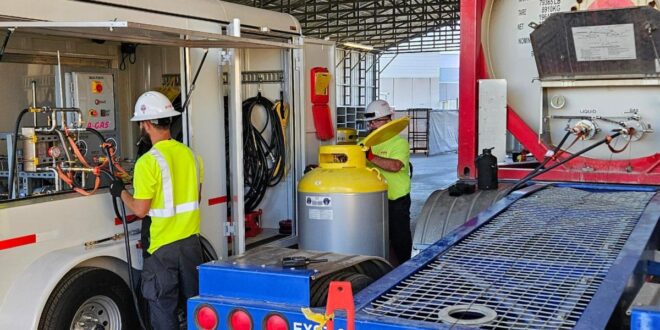
This juncture is precisely where dedicated recovery infrastructure makes a difference. Installation and servicing contractors are increasingly turning to specialised service teams, such as A-Gas Rapid Recovery, capable of recovering refrigerant quickly to ensure that recovery happens correctly. A-Gas is a world leader in responsible lifecycle refrigerant management, helping data centre operators put a circular approach into practice, from refrigerant recovery through Rapid Recovery services at servicing, retrofit, and decommission stages to reclamation and destruction under verified carbon methodologies.
Under today’s standards, the clearest sign of a well-run program is an established recovery plan: a defined process for what happens to refrigerant already in a system before that system is serviced, replaced, or retired. Without one, operators risk specifying a new low-GWP refrigerant for the replacement system while venting the higher-GWP refrigerant from the old one, in other words, avoiding the root of the problem by trading one emissions problem for another. Long-term service contracts with refrigerant recovery teams help ensure the right thing happens the right way, building recovery into the project timeline from the outset rather than treating it as a step to be rushed or skipped.
Three pillars of lifecycle refrigerant management that Matter most
In practice, lifecycle refrigerant management consists of six pillars. However, these three are the main drivers impacting refrigerant asset management for data centres:
The first is recovery. When a data centre is being serviced, retrofitted, or decommissioned, a specialized team should recover all refrigerant from the facility, minimising the window during which material might otherwise be vented or lost.
The second is reclamation. Recovered refrigerant is sent to a processing site where it’s cleaned by means of filtration, distillation, separation, or other mechanical processes to remove oil and contaminants, bringing it back up to recognized virgin-equivalent standards (AHRI-700). That reclaimed product can then flow back into the market⎯directly to the end user or into the broader market to ensure the material is put to full use rather than left idle.
The third pillar is destruction. This option tends to be reserved for refrigerants that cannot be brought back to spec, including older refrigerants that may carry both high-GWP and ozone-depletion concerns. Destruction is carried out under verified carbon methodologies designed to formally retire that material from circulation, and this step does double duty: it removes harmful refrigerant from potential future release while also generating verifiable carbon credits, validated through frameworks such as Verra’s VM0016 methodology and ACR (formerly the American Carbon Registry).
Across these three pillars, the underlying priority is always circularity. Data centre customers aiming for true circularity can achieve it through long-term service contracts, with destruction reserved as a last resort only once reclamation has been exhausted as a viable option.

The future of cooling
The current refrigerant landscape includes a wide mix of materials all explicitly addressed by international frameworks like the Montreal Protocol and its more recent Kigali Amendment, both of which call for a sustained global reduction in HFC and HCFC reliance (it’s worth noting that many popular HFOs contain HFCs). Many of these refrigerants face strict quotas governing how much can be produced and sold into specific regional markets or can no longer be manufactured; either way, these obstacles make it necessary to prioritise recovering the material already in circulation and reprocessing it for future use. Recovery might be a legal obligation, but it carries with it countless benefits, too, allowing the industry to maintain an adequate refrigerant supply for current needs without expanding the pool of materials known to carry meaningful environmental risk.
There is reason for measured optimism here: there are enough HFCs already installed today to meet industry needs for a lifetime, provided they are managed responsibly. Newer refrigerant blends are accelerating this transition further. Blends that combine HFC and HFO compounds are increasingly common in data centre applications, designed specifically to lower the overall GWP of refrigerants in active use while easing the market into tightening quotas. Recovery is the future of cooling. The infrastructure exists. Operators must now partner with recovery teams and refrigerant suppliers to treat refrigerants like the strategic assets they were always meant to be.
Todd Scheving is Business Development Director – Global Data Center at A-Gas.