Engineer News Network The ultimate online news and information resource for today’s engineer
What can nature teach us about lightweight structures, adaptive control and collaborative working?
The BionicSwift, the latest bionic concept from Festo, demonstrates what is possible within robotics.
Lightweight structures are at the heart of the artificial robot bird because in both engineering and in nature, less material, less weight and least energy consumed makes for a successful design.
The BionicSwift weighs just 42g despite a body length of 44.5cm and a wingspan of 68cm. This makes it extremely agile and capable of flying loops and making tight turns.
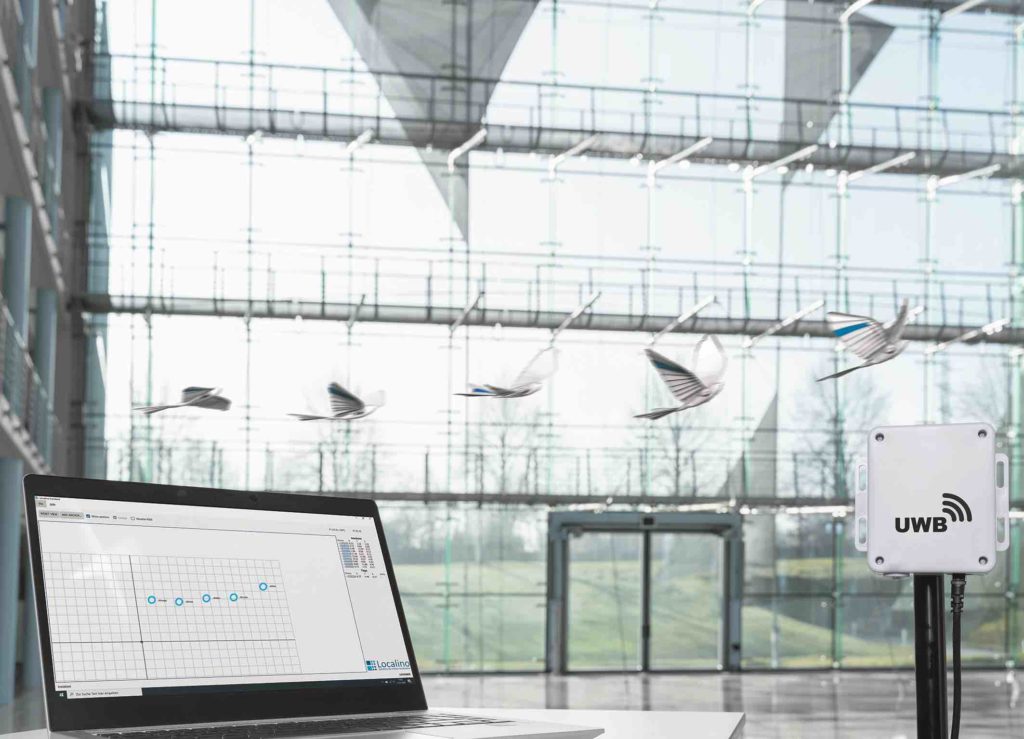
Thanks to radio-based indoor GPS with ultra-wideband technology (UWB) the BionicSwifts fly safely and coordinate within a defined airspace.
To make the flight manoeuvres as life-like as possible, the wings are modelled on the plumage of real birds. The agility of the artificial birds is not just due to their lightweight design and aerodynamic kinematics, but also to the use of function integration.
The intelligent networking of flying objects and GPS routing used in the BionicSwift demonstrates a 3D navigation system that could be used in the networked factory of the future.
By precisely locating the flow of materials and goods, process workflows can be improved, and bottlenecks predicted. Autonomous flying robots are already being trialled as a way of optimising material movements.
Aerodynamic feathers and flying by GPS
Replicating natural flight as closely as possible, the wings of the BionicSwifts are modelled on bird feathers.
The individual feathers are made from an ultra-lightweight, flexible but very robust foam, and overlap each other.
Connected to a carbon quill they fan out during the wing upstroke, allowing air to flow through. They close during the downstroke to provide a more powerful, efficient flight than previous beating wing drives with fixed surfaces.
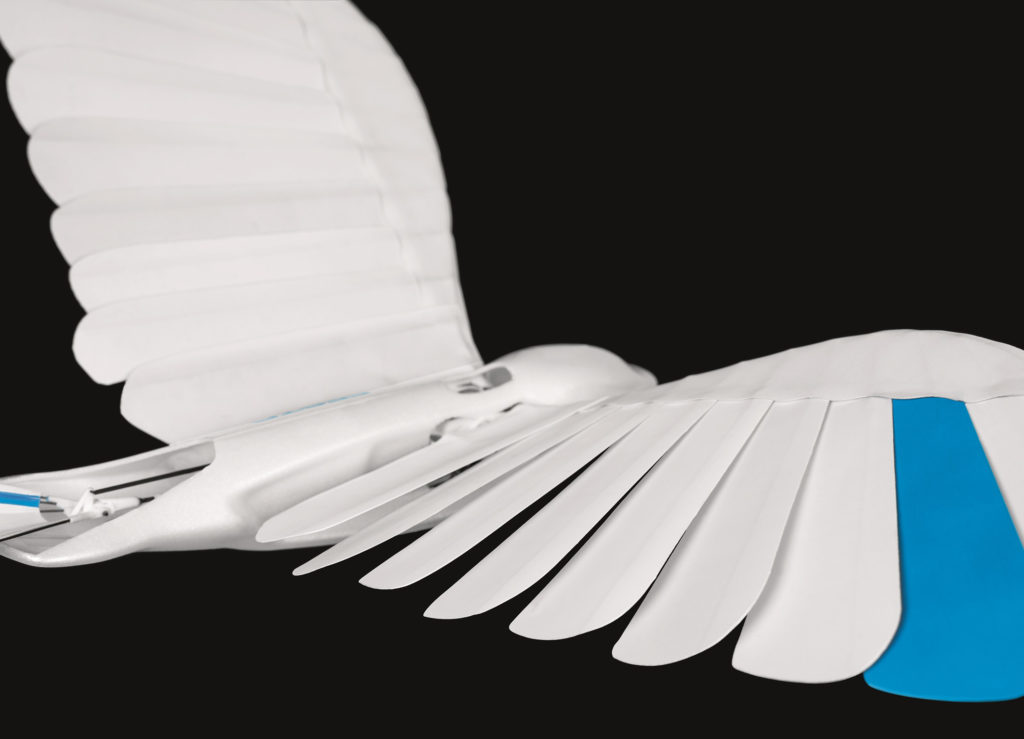
Function integration in the design incorporates the flapping mechanism, wireless communication, control components for the wing and tail elevator, the motors, gears and battery.
All are installed in the smallest of spaces. Through the intelligent interaction of the motors and mechanical systems, the various manoeuvres are precisely coordinated.
Several radio modules form anchors that define the controlled airspace. Each bird is equipped with a transmitter sending signals to the bases, which locate the bird’s exact position and send it to a master computer navigation system.
Pre-programmed flight paths can be planned for the birds. If the birds deviate from this flight path, for example due to a sudden gust, they immediately autonomously correct.
The use of UWB radio technology guarantees safe and interference-free operation.
Commenting on their latest flying robot, Steve Sands of Festo says: ‟Festo use the natural world as a creative spur for sustainable innovation: studying natural phenomena and applying the principles to engineering challenges. The results are demonstrated as display models, which we call Bionic Concepts.
“Why do it? Because it stimulates creativity: not only within the Festo development process but also through crowd-sourcing ideas from a diverse external audience. The Bionic Concepts bring together people who are interested in similar key trend topics such as lightweight structures, machine learning and artificial intelligence.”