Engineer News Network The ultimate online news and information resource for today's engineer
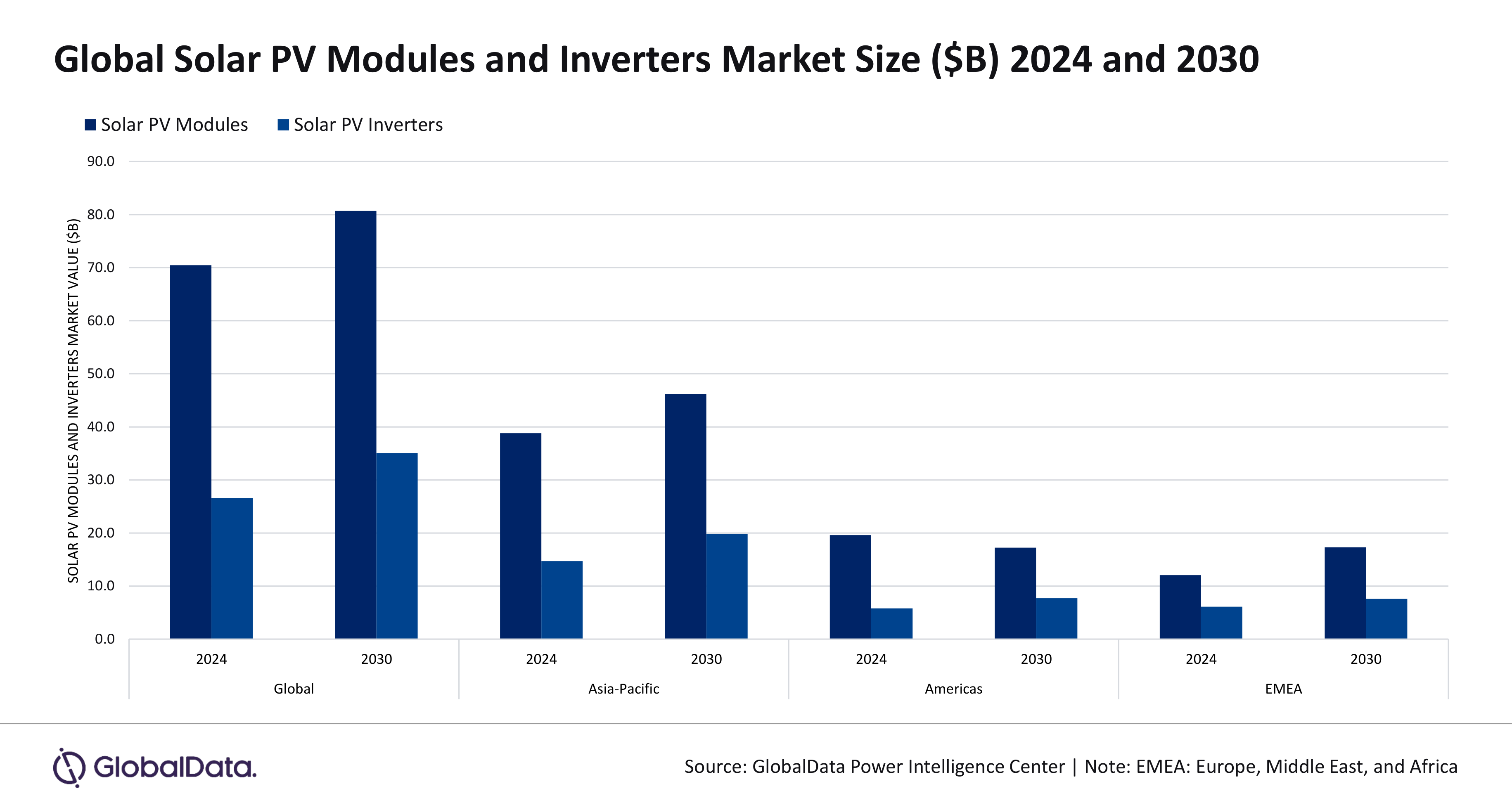
The global solar PV modules and inverters market is forecast to reach $115.8 billion by 2030, largely driven by the Asia-Pacific (APAC) region with its strong policy initiatives, ambitious renewable energy targets, large-scale investments, rapid urbanization, declining technology costs, and expanding solar manufacturing and innovation in major economies, according to GlobalData, a leading data and analytics company.
GlobalData’s latest report, Solar PV Modules and Inverters Market Size, Share and Trends Analysis by Technology, Installed Capacity, Generation, Key Players and Forecast, 2024–2030, shows the global market for solar PV modules is projected to reach $80.7 billion, while the solar PV inverters market is anticipated to reach $35 billion by 2030. The APAC solar PV modules market reached $38.8 billion in 2024 and is estimated to reach $46.2 billion in 2030.
Bhavana Sri Pullagura, Senior Power Analyst at GlobalData, comments: “The global solar PV modules and inverters market is experiencing significant expansion, underpinned by the accelerating global shift toward sustainable energy solutions and net-zero emission goals. Strong government incentives and technological innovations in high-efficiency modules and advanced inverter systems are fostering large-scale adoption across utility, commercial, and residential segments.”
Recent changes in trade policy, including US tariffs, are reshaping supply chains and accelerating localization efforts across the APAC region. In Europe, the Middle East, and Africa (EMEA), module markets are being shaped by policy initiatives focused on quality, domestic industrial capacity, and strategic procurement, particularly in the Middle East.
Pullagura adds: “In the Americas, especially in the US, recent policy measures have strongly encouraged module manufacturing to relocate closer to home. Tariff adjustments and anti-dumping/countervailing duties (AD/CVD) on modules and cells from certain Southeast Asian countries have significantly altered supply chains and increased module prices in the US market. The anticipated decline in the value of solar modules in the Americas, despite ongoing installation growth, is primarily due to significant price erosion driven by oversupply and decreasing production costs.”
The global solar PV inverter market is rapidly evolving, fueled by increasing demand for utility-scale projects, hybrid solar-plus-storage systems, and stricter grid compliance and cybersecurity regulations, particularly in Europe and the US. The APAC region remains the primary production hub, while the Middle East and Africa are emerging as growth areas that require high-capacity and storage-ready inverters for large-scale projects and weak-grid integration. The global solar PV inverter market value is led by the APAC region at $19.8 billion, followed by the Americas at $7.7 billion and the EMEA at $7.6 billion.
Pullagura concludes: “Global solar PV modules and inverters market dynamics are being influenced by national industrial policies, regulatory reforms, and changes in procurement practices. Different regions are responding in various ways: APAC is expanding capacity and local manufacturing; EMEA is concentrating on quality, domestic production, and strategic procurement; and the US is adjusting incentives and trade policies while sustaining deployment momentum. These developments will continue to impact supply chains, technology adoption, and investment flows throughout the solar PV sector.”