Engineer News Network The ultimate online news and information resource for today's engineer
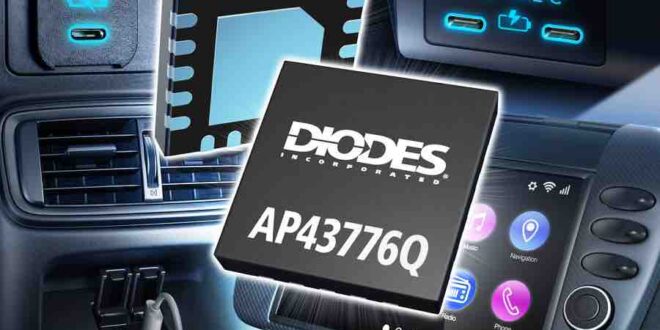
Diodes Incorporated has announced a highly integrated dual-channel USB Type-C protocol decoder.
The DIODES AP43776Q supports USB power delivery (PD) 3.1 standard power range (SPR) and programmable power supply (PPS) as well as Quick Charge QC5, fast charging protocols. It also supports legacy battery charging (BC) 1.2 and is highly optimised for multi-port automotive USB device charging systems.
The AP43776Q features a built-in microcontroller unit (MCU) with 12kB of one-time programmable (OTP) ROM, plus a multi-time programmable (MTP) ROM resource tool. Each PD 3.1 port is fully PPS compliant, featuring a 3.3V to 21V output voltage range with 20mV/step and 50mA/step adjustment. They enable independent charging output voltages for greater power usage optimisation.
An I2C interface enables inter-chip communication with DC-DC controllers and converters in the charging system. This simplifies the control loop and lowers overall component costs. Using the UART interface, two separate AP43776Q devices can be interconnected, so that smart power-sharing may be conducted across all four of their combined USB ports. Besides managing power negotiation attachment procedure, the AP43776Q enables DisplayPort over USB-C by detecting USB Type-C Alternate Mode and driving a suitable USB/DP mux. This facilitates the carrying of video data over the system’s USB connection.