Engineer News Network The ultimate online news and information resource for today's engineer
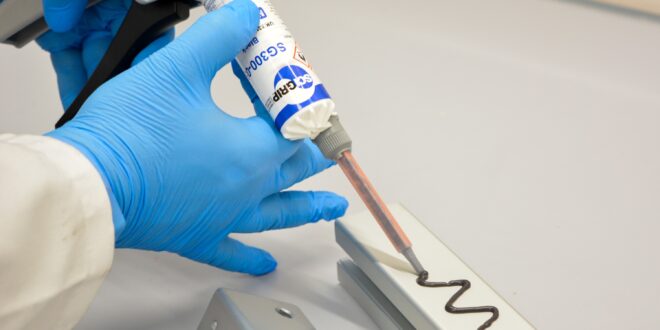
When specifying adhesives, while design engineers and manufacturers understand the performance trade-offs, the process requirements and commercial implications can be far less obvious. Kevin Brownsill explains why data sheets and selector guides can only tell you so much, and that real-world trials matter just as much as the numbers on the sheet. He also looks at how substrate surface energy and bond-line geometry shape material choice, how curing time trade-offs (such as accepting a slower epoxy cure versus switching to a faster UV-curing adhesive) affect production efficiency, and why the true cost of an adhesive should be measured per part, not per gram
Structural adhesives provide strong, load-bearing joints for industrial and engineering applications. Specifying one involves weighing up technical and process requirements.
Choosing a structural adhesive is rarely about finding the ‘strongest’ material. In practice, manufacturers are balancing bond performance against process speed, substrate compatibility, production variability, automation requirements, and overall manufacturing cost. Let us dig into a few of these factors.
Be wary of the data sheet
The most common structural adhesive chemistries are polyurethanes (PUs), epoxies, and methyl methacrylates (MMAs), as these chemistries offer both adhesive strength and cohesive strength. Cyanoacrylate adhesives (CAs) and single-part UV curing acrylic adhesives are also in the mix of candidates you might want to evaluate.
Structural adhesive selector guides and data sheets can help shortlist candidates, but use them with caution. They are not exhaustive, and many properties will have been obtained under ideal laboratory conditions that do not represent your individual application. They are no substitute for practical trials and tests, and it is worth speaking to an adhesives specialist directly, who will have real-world experience of how materials perform under different conditions.
Bond line and substrate considerations
Will the adhesive bond well to your substrates? For the adhesive to wet a substrate — a prerequisite of bonding — it must have a lower surface energy than the substrate.
High-performance plastics such as polypropylene and other polyolefins have low surface energies, regularly between 20 and 40 dynes/cm2, and are therefore difficult to bond. Manufacturers specifying these materials for functional reasons are likely to require an additional surface preparation step, such as priming or plasma treatment.
The size and shape of the bond line matters too. Large bond areas can dictate the gel time or pot life of the material to be specified; it is undesirable for it to start gelling before dispensing and assembly are complete.
Understanding the level of gap filling required is also important: dimensional variation in moulded parts can mean gaps vary from zero to several millimetres across the same assembly, and without accounting for this, too little or too much adhesive may be applied.
The rheology of the material, whether it is thixotropic, low-viscosity, or somewhere in between, will determine whether it is appropriate for the bond line geometry.
It can be helpful to involve an adhesives specialist partner before the substrate choice and bond line design is locked in. If the adhesive is treated as the last part of the puzzle, it can be difficult to find a material that meets all the criteria.
Process considerations
Adhesive selection is as much a process engineering decision as a chemistry one, and trade-offs must be factored in. To benefit from the high strength of an epoxy, a manufacturer may need to accept a relatively slow room-temperature cure.
Fast-curing two-part materials may begin to gel in a mixing nozzle unless dispensed continuously or purged regularly. Single-part UV-curing adhesives offer fast, on-demand cure, reducing the time parts are fixtured before moving to the next stage.
While it may seem like a small factor, the packaging the material is supplied in can have an important impact on the process, and therefore the selection of a material. For example, if the process is to be automated, selecting a material that comes in ten-gram containers may not be wise.
Even a manual bonding process can serve as a platform for incremental process investment: dispensing tools, benchtop robots, or full archytas series systems can improve accuracy, repeatability, and throughput over time. Thinking about this early means the adhesive and process you specify today can scale with production.

Commercials
Does the adhesive you have chosen make commercial sense? It might be technically perfect but expensive enough to damage profitability. We have found that quite often, the cost per part of the adhesive is less — sometimes quite a lot less — than the cost of the application and curing process. Choosing an inexpensive material may be a false economy if it demands significant processing resource or time. Always calculate an overall cost (material plus process, labour, etc) per part, not a just a price per gram.
Specifying a structural adhesive is a complex task. By looking beyond the data sheet, considering process and commercial realities alongside technical performance, and working with an adhesives specialist, manufacturers are more likely to achieve reliable bonding and a process that is appropriate for production at scale.
Kevin Brownsill is Head of Technical: Learning and Development at Intertronics.