Engineer News Network The ultimate online news and information resource for today’s engineer
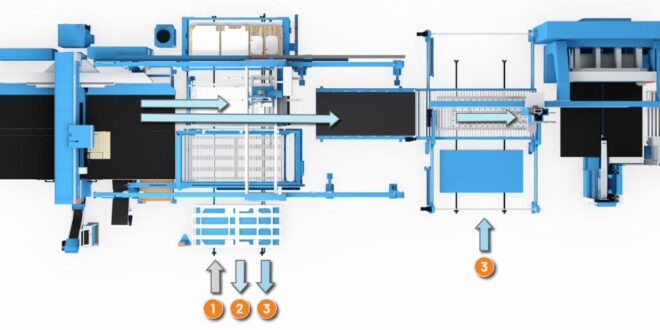
Modular automation is emerging as the most practical path for sheet metal fabricators looking to improve efficiency without the risk of large, all‑at‑once investments. By adding flexible, scalable automation components over time, manufacturers can boost productivity, protect capital investments, and gradually build toward fully connected, lights‑out production. Ross Walker reports
In sheet metal manufacturing, the transition to automation has evolved from a competitive edge into a fundamental operational imperative. In a landscape defined by razor-thin margins, persistent labor shortages, and an escalating demand for high-level customisation, the strategic question for fabricators is no longer whether to automate, but how to execute that transition with precision.
The advantages of automation are clear: it reduces the need for manual labour, minimises human error, increases throughput, and ensures consistent quality. Conversely, fabricators reliant on manual processes encounter bottlenecks that hinder productivity and growth, limiting their ability to adapt to market shifts. Despite these benefits, many businesses remain hesitant to adopt automation.
The inhibiting factors are understandable. There is a palpable apprehension surrounding the costs, risks, and perceived complexity of overhauling a production line. The fear of ‘getting it wrong’ often leads to paralysis. Much of this complexity stems from the sheer number of pathways available.
Should a shop begin by installing a single high-performance machine to achieve the biggest immediate return? Should they pursue incremental process improvements, adding one component at a time? Or is the right answer a full-scale ‘greenfield’ project that creates or converts the entire production line in one fell swoop?
The answer is that there is no single right answer for everyone. For most manufacturers, the most effective path is a phased, modular approach that lets them start small, build confidence with early wins, and expand as production requirements and budgets grow. This is where the concept of how you automate becomes as critical as how much or how fast you do it.
A key success factor in navigating this effectively, whether you are installing a single laser cutter or building a fully automated factory, is modularity.
Modularity: the architecture of flexibility
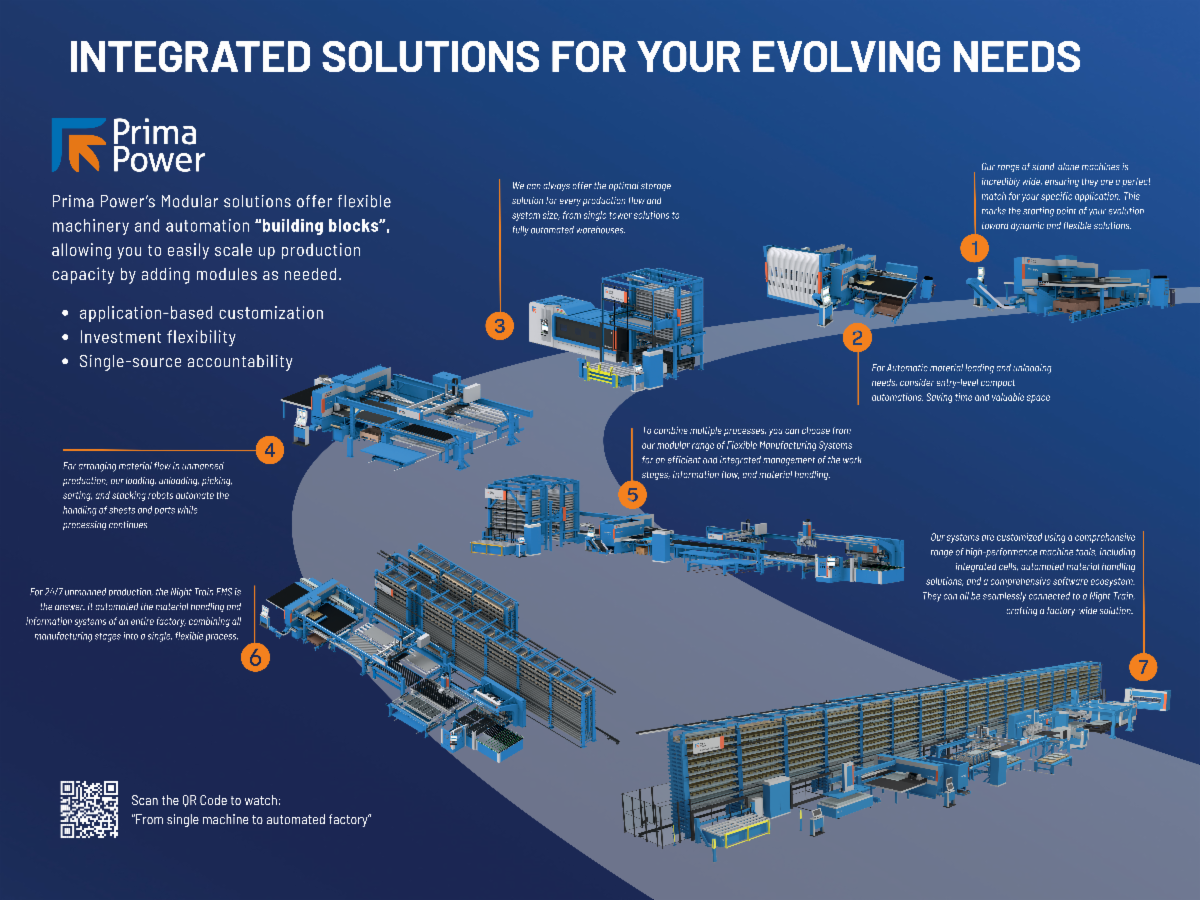
At its core, modularity in sheet metal automation is about architectural foresight. It is not just about buying machines that can physically connect to one another; it is about a design philosophy that governs the entire manufacturing ecosystem. It also creates a practical roadmap for phased automation, so shops can move from a single machine to a fully connected system over time, instead of in one disruptive leap.
In practice, modularity operates on two distinct levels.
First, it concerns the attributes of each individual component. Each asset, from laser and punching machines to automated loading, unloading, and sorting components, must be designed for seamless integration. This ensures that both the flow of material and flow of information are synchronized with precision. This ‘future-proof’ architecture allows individual units to function as part of a cohesive, evolving system rather than as isolated tools.
Second, it concerns the nature of the whole ecosystem. The system itself must be engineered to accept new modules without requiring a complete teardown or conflicting with existing workflows.
When we view automation through the lens of modularity, we stop seeing machines as isolated islands of production. Instead, we see them as building blocks in a fluid, evolving organism. This perspective is critical because it shifts the focus from short-term capacity fixes to long-term strategic capability.
The key benefits of a modular approach
Why is this architectural approach so critical for modern fabricators? Modularity directly impacts the bottom line by enhancing flexibility, equipment effectiveness, and business process optimization.
1. Flexibility
The primary advantage of modularity is flexibility. In the past, rigid automation lines were designed for high-volume, low-mix production. If the market shifted or a product line was discontinued, the entire line often became obsolete.
A modular solution, however, can be tailored to meet a fabricator’s unique needs and resources. It allows a business to adapt to evolving demands without discarding previous investments. If a shop starts with a standalone laser and demand grows, they can add a loading/unloading robot. In markets like data centers, for example, a fabricator might begin with enough capacity to produce a few hundred racks per day, with a clearly defined plan to add modules as orders climb into the 400–600‑unit‑per‑day range. Modularity makes that growth a series of manageable steps instead of a binary choice between “too little” and “far too much” automation.
If demand shifts toward complex forming, they can integrate a panel bender. This ability to scale and adapt protects capital investment against market shifts, ensuring that the factory floor remains relevant regardless of what the sales team brings in.
2. Accelerating material flow
Modularity enhances Overall Equipment Effectiveness (OEE) by speeding up material flow and increasing valuable ‘green-light time’ for sheet metal fabricators, no matter their automation path or stage.
Removing bottlenecks
Fabricators typically begin their automation journey by addressing their single biggest bottleneck or most labor-intensive process. This targeted approach avoids large, multimillion-dollar commitments in favor of a modest initial investment that delivers the most significant impact. It allows them to demonstrate ROI, gain experience, and build confidence.
Modularity then enables them to protect and build on this investment in the future as they add components like load/unload systems and additional machines. The process is controlled and incremental, not an all-or-nothing leap, ensuring that the first step is designed for future adaptability and growth.
A journey from cells to a connected line
One HVAC manufacturer, for instance, began with dozens of standalone punching machines, shears, and press brakes arranged in traditional cells, each staffed by an individual operator. Over several years, they transitioned to a modular line anchored by automated panel bending, followed by a punch‑shear combination machine and a Night Train–fed material handling backbone. Today, a small team runs what used to require many more operators across multiple cells, with panels moving from raw sheet to finished form in a fraction of the time and with far less manual handling.
Automating material handling
Consider a standalone laser cutter. Without automation, a significant portion of its available time is spent waiting for an operator to load a raw sheet or unload finished parts. By layering on material handling capabilities, such as a compact loading/stacking system, fabricators can dramatically shift this dynamic. In typical implementations, green‑light time can climb from roughly 60% in a manual setup to 80–85% with the addition of basic material handling modules.
This is the beauty of modularity: you do not need to buy an additional laser to get 25% more output; you simply need to add a module that allows your existing asset to work harder.
The logic of complementary components
Modularity also unlocks efficiency through complementary technologies. A common misconception is that adding a second machine simply doubles capacity. In a well-designed modular system, the math is often 1 + 1 > 2. The whole becomes greater than the sum of its parts.
Take the example of integrating a punch-shear combination machine alongside a punch-laser machine. In a non-modular environment, these might run independently. However, in an integrated, modular workflow, we can optimise production based on strengths.
We can use the punch-shear, the ‘chainsaw’ of the operation, to chew through high-volume, rectangular work at incredible speeds. Simultaneously, we use the punch-laser, the ‘Swiss Army knife’ for flexible, intricate, mixed contours.
By splitting the work so each machine plays to its strength, the total output and efficiency are significantly higher than simply running two identical machines. In practice, the impact often feels less like simply doubling capacity and more like a 1 + 1 > 2 effect, as assigning the right work to the right module frees each machine to operate in its most productive role and elevates the efficiency of the entire floor.
3. Optimization of business processes
True modularity goes beyond moving metal; it also depends on the software and ‘information flow’ that power Industry 4.0–style smart factories. In smart manufacturing, software is just as critical as the hardware. All modules must seamlessly integrate with systems like Manufacturing Execution Systems (MES) and Enterprise Resource Planning (ERP).
When hardware modules are built to communicate seamlessly, software becomes a real differentiator. Fabricators can fully leverage automated nesting, remnant management, and resource allocation. The software ‘knows’ the capabilities of every module in the system and can automatically route jobs to the machine with the best availability or most suitable tooling.
This integration makes the entire workflow, from the front office to the shipping dock, efficient and cohesive, breaking down the data silos that often come with mismatched equipment setups. It’s the software behind the scenes that unlocks the full potential of modularity.
4. A consistent, unified world
There is a distinct operational advantage to a ‘one-stop’ vendor like Prima Power. You get a single vendor that provides everything you need: a full range of equipment, software, and support. Engineering, designing, and implementing solutions becomes significantly easier when everything operates within a single, coherent environment.
In a fragmented shop with machines and software from various vendors, integration can be a nightmare, with ‘finger-pointing’ when things go wrong. The software vendor blames the hardware vendor, who blames the network integrator. In a modular ecosystem provided by a single partner, these friction points disappear. The components are designed to work together natively.
This unified environment also simplifies the human side of automation. Operators encounter consistent, modern interfaces that feel closer to an intuitive tablet than to a legacy control panel, which makes it easier to recruit and retain tech‑savvy talent. Prima Power reinforces this with on‑site training and ongoing support so that teams can build confidence with a single machine and then carry that knowledge forward as additional modules come online.
Because Prima Power designs and manufactures the machines, automation, software, and controls as one ecosystem, customers avoid the finger‑pointing that can occur when multiple vendors are involved. At the same time, an open software and API philosophy gives manufacturers the option to build custom integrations or analytics on top of the platform when they have in‑house expertise. That combination of single‑source accountability with extensibility is a key reason customers return to the same modular family when they add new capabilities.
Furthermore, this consistency simplifies daily operations. A uniform user interface across machines reduces the training burden on operators. If an employee knows how to operate the laser, the punch or bender interface feels familiar. The same production planning and programming software suite drives all components, meaning that ordering add-ons or expanding the system is a plug-and-play experience rather than a complex engineering project.
The ultimate automation system
Prima Power’s Night Train FMS is the definitive model for complete automation. As a Flexible Manufacturing System (FMS), it fully integrates material flow, data management, and machinery into a single, seamless production cycle. The Night Train FMS sets an industry benchmark by transforming individual processes into a continuous, 24/7 ‘lights-out operation.
However, the Night Train FMS is obviously not the right starting point for every business. For many fabricators, Night Train represents the culmination of a modular journey that began with a single machine and a focused effort to relieve one bottleneck at a time. Many manufacturers find that a more strategic, gradual approach delivers a better return on investment without straining resources.
Build smarter with modularity
Automating sheet metal manufacturing is a journey rather than a one‑time leap. The most successful manufacturers treat that journey as a sequence of modular decisions, each step solving a current problem while deliberately setting up the next. Modularity is your guide, offering flexibility to adapt, maximize efficiency with smart add-ons, and unify hardware and software systems.
Whether upgrading one machine or creating a fully automated factory, the key is building with modular blocks. In a fast‑changing industry, modularity turns automation into a strategic advantage, helping manufacturing capabilities grow in lockstep with business ambitions.
Ross Walker is Regional Sales Manager, Prima Power.