Engineer News Network The ultimate online news and information resource for today's engineer
Jochen Kern tackles the hugely important issue of sustainability in precision metal part manufacturing
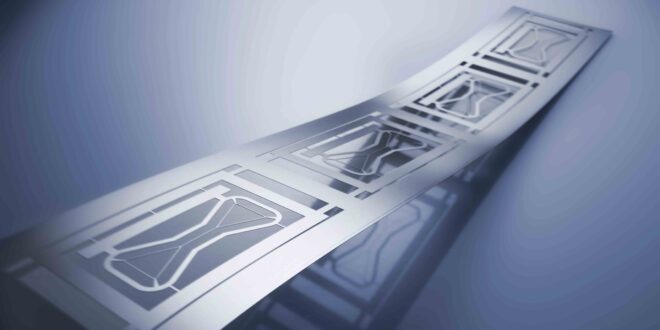
Photo-chemical etching (PCE) changes the equation because it delivers high precision without relying on force or heat. Material is removed chemically through photolithographically defined patterns, so the base metal’s properties remain intact and edges are inherently burr-free. This is as much a waste discussion as a quality discussion. Burr-free production eliminates whole classes of post-processing, reduces handling damage, and lowers the risk of contamination traps that trigger rejects later in the value chain. When a part is “right first time,” sustainability follows naturally.
Sustainability in manufacturing is often discussed in broad strokes, energy transition, circular economy, net-zero roadmaps. Yet for engineers and operations leaders, the decisive gains are frequently made in smaller, more practical places like yield, scrap rates, rework loops, and the number of process steps between raw material and a validated part.
In precision metal components, those “small” levers can dominate the footprint, because tolerances are tight, materials are valuable, and downstream consequences of variation are expensive.
Precision manufacturing has traditionally carried an implicit trade-off. The finer the feature, the more processing, tooling, and finishing is required. More fixtures, more cut paths, more inspection, more rejects. Thin metal components can accumulate secondary step like deburring, stress relief, cleaning, polishing, before they are fit for assembly. Each step consumes energy, introduces consumables, creates waste streams, and increases the probability of failure.
Sustainability, in this context, is inseparable from process simplicity.
Photo-chemical etching (PCE) changes the equation because it delivers high precision without relying on force or heat. Material is removed chemically through photolithographically defined patterns, so the base metal’s properties remain intact and edges are inherently burr-free. This is as much a waste discussion as a quality discussion. Burr-free production eliminates whole classes of post-processing, reduces handling damage, and lowers the risk of contamination traps that trigger rejects later in the value chain. When a part is ‘right first time’, sustainability follows naturally.
Waste reduction begins at the layout stage. In many conventional methods, the economics are driven by tool access, cut time, or die constraints. Nesting efficiency becomes secondary. In PCE, complexity is largely digital, so parts can be tessellated and nested for material utilisation without the same penalty. Better nesting means more parts per sheet or per metre of strip, and less scrap per functional component. It also encourages a different mindset, with engineers able to explore geometry that improves performance while still maintaining efficient panelisation.
Tooling is another under-discussed lever. Hard tools consume material and energy to produce, then wear, and eventually become obsolete when designs change. PCE uses photo-tools derived from digital data, so iteration typically means updating artwork, not scrapping a die. That reduces both physical waste and late-stage disruption. Fewer last-minute changes translate into fewer scrapped parts and less expedited logistics.
Thermal and mechanical stress is also a sustainability issue. Laser cutting can introduce heat-affected zones. Stamping can introduce work hardening and distortion. Those effects often demand corrective steps (or create variation only discovered during assembly). PCE’s stress-free nature reduces the need for corrective loops. That saves energy and consumables, and improves predictability. Predictability matters because it lowers overproduction. When a process is stable, you do not need to manufacture “extra” to hit delivery targets after fallout.
In high-tech and medical contexts, cleanliness and traceability matter too. Components that require aggressive cleaning due to burrs or recast layers increase chemical usage and wastewater loads. PCE’s smooth edges reduce the cleaning burden. And because PCE workflows are digitally defined, it is straightforward to integrate fiducials or identification features for inspection and traceability without additional operations. Better traceability reduces the scope of quarantine and scrap when issues occur.
There is also a system-level benefit. PCE enables lighter, more integrated designs. When designers combine functions (filtering, spring compliance, shielding, flow control) into a single thin metal element, assemblies can be simplified. Fewer components means fewer suppliers, fewer shipments, fewer fasteners, and fewer interfaces that can fail. In sectors like wearables, sensors, and power electronics, functional integration supports reduced mass and improved thermal behaviour. Sustainability is not only about how a part is made, it is about what the part enables over the product lifetime.
A further, often overlooked benefit is the way PCE supports process standardisation across product variants. Because pattern changes are digital, families of parts can be produced on common lines with common control plans, reducing changeover scrap and simplifying qualification. In regulated environments, that stability reduces the need for repeated re-validation and the waste that comes with failed lots. It also improves supply resilience. When designs can be ported between sheet and reel formats within one process philosophy, manufacturers can balance capacity without redesigning the part and without compromising critical performance characteristics either.
None of this suggests that PCE is automatically sustainable in every scenario. Etchant chemistry, rinse stages, and material selection matter, and responsible manufacturers measure and optimise. But the direction is clear, processes that reduce steps, reduce rework, and increase yield tend to reduce environmental impact. In practice, sustainability is usually won by eliminating inefficiency rather than adding offsets.
The most powerful outcome, however, is cultural. When teams view sustainability as a precision problem — how to deliver performance with minimal waste — innovation accelerates. PCE supports that acceleration because it makes complexity manufacturable and repeatable. Designers are no longer forced to compromise geometries to suit a punch or a cut path, they can optimise for function and then nest intelligently for yield.
As we move into 2026, customers in medical, electronics, automotive, and energy are increasingly asking not only ‘can you make it?’ but ‘can you make it consistently, at scale, with minimal waste?’
The answer will come from processes that embed repeatability and efficiency into the physics of production. In precision metal parts, PCE is one of those processes, quietly enabling products that are lighter, cleaner, and more reliable, while reducing hidden waste between concept and shipment.
Jochen Kern is Head of Sales & Marketing, Micro Component Group.