Engineer News Network The ultimate online news and information resource for today's engineer
When a company operates multiple manufacturing facilities, internal logistics does not end at the factory gate. Raw materials, semi-finished goods, spare parts, tools, load carriers and other materials regularly move between sites. For logistics and production managers, this raises a crucial question: Where exactly is the material between leaving the warehouse at Site A and being received into inventory at Site B?
Medium-sized and larger manufacturing companies therefore need more than basic transport documentation. Warehouse movements and site-to-site transport need to form one connected process. COSYS combines warehouse management with internal transport management (IBT), allowing inventory movements, transport orders and handovers to be documented digitally.
When a warehouse movement becomes a transport
Consider a manufacturing company operating two facilities. Site A produces components required for final assembly at Site B. Demand at Site B suddenly increases, and an additional 15 containers of components need to be supplied.
With COSYS Warehouse Management Software, the picking and goods issue process can first be recorded at the source warehouse. The required materials are clearly identified and the corresponding inventory movement is booked. COSYS IBT then manages the subsequent transport to the second manufacturing site.
The transport order contains the origin, destination and other relevant transport information. This avoids an information gap between warehouse and transport processes. Once the materials arrive at Site B, they can be transferred into the receiving site’s warehouse process.
This becomes particularly important when companies move not just individual parcels, but containers, pallets or larger quantities of material between manufacturing facilities.
Mobile scanning creates clear handover points
Professional mobile data capture devices can be used throughout the process. One example is the Zebra TC501, which enables employees to scan barcodes directly from materials, containers or storage locations.
The real value lies not in the individual scan, but in its integration into the overall process. When material is prepared for transport at Site A, the handover can be documented digitally. Additional scans record defined transfer points and confirm arrival at the destination.
If questions arise, your employees no longer need to reconstruct whether a container is still in the source warehouse, has already been handed over for transport or has arrived at Site B. The physical movement of goods is backed by a digital history.
Automated dispensing systems bridge availability gaps
Not every site-to-site transport ends at a staffed warehouse or materials counter. Spare parts, tools and smaller items of equipment may be required at the destination outside normal operating or issue hours.
This is where automated dispensing systems can be integrated into the process. Once the material arrives, it is assigned to a suitable compartment and made available to authorised employees. Both deposit and collection are digitally documented.
For example, Site A may send an urgently required spare part to Site B, where the relevant materials counter is not staffed during the night shift. Rather than waiting until the following morning, the part can be securely deposited and collected independently by an authorised maintenance technician.
Business Intelligence provides visibility across the site network
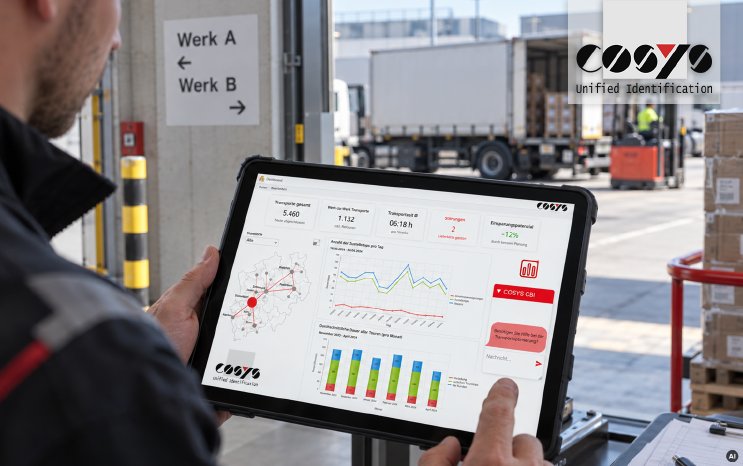
Digital documentation also generates process data that goes far beyond the status of individual transports. COSYS Business Intelligence can visualise transport volumes, lead times, order volumes and recurring peaks in workload across different sites.
This enables you to identify which facilities exchange particularly high volumes of material and which transport routes regularly experience longer lead times.
Warehouse data becomes valuable in this context as well. If a particular component repeatedly requires short-notice transfers from Site A to Site B, for example, this may indicate a recurring mismatch between inventory allocation and actual material demand.
Process Mining identifies gaps between warehouse and transport
Process Mining takes the analysis one step further by examining how processes actually run based on the recorded operational data.
The data may reveal that materials at Site A are picked and prepared quickly but then regularly wait for a significant period before being collected for inter-site transport. At Site B, the physical shipment may already have arrived while the corresponding goods receipt or put-away process takes place considerably later.
For supply chain, logistics and production managers, this makes the transitions between individual process stages visible – precisely the areas that can easily be overlooked when warehouse and transport operations are analysed separately.
Connecting warehouse management and internal transport
This is where the modular COSYS approach provides particular value. Warehouse management and IBT do not have to operate as isolated processes. They can be connected along the actual material flow, while automated dispensing systems, Business Intelligence and Process Mining extend the available data and functionality.
In addition to its software modules, COSYS provides professional mobile data capture hardware such as the Zebra TC501, along with device services, implementation and support. Companies can therefore digitalise existing workflows step by step and expand the solution as operational requirements grow.
For manufacturers operating several facilities, this creates visibility across an area that often sits between conventional warehouse and transport processes: the material flow from inventory at Site A, through inter-site transport, to inventory or consumption at Site B.