Engineer News Network The ultimate online news and information resource for today's engineer
The CO₂ stream renewable natural gas (RNG) operators have been venting or burning could be their next revenue line. Divyam Mandalia explains how catalytic oxidation turns VOC-laden off-gas into a saleable product while improving CI scores and eliminating the recurring media costs that quietly erode project economics
Renewable Natural Gas (RNG) projects at landfill and dairy sites have understandably centered their design and economics around methane capture and upgrading. Membranes, pressure swing adsorption (PSA), and amine systems are routinely deployed to separate methane from raw biogas, allowing it to be injected into pipelines or sold as transportation fuel.
Yet once methane is separated, a significant CO₂ rich stream remains. Historically, that CO₂ off-gas has often been vented, reused for regeneration, or sent to a thermal oxidiser when trace volatile organic compounds (VOCs) are present. In many projects, it has been treated as a secondary concern, necessary to manage, but not necessarily optimised. That mindset is changing.
Operators are increasingly recognising two realities. First, CO₂ venting can negatively impact a project’s carbon intensity (CI) score. Second, purified CO₂ can represent a valuable product stream, particularly in regions where beverage grade and industrial CO₂ are in short supply. However, CO₂ from landfill and dairy RNG sites is rarely clean enough for direct reuse. It often contains residual oxygen, moisture, siloxanes, hydrogen sulphide, and fluctuating concentrations of VOCs. Meeting strict end use specifications, especially for beverage grade CO₂, requires more than simple separation. It requires targeted purification.
Why VOC removal in CO₂ matters more than ever
CO₂ off-gas from RNG facilities presents a distinct technical challenge. VOC concentrations can vary minute-to-minute depending on feedstock composition and process conditions. Trace contaminants must be reduced to extremely low levels, often below single digit ppm thresholds, to satisfy food, beverage, or sequestration standards.
Temperature swing adsorption (TSA) and other media-based technologies can selectively capture VOCs, but these approaches introduce complexity. Regenerative systems require additional gas streams, utility inputs, and periodic bed cycling. Non regenerative systems may appear economical in the short term, but frequent media replacement, sometimes every six to twelve months, can drive long term operating costs significantly higher. Catalytic oxidation offers a different path.
Instead of capturing VOCs on media, catalytic oxidation converts them through reaction with oxygen. In this process, VOCs react to form carbon dioxide and water. The reaction is controlled within a catalyst bed containing precious metals such as platinum or palladium, selected based on metal loading and the expected severity of the VOC mixture. The result is a continuous, once-through process. VOCs are not stored — they are destroyed. And importantly, the primary byproduct of the reaction is additional CO₂, which aligns directly with the desired product stream.
Engineering for efficiency and selectivity
Designing an effective catalytic oxidation system for RNG CO₂ streams is not a simple matter of adding heat and catalyst. It requires careful optimisation across several key variables. Flow rate and operating pressure are foundational parameters that determine equipment sizing. VOC loading and oxygen availability directly influence reaction kinetics. If insufficient oxygen is present, methane could react undesirably; if temperatures exceed optimal ranges, valuable methane recovery may be compromised.
Operating temperature and residence time within the catalyst bed are especially critical. Temperatures must be high enough to ensure complete VOC destruction, yet controlled to avoid unnecessary methane conversion. Residence time must be sufficient to allow reaction completion, but excessive catalyst volume increases capital cost due to the use of precious metal materials.
This creates a narrow and carefully engineered operating window. The goal is to achieve high destruction efficiency, often reducing VOCs to below 10 ppm, while preserving methane recovery potential and minimising energy consumption. Upstream integration is equally important. Catalysts are sensitive to sulfur compounds and siloxanes, making prior removal of H₂S and silicon-based contaminants essential. Downstream, the water generated during oxidation must be removed to meet tight moisture specifications, which can fall in the 15–20ppmv range for certain applications.
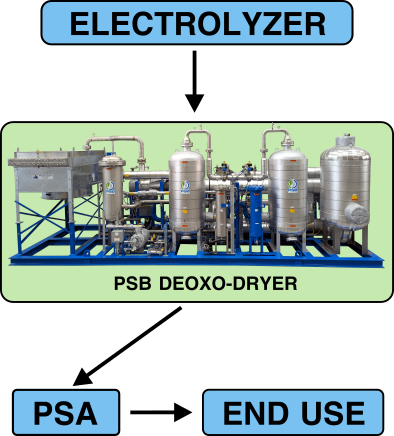
When properly integrated, catalytic oxidation becomes part of a broader purification train, working in concert with upstream contaminant removal and downstream drying systems to deliver a high-purity CO₂ product.
Environmental performance and CI score implications
The environmental implications of CO₂ purification extend beyond regulatory compliance. When CO₂ off-gas is vented, it can negatively impact CI scoring and overall project sustainability metrics. By contrast, purifying and capturing that stream supports improved carbon accounting outcomes. In certain configurations, projects can move closer to carbon negative performance by preventing venting and enabling beneficial reuse.
Catalytic oxidation further enhances environmental performance by removing not only VOCs, but also trace hydrogen and carbon monoxide that may be present in the stream. By converting reactive impurities into stable products, the system contributes to safer handling and higher quality downstream CO₂. Compared to traditional thermal oxidisers, catalytic systems typically operate at lower temperatures, reducing fuel consumption and enabling more efficient heat integration. Thoughtful placement downstream of compressors can leverage existing thermal energy, while larger heat recovery economisers can further reduce electrical load on heaters. These incremental efficiency gains add up over time, lowering total cost of ownership while strengthening environmental performance.
Rethinking CO₂ purification strategy
When evaluating purification strategies for CO₂ off-gas at landfill and dairy RNG facilities, lifecycle cost often tells a very different story than upfront capital expense. Media-based adsorption systems can appear attractive within a six month financial window. The vessels are straightforward, and the initial investment may seem modest. However, recurring media replacement, sometimes required every six to twelve months — can steadily drive operating expenses upward over a four to five year horizon. What looks economical at commissioning can become operationally burdensome over time.
Catalytic oxidation systems shift that equation. Properly engineered catalyst beds typically carry guaranteed lifetimes of one to two years, with many installations achieving three to five years depending on gas quality and maintenance practices. Because the process is continuous and once-through, there is no need for repeated bed cycling, regeneration gas streams, or frequent media changeouts. VOCs are converted rather than captured, reducing consumable costs and simplifying long term operation.
Maintenance philosophy also changes under this model. Major components such as coolers and rotating equipment are designed for extended service life, but proactive spare part stocking becomes a strategic decision rather than an afterthought. In large scale RNG installations, where downtime can interrupt multimillion dollar revenue streams tied to both methane injection and CO₂ sales, protecting uptime is essential. Investing in spare critical components transforms maintenance from reactive troubleshooting into structured risk management.
This is where system design and integration expertise become critical. PSB Industries specialises in the design and fabrication of systems for dehydrating and purifying gasses and liquids, with a focus on integrated solutions rather than standalone equipment. By combining catalytic oxidation with downstream drying and upstream impurity removal considerations, PSB Industries approaches CO₂ purification as part of a cohesive process train. The result is not simply VOC destruction, but a coordinated system that protects catalyst life, ensures moisture compliance, preserves methane recovery, and supports long-term operational stability.
As landfill, dairy, and broader CO₂ focused RNG projects mature, operators are increasingly looking beyond methane alone. The CO₂ stream, once treated primarily as a byproduct, has become a strategic asset. Unlocking its value requires technologies capable of managing fluctuating VOC concentrations, maintaining strict purity specifications, and operating efficiently across multi-year cycles without excessive consumable costs. Catalytic oxidation-based VOC removal, when integrated into a thoughtfully engineered purification system, offers a pathway toward that goal. As RNG infrastructure continues to scale across North America, the central question is no longer whether CO₂ off-gas must be treated, but how effectively it can be purified, preserved, and positioned as a revenue generating component of the overall project.
Divyam Mandalia is Director of Global Purification at PSB Industries.