Engineer News Network The ultimate online news and information resource for today's engineer
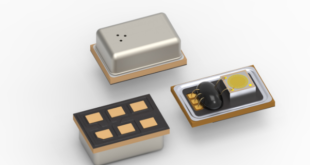
Diodes Incorporated announces that its family of quad- and dual-channel 4:1 and 2:1 bus switches are now available in an ultra-thin QFN (UQFN) package.
The UQFN package makes it easier for OEMs to increase PCB density and reduce product dimensions when developing PC notebooks and tablets as well as networking and telecommunications equipment.
Discrete logic devices, such as bus multiplexers and demultiplexers, remain a critical element of embedded design. The UQFN package measures just 3mm × 3mm × 0.65mm high, which is significantly smaller than comparable devices in standard packages. This smaller size allows the bus switches to be added to almost any design, even those with a high level of component density.
Each channel in the bus switches can multiplex/demultiplex a single output from between two or four inputs.
While the path for all channels is selected through common inputs, the channels benefit from a dedicated active-low enable control, allowing each channel to be operated independently.
All devices offer tri-state operation, presenting high-impedance outputs when the enable pin is held high.
The UQFN package used by the devices includes a thermal pad for more efficient heat dissipation. In addition, all of the devices in the four variants feature a very low on-resistance of just 5Ω, a near-zero propagation delay, and ultra-low quiescent current.
PI3B3253ZHD and PI3B3257ZHD (dual, 4:1) and the PI3CH480ZHD and PI5C3257ZHD (quad, 2:1) bus switches have previously only been available in the QSOP and TSSOP packages, offering pin-compatibility with industry standard 74 series logic devices. The ZHD suffix on the part number denotes the UQFN package.
By adding UQFN, which is one of the smallest packages available, to the packaging options, Diodes gives OEMs increased choice and even greater design flexibility.