Engineer News Network The ultimate online news and information resource for today's engineer
Asia is expected to lead the global VCM industry capacity additions from new-build and expansion projects by 2026 with a share of 66% between 2022 and 2026, forecasts GlobalData.
The data and analytics company’s latest report, Vinyl Chloride Monomer (VCM) Industry Installed Capacity and Capital Expenditure (CapEx) Forecast by Region and Countries including details of All Active Plants, Planned and Announced Projects, 2022-2026, reveals that the total VCM capacity of new-build and expansion projects in Asia is expected to be 3.4 million tonnes per annum (mtpa) by 2026.
Sudarshini Ennelli, Oil and Gas Analyst at GlobalData, comments: “For the upcoming new build projects, the region is expected to add a capacity of 2.61mtpa from five new build planned and announced projects. Whereas for the expansion projects, the region is expected to add a capacity of 0.76mtpa from four planned and announced projects.”
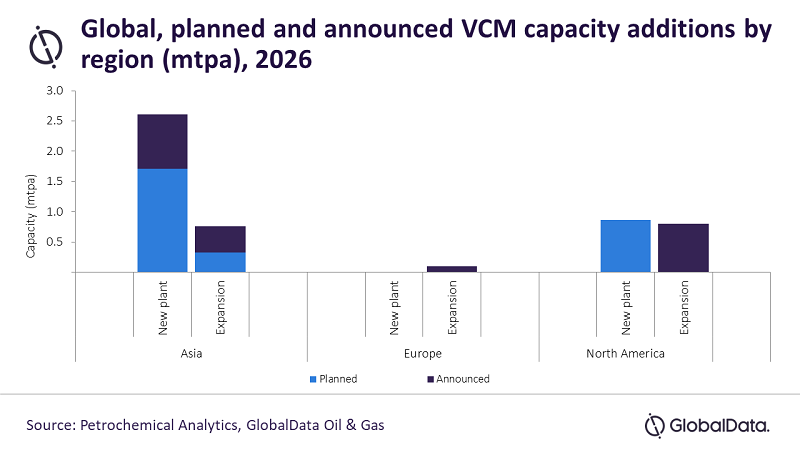
China, Thailand, India, Indonesia, Pakistan, and Vietnam are the key countries in Asia in terms of VCM capacity. The main capacity addition will be from a planned project at the Tianjin Bohai Chemical Development Company Tianjin Vinyl Chloride Monomer (VCM) Plant, with a capacity of 0.80mtpa.
Sudarshini concludes: “Formosa Plastics Group Ningbo Vinyl Chloride Monomer (VCM) Plant stands second with a capacity addition of 0.60mtpa, followed by Shenhua Yulin Vinyl Chloride Monomer (VCM) Plant adding a capacity of 0.51mtpa.”