Engineer News Network The ultimate online news and information resource for today's engineer
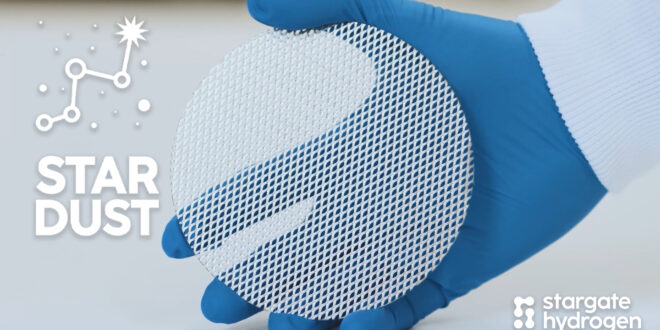
Stargate Hydrogen announces the commercial availability of STARDUST, a proprietary ceramic catalyst that increases the output efficiency of its alkaline electrolysers stacks to 48kWh/kg while eliminating all dependency on iridium and other platinum-group metals (PGMs).
STARDUST is not a new product category. It is an enhancement built directly into Stargate Hydrogen’s existing product line, available today in stacks up to 0.5MW, with integration into the 5MW stack underway. Customers receive the performance improvement with no system redesign needed and no change to the balance of plant.
For project developers and EPC contractors, STARDUST reduces electricity consumption per kilogram of hydrogen produced, translating directly to a lower levelized cost of hydrogen (LCOH). The efficiency gain compounds across the project lifetime: a stack with a longer expected electrode lifetime, producing hydrogen at improved conversion rates, changes the economics of projects that have historically been marginal at current electricity prices.
For investors, STARDUST represents productized intellectual property backed by patent filing and manufactured at scale in Tallinn. Stargate Hydrogen’s factory currently produces 140 MW annually, with capacity expandable to 1 GW+ through incremental investment. The technology is CE certified and fully compliant with Made in Europe requirements.
The electrolyser industry has long operated under a structural constraint: PEM electrolysers offer high efficiency but depend on iridium and platinum, metals that are expensive, supply-constrained, and largely processed outside Europe. Alkaline systems avoid that dependency but have historically underperformed PEM on efficiency. STARDUST closes most of that performance gap while remaining in the alkaline cost class. It uses a non-PGM ceramic formulation, the exact composition is proprietary and patent-protected.
Manufactured in Estonia, STARDUST gives European infrastructure projects a credible domestic alternative at a time when supply-chain sovereignty has become a policy priority under the European Green Deal and IPCEI frameworks. Stargate Hydrogen holds IPCEI status, placing it among a select group of companies backed by the EU to deliver large-scale cross-border hydrogen infrastructure.