Engineer News Network The ultimate online news and information resource for today's engineer
Asia is set to lead the global purified terephthalic acid (PTA) industry capacity additions with a share of 89% by 2027, by gaining capacities from new-build and expansion projects between 2023 and 2027, according to GlobalData, the data and analytics company.
GlobalData’s latest report, Purified Terephthalic Acid (PTA) Industry Installed Capacity and Capital Expenditure (CapEx) Forecast by Region and Countries including details of All Active Plants, Planned and Announced Projects, shows that the total PTA capacity of new-build and expansion projects in Asia is expected to be 47.55 million tonnes per annum (mtpa) by 2027. Increased usage of PTA in sectors such as packaging and textile industries are the key factors for the growth of the PTA industry in Asia.
Nivedita Roy, Oil and Gas Analyst at GlobalData, comments: “For the upcoming new build projects, the region is expected to add a capacity of 47.40mtpa from 22 planned and announced projects, whereas, for the expansion of the existing PTA projects, the region is expected to add a capacity of 0.15mtpa from one planned project.”
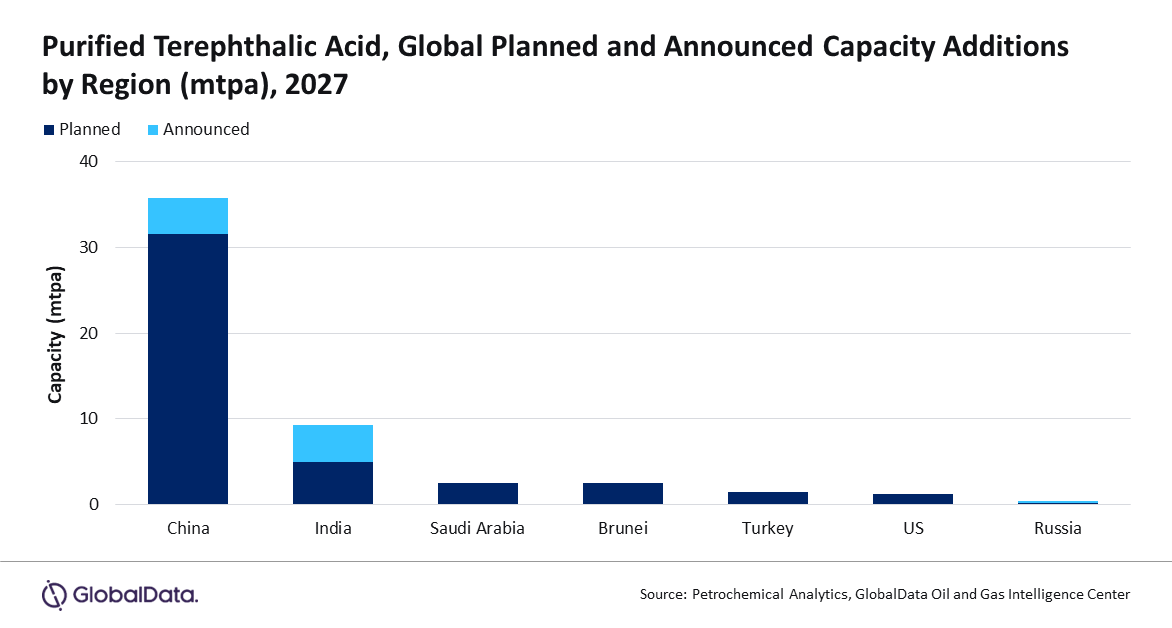
China and India are the key countries in Asia in terms of PTA capacity additions. The main capacity addition in China will be from two planned projects, Fujian Fuhaichuang Petrochemical Zhangzhou Purified Terephthalic Acid (PTA) Plant and Guangxi Tongkun Petrochemical Qinzhou Purified Terephthalic Acid (PTA) Plant, each with a capacity of 3 mtpa. Both are expected to commence production of PTA in 2025.
Nivedita concludes: “In India, the main capacity will be from an announced project, Reliance Industries Dahej Purified Terephthalic Acid (PTA) Plant 3, with a capacity of 3mtpa. It is expected to come online in 2026.”