Engineer News Network The ultimate online news and information resource for today’s engineer
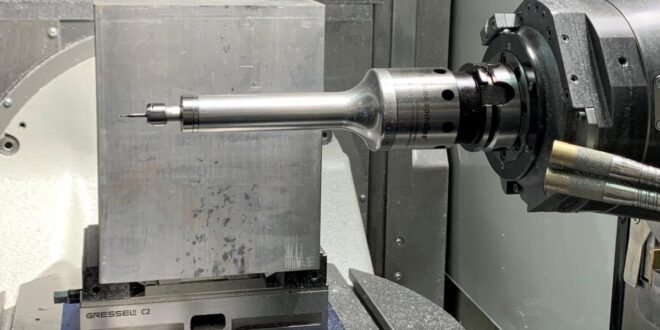
Mike Blanchard explains why adding high-speed air turbine spindles is the most practical way for shops to unlock the full potential of five-axis CNC machines
Five-Axis CNC machines have become essential for creating the complex geometries demanded by industries such as aerospace, defense and medical device production. These advanced machines offer superior part accessibility and minimise the need for repositioning, enabling shops to eliminate secondary set-ups and post-processing. However, for many machine shops, unlocking the full performance potential of five-axis equipment requires more than sophisticated motion control: it also demands higher spindle speeds.
Traditional five-axis machines often top out at spindle speeds between 6,000 and 15,000RPM. While this is sufficient for heavy roughing operations using large diameter tools, when it comes to finishing intricate features or micro-drilling, small tools require consistent spindle speeds of 40,000 to 90,000RPM on the toolpath to function effectively. Without that capability, shops risk poor surface finishes, broken tools and unacceptably long cycle times. This is where governed high-speed air-driven spindles offer a transformative upgrade.
The case for add-on spindles over new equipment
Faced with speed limitations, some shops invest in ultra-high-speed five axis machines, often costing upwards of $1 million. While these machines achieve relatively high RPMs, they are not equipped for roughing operations, and the main spindle heats up and wears out rapidly if operated close to the maximum speed range. Others may opt for multiple machines, one for high-speed finishing and one for heavy cutting, creating inefficiencies in programming, labor and floor space.
Adding governed high-speed spindles is generally a smarter, more cost-effective solution. These compact spindles can be automatically tool-changed into the existing spindle on a five-axis machine. This allows the main spindle to handle the heavy cutting at lower RPMs, while the air turbine spindle takes over for high-speed milling, finishing or drilling. This ability to run both hogging and detail operations on a single machine increases throughput while eliminating the need to reposition parts or buy new equipment. With retrofit spindle solutions costing less than $6,000, shops often achieve the essential both high SFM to run small tools and get excellent ROI within a matter of weeks, especially when part volumes are high or production cycles are tight. Shops are also able to then take on jobs that were previously unprofitable and therefore declined.
Why high-speed spindles work: cycle time and consistency
High-speed machining does not just mean increasing RPMs; it slashes cycle times and improves part quality. When small tools operate below their ideal surface footage due to limited spindle speed, they tend to drag through material, overheat, and wear prematurely. In contrast, governed air turbine spindles maintain consistent high-speed cutting even under load, enabling higher feed rates and optimised surface finish and accuracy.
For example, if a shop runs a tool at 10,000 RPM, and the same tool can operate at 40,000 RPM using a high-speed spindle, the feed rate can be increased proportionally. This leads to 75% reductions in cycle time, a major productivity boost.
Another interesting feature is that governed air spindles operate with no heat, avoiding the thermal growth and tool length deviation common in high-frequency electric or gear-driven alternatives. As a result, these add-on air spindles ensure reliable 2 Micron part tolerance.
Integration made simple and smarter
One of the key advantages of using add-on spindles is that they do not require complex retrofitting, wiring or control systems. Most modern five-axis machines already come equipped with through-spindle air, which enables automated loading of these air turbine spindles from the CNC magazine with no additional wiring or controls. For machines that lack this feature, mounting block-and-collar systems are available to deliver compressed air precisely when needed, activating only when the spindle is engaged. These systems are fully compatible with automatic tool changers and require no software integration, allowing for seamless high-speed machining without interrupting the existing workflow.
Additionally, manual plug in options are available for shops running single tool operations or working with machines that do not require automation. In every configuration, integration can be quick, clean, and compatible with standard CNC operations.
Making the most of five-axis capability
The combination of speed, stability and easy integration is particularly valuable in five-axis environments, where part complexity often includes undercuts, deep cavities and hard to reach geometries. These features frequently require smaller tools and finishing operations that traditional spindles struggle to perform.
Because five-axis machines can approach parts from more angles without re-fixturing, they are often relied upon for completion of all machining steps in a single setup. High-speed spindles maximise this capability by reducing the time it takes to finish fine detail features, engravings and small holes, operations that otherwise become bottlenecks. They also reduce the need for manual post-processing, which introduces variability and slows throughput. When finishing can be done in-machine, under precise toolpath control, consistency improves and fewer parts are scrapped.
Unlike standard air driven or coolant driven ‘speeders’ that bog down under load, tooling experts like the U.S. manufacturer Air Turbine Tools offer unique solutions that maintain consistent high RPMs through their programmed cuts, even under the resistance of composite materials, tool steels or difficult alloys, without generating heat or thermal growth that could affect tool geometry. The result is shorter cycle times, reduced tool breakage, and tighter dimensional tolerances, particularly for small tools milling at 40,000 or 90,000RPM. Air Turbine Tools’ range of spindles features narrow 0.75-in/19 mm barrel diameters extending up to 100 mm, enabling access to hard‑to‑reach areas, cavities and angles. This feature is a major advantage in programming on five-axis machines.
Air Turbine Tools spindles load in and out of the main spindle on demand. This preserves the roughing power of the machine’s native low-RPM spindle while enabling high-speed finishing, engraving or drilling without moving the part or changing machines. This approach has been shown to cut production times by up to 75%, offering payback periods measured in weeks rather than months.
The bigger picture: spindles as a strategic upgrade
At a time when capital equipment budgets are tight and throughput demands are high, smart investments in modular upgrades can offer surprising returns. Instead of purchasing a new machine or maintaining a separate high-speed set-up, manufacturers can amplify the versatility of their existing five axis platforms with a relatively low cost, no maintenance spindle addition.
These add-on spindles streamline production by enabling faster in-machine finishing, at 40,000 to 90,000RPM, reducing secondary operations and minimising tool wear. They also save wear and hours of use of the main spindle, avoiding the downtime, repair costs and lost productivity that can result from overtaxing expensive CNC equipment.
For any shop working in aerospace, defence, electronics, mold-making or medical manufacturing, especially those handling small diameter tooling, tight tolerances, or exotic materials, the case for high-speed spindle upgrades is increasingly clear.
By pairing five-axis motion control with governed constant high-RPM finishing capability, manufacturers can not only improve cycle time, part quality and tool performance, but also fundamentally rethink what their current equipment is capable of achieving.
Mike Blanchard is Technical Advisor at Air Turbine Tools.