Engineer News Network The ultimate online news and information resource for today's engineer
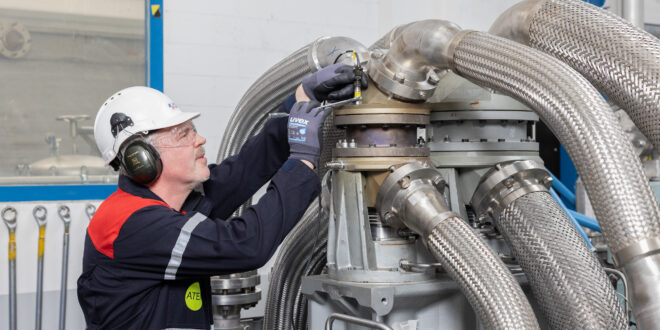
In the dynamic world of gas storage and transportation, reciprocating compressors are the beating heart of the infrastructure. Tasked with moving large volumes of gas across pipelines and into storage facilities, these machines must operate with maximum efficiency and reliability. Any failure, no matter how minor, can result in costly downtime, lost product, and operational chaos. In this high-stakes environment, field services play a vital role in compressor maintenance and repair, which are not merely a support function but a strategic imperative. Travis Shul and David Mason examine the needs of compressor operators to ensure control and monitoring processes are properly delivered for long-term efficiency and reliability
Reciprocating compressors in gas applications are exposed to high pressures, extreme conditions, and continuous duty cycles. Their complex configuration comprising pistons, valves, cylinders, crankshafts, and intricate control systems means they require specialized care. Despite being built for heavy-duty use, these machines are all subject to wear and tear, especially when working with fluctuating loads and irregular maintenance schedules.
Tailoring the best service
Unexpected failures can cascade through an operation. A seized piston, a cracked valve, or a failed rod bearing doesn’t just halt compression, it disrupts supply schedules, strains regulatory compliance, and inflates repair costs through emergency interventions. To mitigate these risks, operators increasingly turn to providers of field service facilities, who offer comprehensive maintenance programs tailored for reciprocating compressors.
Proactive maintenance is the most cost-effective way to ensure ongoing reliability. A compressor that performs consistently with minimal downtime contributes directly to the bottom line. The right service partner helps achieve this by aligning their services with the operator’s business goals, not just their equipment needs.
This means offering a broad range of services beyond supplying personnel and equipment for routine maintenance and repairs. Service level agreements (SLAs) that define uptime guarantees and regular support for multiple assets offer greater peace of mind. These can be partnered with lifecycle cost modeling, which gives details on projected maintenance costs and helps with budgeting and cost analysis.
Further benefits can be gained by providing inventory and parts management, which, coupled with expert knowledge of the assets on site, can streamline stockholding and ensure the required parts are on site ready for planned maintenance projects. Further benefits can be gained from training in-house teams to identify early warning signs and promote the proactive maintenance strategy.
True flexibility is key
Field service teams bring deep domain knowledge, OEM or equivalent technical training, and specialized tooling to the operator’s site, reducing the time, cost, and complexity of transporting heavy machinery to workshops. This convenience is matched by their flexibility: mobilizing quickly to remote compressor stations, working in challenging environments, and integrating seamlessly with the customer’s operations.
Gone are the days when compressor maintenance was based on reactive models and waiting for something to break before fixing it. Today, the leading service providers advocate proactive maintenance strategies that anticipate failure modes before they occur. The use of condition monitoring equipment and remote diagnostics enable trends to be identified and acted upon.
Modern maintenance providers use scheduled overhauls that are based on duty cycles and real-time data, not just calendar intervals. In addition, root cause failure analysis is used to prevent repeat breakdowns. Gathering more data and using it effectively is key to providing a comprehensive preventive maintenance package.
The evolution towards proactive maintenance
The proactive approach to maintenance allows gas operators to shift from a cost-center model of repair to a value-creation model of reliability. By avoiding failures, unplanned shutdowns, and emergency repairs, companies save not only in direct costs but gain in reputation and adhere to regulatory compliance.
In many cases, the ideal provider will also help customers to benchmark performance against industry standards and continuously refine maintenance strategies. By ensuring equipment operates within optimal parameters, service partners help maximize gas throughput, reduce energy use, and extend equipment life, delivering both operational and financial value.
In a competitive field, top-tier service providers distinguish themselves by offering value beyond the repair. They build long-term relationships grounded in trust, performance, and technical excellence. This can be illustrated by a few examples of outstanding service.
Expanding the hydrogen network
Hydrogen fuel networks are growing rapidly, and they must include compressors to enable the transport and storage of hydrogen ready for delivery. Depending on the role of a facility, different sizes of compressors are required to maintain optimal storage conditions and transfer gas either to tankers for local transport or to refill vehicles on the forecourt.
A site operating as a hydrogen filling station for tankers which transport gas to service stations and larger customers tests different designs of compressors to determine the best solutions for the wider network. In this business, any downtime on the compressor would result in a backlog in deliveries, which would have a significant impact on the business, including penalties for missed deliveries.
The decision on which OEM to select is based on many factors, primarily the expected availability of the compressor, which is key to an effective business. Avoiding unexpected downtime is essential and can be achieved through a combination of proven design, digital monitoring services and reliable field service support. Local support is crucial in this market – accepting the fact that there will be a need for regular maintenance and having the support network in place to deliver a fast response is essential.
Building the relationship
The first step is to strike up a good relationship and build on it by keeping in touch and developing a proactive maintenance strategy. One of the first priorities is to create a list of long lead-time items – major capital parts that are crucial in a major repair. The chance of needing these is slim, but if they are required, the cost of weeks of downtime would be considerable. In this example, this strategy has already paid dividends.
During the festive period, a compressor experienced some valve temperature issues. The field service engineer from the chosen maintenance provider flew in and was on site within 24 hours. An additional site visit by the sales contact reassured the business that prompt action would be taken. The valves were removed, switched out for new parts and within the day, the compressor was back up and running thanks to the spare parts being on site.
Successful interventions such as this help to foster existing relationships, building trust and understanding. It is difficult to overstate the importance of trust between the operator and their maintenance supplier.
A trusted partner will also tell you when maintenance intervals can be extended without detrimental effects to the machine. For example, a compressor using composite rings was routinely overhauled every 12 months. However, closer inspection showed that the rings were in perfect condition after a year and in fact they could perform effectively for at least twice as long. Adjusting maintenance schedules to suit each application is crucial to establishing the optimum for intervention.
Expert knowledge saves money
In a separate example, a chemical company with 14 compressors working in a polypropylene process had previous experience with poor maintenance services such as underquoting jobs and overrunning projects because of a lack of knowledge. This had a doubling effect on the costs of the maintenance – the project took twice as long as planned, doubling the manhours, and the lost production time also doubled, increasing costs to productivity.
The company was looking to reduce maintenance costs and improve reliability, and the new provider selected a hand-picked team to carry out planned maintenance. The management was impressed by the work procedures used throughout the project, as well as the professionalism and knowledge of all the personnel.
At the heart of these tasks are the technicians on the ground; their knowledge and commitment to delivering the best service is crucial to maintaining the customer relationship. Technicians live a 24/7 lifestyle – always aware that they can be called on to support customers at a moment’s notice. The relationship between customer and technician is central to an effective operation and extended reliability.
Taking the wider view
While the technicians and their knowledge are very important, there is also the role of the parent company to consider – compressors are used all over the world making a global network of service centers crucial to extending local support to customers. Proximity to the customer on a geographical basis reduces time in the event of unplanned maintenance or repairs, keeping downtime to a minimum.
Furthermore, the company needs to offer capabilities that go beyond mechanical repairs, such as control system diagnostics, pulsation analysis, and API-standard compliance assessments. By providing a holistic approach to maintenance, and looking at the compressor systems as a whole, it is possible to achieve unprecedented levels of reliability.
Finally, as part of the technician-operator relationship, the process of passing on knowledge through training is key. While on site, these technical experts not only support operators with their expertise to resolve problems, they also pass on their wisdom, helping customers to better understand their machines.
Meeting new expectations
As the gas industry evolves to meet higher efficiency and reliability standards, the expectations for field service partners are rising. It is not only about who can get there first, it’s also about who can keep the operation running longest, safest, and most cost-effectively.
For asset-intensive operations relying on reciprocating compressors, the maintenance partner of tomorrow will be data-savvy, strategically aligned, and relentlessly focused on reliability. By partnering with a company that has expertise in all brands as well as OEM knowledge and a company ethos that focuses on the end user, there are many rewards. Reduced downtime, extended asset life, lower total cost of ownership, and a competitive edge in a high-stakes market.
Travis Shull and David Mason are Account Managers, Services Division at Burckhardt Compression.