Engineer News Network The ultimate online news and information resource for today’s engineer
Optical coherence tomography (OCT) has become an essential tool in modern medical imaging, with swept-source OCT (SS-OCT) emerging as a leading modality because of its superior imaging speed, depth penetration, and sensitivity. By employing swept laser sources, SS-OCT enables high-resolution, real-time visualisation of tissue microstructures, making it particularly valuable in applications such as ophthalmology, cardiology, dermatology and dental imaging.
A critical component at the core of the instrument is the data acquisition system. The digitiser, responsible for accurately capturing interferometric signals, directly affects image quality, imaging depth, and scan speed. As SS-OCT systems continue to push for higher scan speed, better axial resolution, and greater imaging depth, the demands placed on digitisers — such as sampling rate, bandwidth, dynamic range, and real-time processing — have become increasingly stringent.
This article will explore the key role of digitisers in enabling state-of-the-art SSOCT systems and explain why Teledyne digitisers, including the ADQ32 and ADQ35, provide the performance, flexibility, and advanced features required by SS-OCT instrument developers striving to build next-generation imaging solutions.
SS-OCT vs SD-OCT
Swept source OCT (SS OCT) offers major technical advantages over spectral domain OCT (SD OCT) because of its high speed swept laser source and single photodetector design, which deliver faster scan rates, deeper tissue penetration, and far less sensitivity roll off with depth.
Its longer operating wavelength (~1050nm) improves imaging through scattering tissues and enables superior visualisation of the choroid and deeper ocular structures. SS OCT also provides higher signal-to-noise performance and more stable phase information, making it especially powerful for high-density volumetric imaging and OCT angiography.
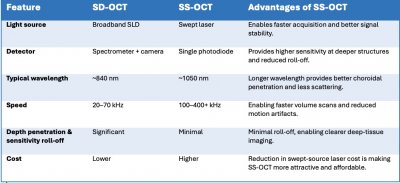
Historically, swept lasers were the most expensive part of SS OCT systems. However, new semiconductor based tunable lasers (e.g., MEMS VCSELs) are being designed for low cost, high volume production, making SS-OCT instruments more competitive and affordable
SS-OCT digitiser requirements
Overall system performance is tightly constrained by the quality and capability of the digitiser. Developers are not simply looking for fast data acquisition; SS-OCT developers need digitisers that combine multi-GS/s sampling, low jitter, high analogue bandwidth, and high ENOB performance for the accurate capture of GHz interferometric fringes. They also require deterministic timing, real-time k space linearisation, and high throughput streaming to support real-time imaging pipelines. System performance is ultimately limited by the digitiser’s ability to acquire clean, precisely timed data at extremely high speeds.
Key developer requirements for SS-OCT digitisers typically include:
- 1 to 5GSPS sampling rates to accurately capture rapidly swept interferometric signals. Imaging depth is proportional to digitiser sampling rate and laser coherence length. Increasing swept-source laser sweep rates, coherence length, and k-clock frequencies are driving the need for higher speed digitizer technology.
- Wide analogue bandwidth (1 to 2GHz) to support high-frequency fringe signals without distortion and k-clock frequencies in the range of 1–2GHz.
- High dynamic range and low noise to preserve weak reflections from deeper tissue layers. 12-bit vertical resolution at up to 5GSPS sampling rate.
- Real-time data handling, including peer-to-peer streaming and FPGA pre-processing, to avoid bottlenecks at high A-scan rates. Real-time streaming to CPU or GPU at gigabytes per second rates.
- Low-latency processing, enabling immediate image reconstruction or feedback.
Teledyne’s ADQ3-series digitisers meet and exceed these requirements.
ADQ3 Digitiser Series for SS-OCT
Up to 5 GSPS capability ensures that even the fastest swept lasers can be sampled with high fidelity, capturing high-frequency fringe frequencies and preserving axial resolution. This high sampling rate, combined with excellent analog front-end performance up to 2.5GHz, allows developers to fully exploit the bandwidth of modern SS-OCT light sources without compromise.
An essential part of the digitiser solution is dedicated application-specific firmware. FWOCT is firmware developed by Teledyne SP Devices to map the sampled k-clock to the OCT signal in SS-OCT imaging systems and perform all the other signal processing steps to produce OCT images. The k-clock and OCT signal are connected to a dual-channel digitiser. The k-clock signal is sampled by the digitizer and then processed to find the desired OCT sampling points. For the selected points, the corresponding value of the OCT signal input is estimated with high precision. This has many advantages compared to direct-clocking approaches – see Digitiser for swept-source OCT (SS-OCT.
Integrated firmware moves key processing steps such as resampling (k-linearisation), digital filtering, and potentially FFT preparation — onto the digitiser itself, and this has several advantages:
- Reduced host CPU/GPU load, enabling simpler system architecture.
- Lower data transfer bandwidth requirements, since data can be pre-processed before streaming.
- Deterministic, real-time performance, essential for high-speed imaging systems.
- Improved phase stability due to tightly controlled, hardware-level processing.
FWOCT Highlights
- Flexible k-clock support (4–2000MHz) for use with a wide range of lasers.
- K-clock interpolation to support MZI-interferometers and low k-clock frequencies (4–2000MHz k-clock supported).
- Programmable modes to select sampled k-clock points mapped to the OCT signal. For example, rising edge, rising and falling edge, or interpolated configuration with multiple points per k-clock period.
- High maximum OCT signal bandwidth (0–2000MHz).
- Signal noise reduction by user-configurable FIR filters.
- Timing adjustments between the k-clock and OCT signal paths.
- FFT with flexible output formats – complex, squared magnitude, logarithmic.
o FFT size scales with A-scan rate up to 32k bins
o Lower latency than FFT implemented in GPU
- Background removal.
- Dispersion compensation.
In contrast, many competing solutions rely heavily on software-based processing after acquisition, which introduces latency, increases system complexity, and can limit achievable imaging speeds.
Taken together, the combination of up to 5GSPS capable hardware and dedicated FWOCT firmware provides a tightly integrated acquisition and processing platform. For these reasons, the ADQ3-series stand out as a leading choice for SS-OCT developers seeking to push the limits of speed, sensitivity, and real-time imaging capability.
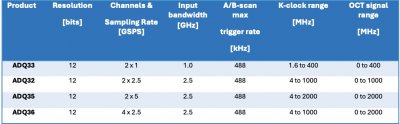
ADQ32, ADQ33, and ADQ35 are available in either PCIe format or with a USB 3.2 interface (see ADQ3-USB – Teledyne SP Devices) while ADQ36 is available in PXIe.