Engineer News Network The ultimate online news and information resource for today’s engineer
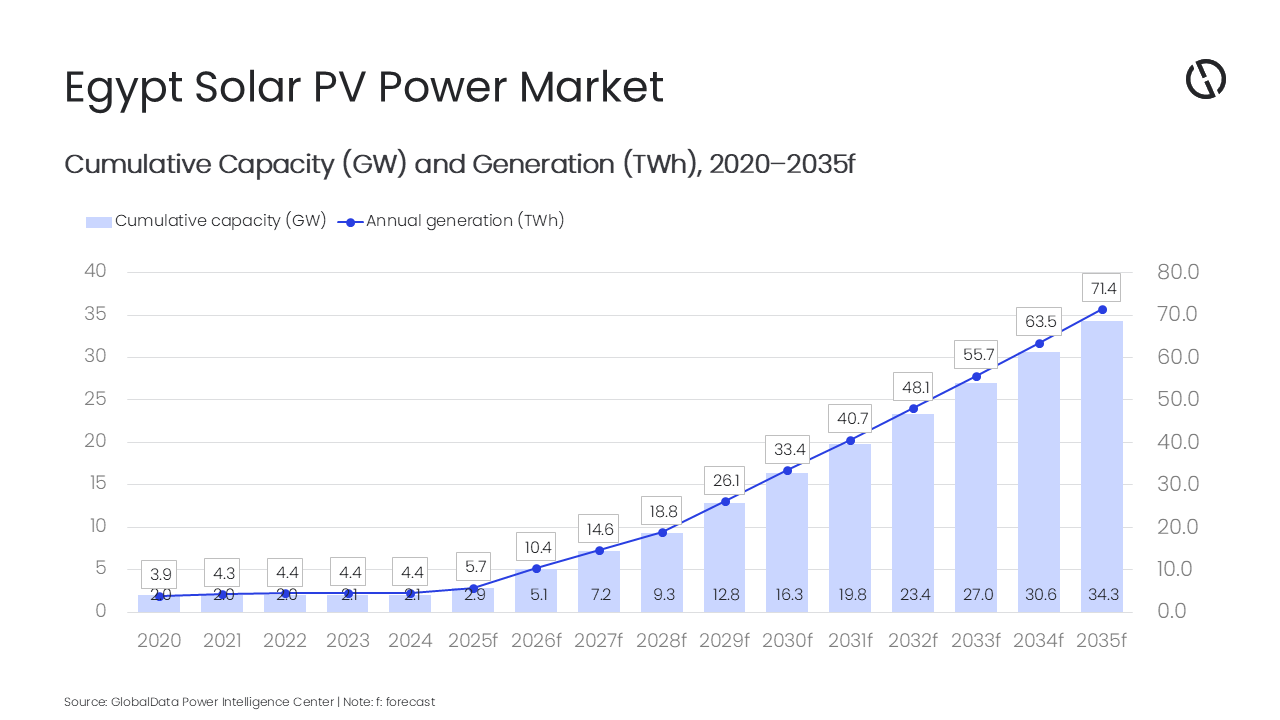
Power generation in Egypt has historically been dominated by natural gas, with large scale combined cycle plants forming the backbone of the electricity system. Until recently, renewable energy, particularly solar, played only a limited role, with solar PV capacity remaining below 2GW in 2020. In recent years, the country has accelerated renewable deployment as part of a broader shift in its generation mix, with solar PV emerging as the fastest growing technology in this transition. Against this backdrop, solar PV capacity is forecast to increase from approximately 2.9GW in 2025 to around 34.3GW by 2035, according to GlobalData.
GlobalData’s latest report, Egypt Power Market Trends and Analysis by Capacity, Generation, Transmission, Distribution, Regulations, Key Players and Forecast to 2035, shows the country’s cumulative renewable power capacity is expected to reach approximately 49.7GW by 2035, driven primarily by solar PV additions. This rapid scale up reflects Egypt’s focus on utility scale deployment, supported by favorable irradiation levels and a growing pipeline of large projects.
The expansion of solar capacity is underpinned by a comprehensive policy and investment framework. Foundational legislation such as the Renewable Energy Law and Electricity Law opened the market to independent power producers, while incentives including tax reductions, reduced customs duties, and access to land have improved project viability. Long term power purchase agreements (PPAs), sovereign guarantees, and the expansion of build own operate models have further strengthened investor confidence and accelerated project execution.
In addition, national initiatives such as the Nexus of Water, Food and Energy platform have mobilized international financing and enabled large scale solar deployment. Fast track mechanisms such as the Golden License have streamlined regulatory approvals, significantly reducing development timelines. Increasingly, new solar projects are also integrating battery storage, enhancing grid stability and enabling better management of peak demand.
Mohammed Ziauddin, Power Analyst at GlobalData, comments: “Solar PV is emerging as the dominant growth driver in Egypt’s power sector, supported by strong resource availability, improving project economics, and sustained policy support. Its scalability and cost competitiveness make it well suited to meet rising electricity demand, while complementary technologies continue to support system stability.”
Wind power is also expanding steadily within Egypt’s renewable portfolio, with total capacity projected to increase from approximately 3GW in 2025 to around 15.1GW by 2035. Growth is supported by strong wind resources in the Gulf of Suez and Red Sea regions, along with continued project development and investment activity.
Thermal power continues to anchor Egypt’s electricity system, with natural gas remaining the dominant source of generation. Gas-fired capacity is expected to remain broadly stable at around 45-50GW through 2035, reflecting its critical role in providing baseload and flexible generation. In addition, nuclear power is set to emerge as a new component of the generation mix through the El Dabaa Nuclear Power Plant, with capacity projected to reach approximately 4.4GW by 2035, supporting long-term energy diversification.
Zia concludes: “Over the next decade, Egypt is expected to prioritize large-scale solar deployment as the central driver of its power sector expansion. Beyond domestic demand, solar is also expected to play a broader strategic role in enabling green hydrogen production and supporting cross-border electricity trade initiatives, positioning the country as a regional clean energy hub. Alongside sustained reliance on natural gas and the introduction of nuclear power, this approach is expected to support a diversified and resilient electricity system while strengthening long-term energy security and export potential.”