Engineer News Network The ultimate online news and information resource for today’s engineer
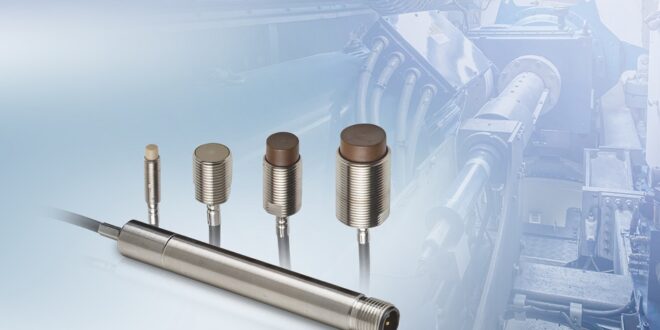
The eddyNCDT 3005 is a high performance inductive (eddy current) sensor system designed for precise and fast displacement measurements on metal targets in harsh environments. With its compact controller housing, high temperature stability and robust design, the eddyNCDT 3005 is suited for industrial measurement tasks and automation solutions.
The robust design of the eddyNCDT 3005 sensors makes them suitable for integration into machines and systems. The sensor head, cable and controller (integrated in the cable) are all sealed against pressure and liquid ingress. The system performs in environments where pressure, dirt, oil and high temperatures occur. It offers a unique combination of micrometer precision, robustness and flexibility by adapting the system to the customer’s application. Active temperature compensation enables accurate measurement results even in environments where large temperature fluctuations occur.
The sensors are designed for ambient temperatures up to a maximum of +125°C as standard and can be custom engineered for temperatures from -20°C to 180°C. The measuring system is suitable for an ambient pressure of up to 10 bar. The system is factory-calibrated for either ferromagnetic or non-ferromagnetic materials, depending on customer requirements, with special calibration options for specific target or mounting geometries. The compact design of the controller with a diameter of just 12 mm allows integration into confined and hard-to-reach installation spaces. The measurement signal is delivered via analogue voltage or via RS485 enabling networking possibilities and compatibility with modern industrial Ethernet interfaces via a gateway module.
Glenn Wedgbrow, Business Development Manager at Micro-Epsilon UK comments: “The eddyNCDT 3005 sets new standards in terms of eddy current displacement measurement. The complete conditioning electronics are miniaturised and mounted into a compact cylindrical housing, integrated into the sensor cable, one metre from the sensor head. Having the electronics remote from the sensor enables more compact sensor head dimensions and higher operating temperatures, compared to sensors with integrated electronics.”
“With a very competitive pricing structure, the system can be supplied from stock. Equally, for higher volume applications, the system can be modified to suit individual OEM requirements. The sensors are ideal for companies that need to measure vibration, shaft runout, concentricity, gap, tip timing, eccentricity, oil film thickness and position, to micrometre level accuracies,” adds Wedgbrow.