Engineer News Network The ultimate online news and information resource for today's engineer
Adrian Wood explores how high-tech manufacturers can reduce the disruption, cost and risk typically associated with engineering and production changes. He looks at how virtual twin technology is helping manufacturers validate changes before they hit the shop floor, turning complex adjustments into far more manageable events. There is a detailed look at: what measurable business benefits manufacturers are seeing, from fewer engineering change orders to lower prototype spend; why manufacturing change becomes so costly when issues are found too late in the process; and how virtual twins help teams test and validate changes earlier to improve speed and first-time quality
Energy performance does not come from individual initiatives. It comes from operations that were designed with energy in mind at every level. The manufacturers who come through this strongest will be the ones who used digital tools not just to cut costs, but to redesign how they operate—treating the virtual twin not as a project deliverable, but as operational infrastructure.
As we all know, in the fast-paced world of High-Tech, change is the only constant. Whether it’s a sudden shift in market demand, a new regulatory requirement or an engineering change order (ECO), manufacturing engineers are under immense pressure to quickly adapt. But for many, change is synonymous with risk, delays and skyrocketing costs.
What if complexity was no longer a barrier? What if every change you made was, in fact, a ‘non-event?’”’
The high-tech paradox: innovation vs. eExecution
High-Tech companies face a unique set of challenges. Products are becoming increasingly complex, blending mechanical, electrical, and software components. At the same time, the industry is grappling with skilled labor shortages, supply chain disruptions, and the constant need to protect intellectual property (IP).
Traditional manufacturing planning—relying on spreadsheets and physical prototypes—is struggling to keep up. Research by Tech Clarity shows that:
- 25% of manufacturing engineering time is wasted on non-value-added activities like rekeying or searching for data.
- The cost of physical prototypes and late-stage engineering changes can cripple product profitability.
- Discovering a manufacturability issue during the production phase is exponentially more expensive than finding it in a virtual environment.
Enter the virtual twin: the ‘non-event‘ enabler
A Virtual Twin is not just a 3D model; it is a dynamic, science-based representation of the product, processes, resources and operating context across the manufacturing lifecycle, integrating the knowledge and know-how needed to create and run it in the real world. By connecting the virtual and real worlds, DELMIA allows engineers to validate manufacturability before a single piece of equipment is commissioned.
Here is how the Virtual Twin transforms change into a non-event:
1. Shifting left: finding issuessooner
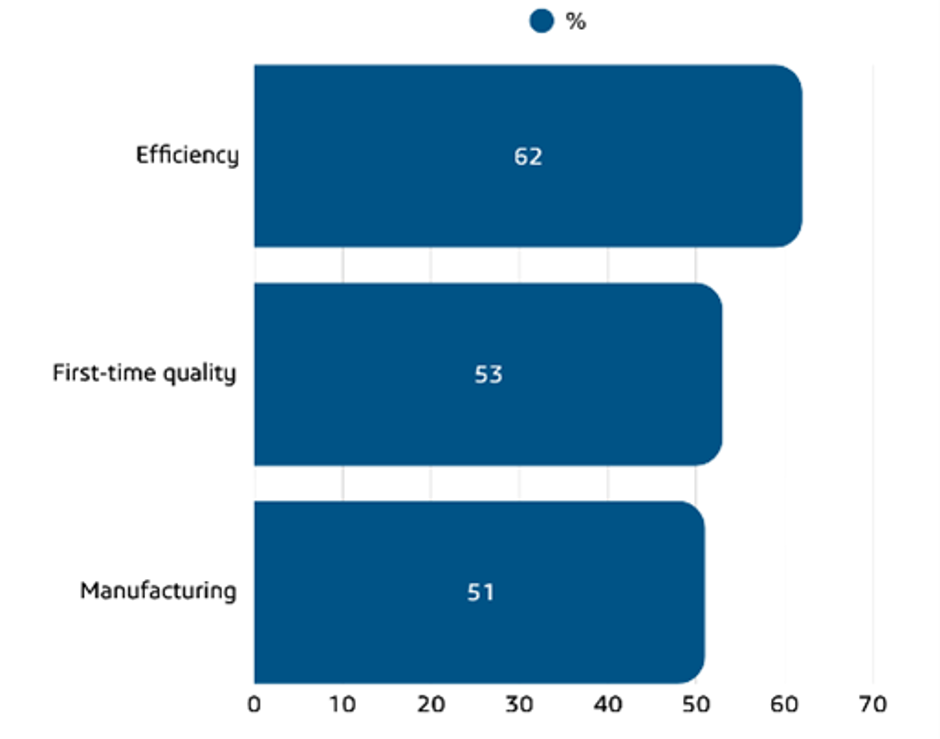
Top performers in the industry are 65% more likely to identify physical issues during the design phase. By ‘shifting left’, they use 3D simulation to validate assembly processes, line balancing, and ergonomics early in the cycle. When a change is needed, it is tested virtually, ensuring that it works ‘first time right’ when it hits the shop floor.
2. Eliminating the prototype bottleneck
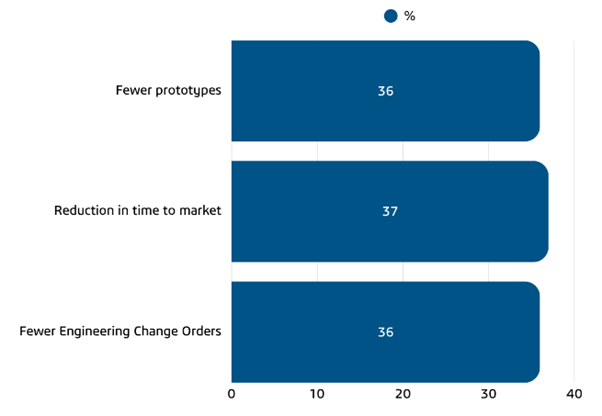
Companies leveraging virtual simulation technologies can eliminate approximately one-third of their physical prototypes. This not only saves significant costs but also reduces time-to-market by 37%. Changes that once required weeks of physical testing can now be validated in a virtual afternoon.
Quantify the potential
3. Strengthening the digital thread
One of the biggest risks in high-tech is the loss of know-how and intellectual property, especially when working with contract manufacturers. A Virtual Twin creates a secure digital thread that connects all stakeholders from design through production on a shared platform. Top performers are 29% more likely to collaborate with contract manufacturers in this way, enabling a single source of truth with controlled access, full traceability and stronger protection of critical IP across the value chain. The Results: Efficiency, Quality, and Sustainability
The business value of this transformation is measurable. By adopting Virtual Twin solutions, manufacturers are seeing:
- 36% reduction in Engineering Change Orders (ECOs).
- 50% less spend on physical prototypes compared to their peers.
- Improved sustainability and regulatory compliance through predictive analytics and simulation of production scenarios.

Is your organisation ready?
In the High-Tech industry, top performers are already using Virtual Twins to tame complexity and turn market volatility into a competitive advantage.
Do not let your next change be a crisis. Solutions such as DELMIA’s Virtual Twin, can help to validate every move, upskill your workforce with immersive environments, and ensure that your next engineering change is exactly what it should be: a non-event.
So, is your manufacturing process agile enough to make your next big change a non-event.
Adrian Wood, Director of Strategic Business Development for DELMIA.
Discover how to leverage virtual builds for significant business value by accessing the full report Digitalizing Manufacturing Engineering in the High Tech Industry.