Engineer News Network The ultimate online news and information resource for today's engineer
The Industrial Internet, also known as the Industrial Internet of Things (IIoT), involves the use of connected sensors and actuators to control and monitor industrial machinery and environments. As it helps detect faults early and predict maintenance requirements, the global oil and gas sector is witnessing a growing adoption of IIoT in the upstream, midstream, and downstream segments, says GlobalData.
GlobalData’s Strategic Intelligence report, Industrial Internet in Oil & Gas, says assets across exploration, drilling, and production. This technology shift enables autonomous operations, predictive maintenance, enhanced efficiency, and the agility crucial for navigating volatile markets.
Ravindra Puranik, Oil and Gas Analyst at GlobalData, comments: “The oil and gas industry in 2026 faces unprecedented external pressures: high and volatile prices, supply uncertainty, climate change concerns, rising consumption of cleaner energy, and realigning global energy trade routes. Besides these, companies are facing significant operational challenges driven by factors such as US tariffs, the Iran conflict, sanctions, and protectionist policies. To secure future growth and resilience, operators are embracing the Industrial Internet across their businesses.”
The upstream segment is at the frontline of Industrial Internet adoption. Projects are increasingly capital intensive and geographically remote, facing new subsurface challenges and rising environmental, social, and governance (ESG) scrutiny. As a result, real-time monitoring and modelling are now expected, not optional. Digital twins, AI-driven drilling optimization, and field-wide IoT networks enable operators to simulate outcomes, remotely manage wells, predict equipment failures, and integrate new production faster than ever.
In the midstream segment, sensors placed across pipelines and tanks provide real-time data on pressure, flow, and integrity, enabling faster leak detection and improved responses to anomalies.
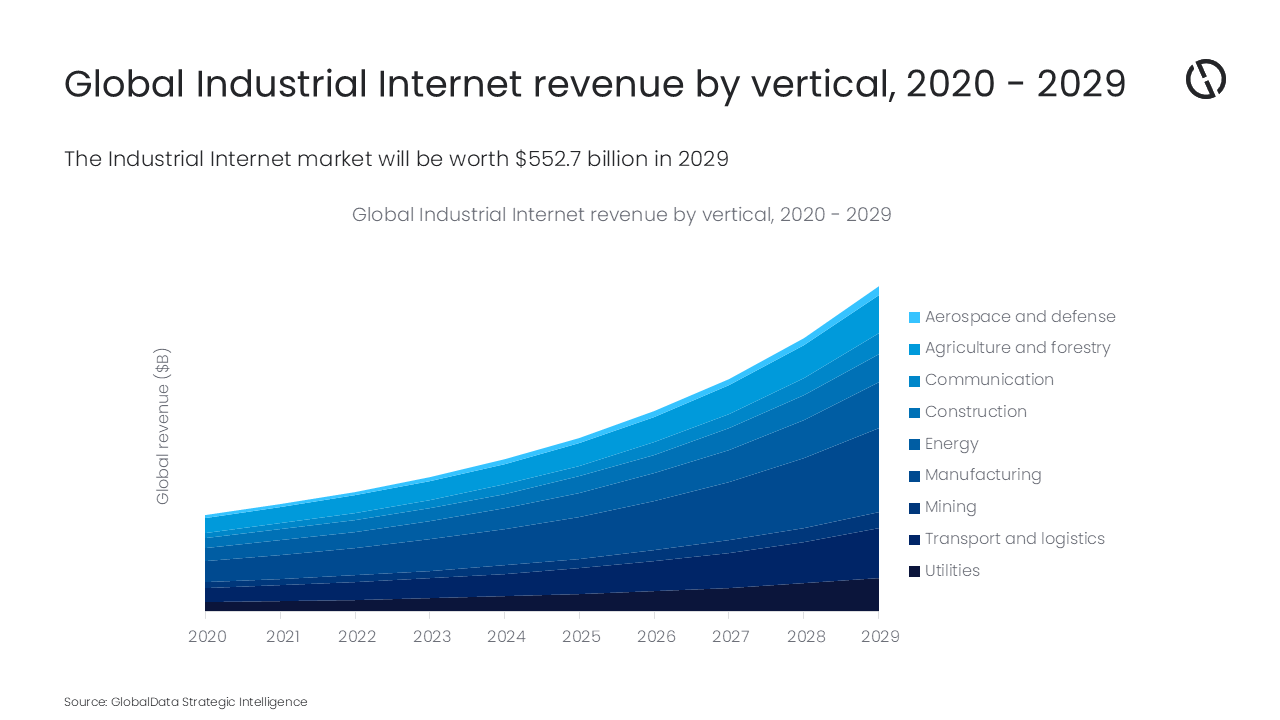
The global Industrial Internet market is experiencing rapid expansion and is forecast to reach $552.7 billion in revenue by 2029, reflecting a robust compound annual growth rate (CAGR) of 16% from 2024 to 2029. Of this, the energy sector is expected to generate $79 billion in Industrial Internet market revenue by 2029.
In the downstream segment, real-time data collection and advanced process automation now underpin production optimization, emissions control, and energy management. Digital twins are enabling continuous process modeling, rapid scenario testing, and proactive troubleshooting.
Puranik concludes: “Autonomous operations are rapidly becoming standard in digitally advanced oilfields, particularly in offshore environments such as fixed platforms and FPSOs, where remote and reliable management is both a logistical necessity and a cost imperative. Also, cloud-based analytics and AI systems connect the dots from raw input to final distribution, improving the accuracy of demand forecasting and inventory management even in volatile markets.”