Engineer News Network The ultimate online news and information resource for today's engineer
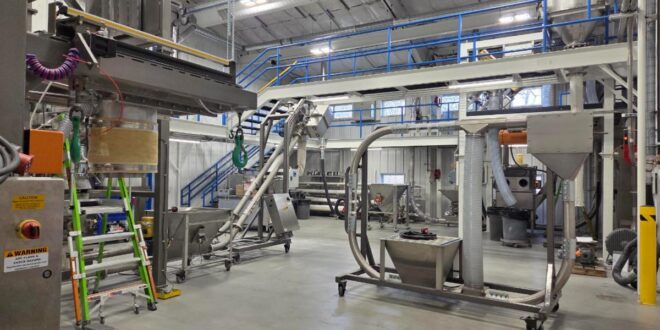
Hapman‘s new test lab designed to help processors more accurately evaluate how materials will perform in conveying applications. The expanded facility allows customers to validate equipment selection, refine system design and reduce project risk before equipment is installed.
The facility now accommodates bulk bag unloading and filling, higher-throughput conveyors and integrated system tests that link multiple Hapman technologies together. This allows engineers to run end-to-end trials that mirror actual production processes, from loss-in-weight bulk bag unloading through conveying to gain-in-weight bulk bag filling, using full-scale equipment and real customer materials.
Within the lab, customers can test applications involving bulk bag unloaders with conditioning, pinch valve and access chamber options, lump breaking, screening and rotary airlock discharge, all mounted on load cells for precise loss-in-weight control. The space also supports bulk bag filling with adjustable bag height, traversing fill heads and rear hooks, densification features and gain-in-weight load cell control. A wide selection of conveying technologies is available for testing, including multiple sizes of Helix flexible screw conveyors, pneumatic conveyors up to larger 30 and 36 e-line units, as well as CablePro and TubePro tubular drag conveyor configurations. This range allows Hapman to compare different technologies under identical conditions and make evidence-based recommendations.
Customer collaboration is central to the test lab process. Before any test, Hapman reviews the customer’s RFQ data and process requirements, then selects and configures equipment to meet those needs. Once the test plan is established, the customer’s material is brought into the lab to confirm performance assumptions and validate equipment parameters. If a test shows that a chosen technology is not the best fit, the team can quickly trial alternatives and document improved performance for the customer’s review.
By combining full-scale equipment, integrated system controls and structured collaboration with customers, Hapman’s new test lab provides a practical, data-driven environment for de-risking bulk material handling projects. Processors gain clearer insight into how materials will behave, which technologies are best suited to each application and what design details will help achieve consistent, predictable performance.