Engineer News Network The ultimate online news and information resource for today’s engineer
Asia is expected to lead the global ammonia industry capacity growth from new-build and expansion projects by 2030 with a share of 20%, according to GlobalData, the data and analytics company.
GlobalData’s report, Ammonia Market Capacity and Capital Expenditure (CapEx) Market Forecast by Region, Top Countries and Companies, Feedstock, Key Planned and Announced Projects, 2022-2030, reveals that the total ammonia capacity of new-build and expansion projects in Asia is expected to be 9.93 million tonnes per annum (mtpa) by 2030. Out of this capacity addition, 9.72 mtpa is from new-build projects and the remaining capacity is from expansion projects.
Teja Pappoppula, Oil and Gas Analyst at GlobalData, comments: “Asia will continue to lead the global ammonia market with the larger number of new projects driven by growing economies in the region.”
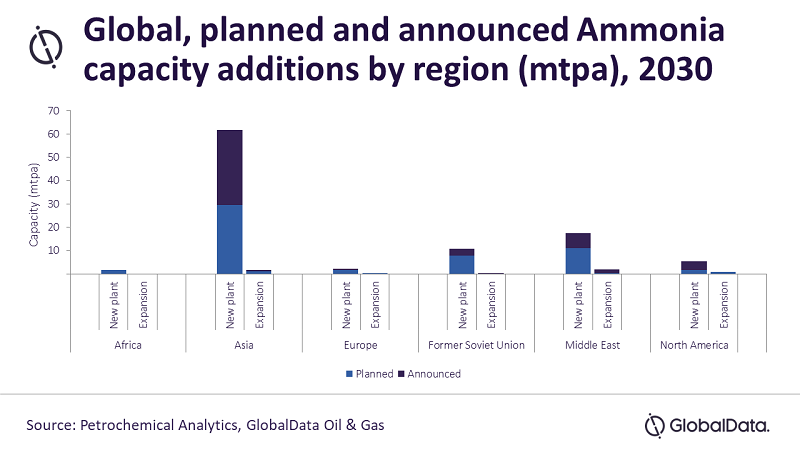
The Middle East is expected to have the second-highest ammonia capacity additions globally, behind Asia. The region will contribute about 9.28 mtpa of the total global new-build and expansion ammonia capacity additions by 2030. Major capacity additions for the Middle East will be from Iran, with new-build and expansion capacity additions of 4.96mtpa, by 2030.
Africa stands third, with new-build and expansion capacity of 8.11mtpa by 2030. Of these, most of the ammonia capacity additions will come from new-build projects.