Engineer News Network The ultimate online news and information resource for today’s engineer
Distance and speed of charging are vital in the competitive EV sector and, like all vehicle components, high-power integrated traction inverters – which convert DC into AC and capture energy for the vehicle – need to combine superior performance with being as small and light as possible. Measuring just 29mm x 21mm x 12mm and weighing 27g, LEM’s new HSTDR current sensor is significantly more compact than a traditional C-core sensor, making it much easier to be integrated into space-limited inverter boxes.
The sensor enables traction inverters to operate at maximum efficiency by combining high accuracy with affordability and the ability to operate in demanding environments (the sensor has an operating range of -40°C to +125°C and is robust enough to cope with vibrations up to 10G). Using open loop Hall effect technology and an innovative magnetic core design, the HSTDR offers excellent immunity against external field and cross talk as well as consistent behaviour over frequency with little part-to-part phase shift dispersion, ensuring more accurate torque control.
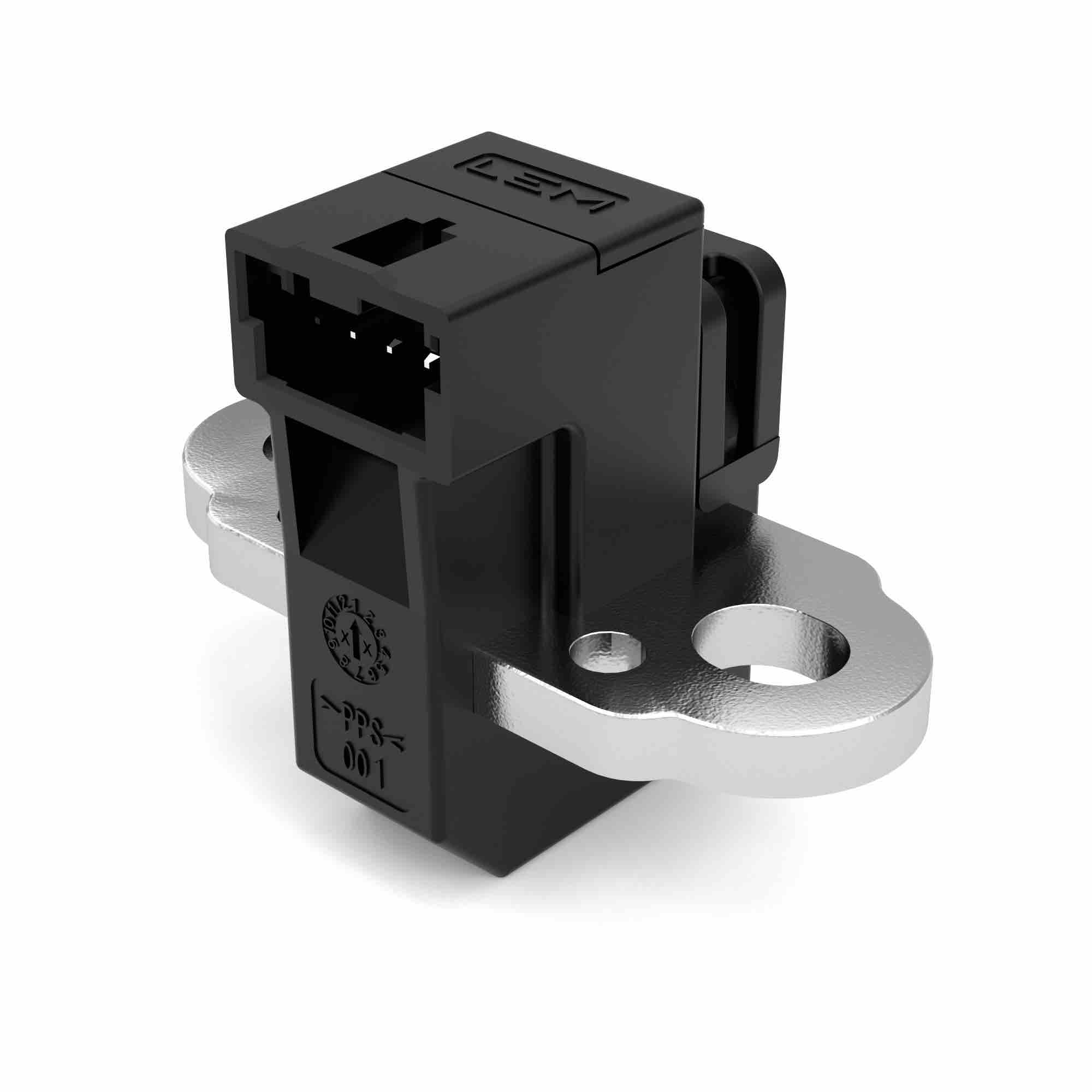
What makes the sensor unique is not only that it is 42% smaller than its predecessor (LEM’s HSNDR) but also weighs 50% less and offers 50% greater measuring range, as well as best-in-class accuracy and a global error over temperature and lifetime below 3.5%. Giving EV manufacturers the choice of having different current measuring ranges in the same housing – from ±300 A up to ±1500 A – the sensor ensures galvanic separation between the primary circuit (high power) and the secondary circuit (electronic circuit), which is also suitable for 800V battery systems.
One way LEM’s designers were able to minimise the footprint of the HSTDR was by making it the only sensor for EV traction inverters, DC link and 3-phase current measurement to feature an integrated busbar, starting with the earlier HSNDR, fitting perfectly into the smallest possible core aperture. Now, with access to a fully calibrated package of core, busbar and sensing element, car component designers and EV manufacturers will have the flexibility to achieve major reductions in their products’ time to market.