Engineer News Network The ultimate online news and information resource for today's engineer
Norm Phelps looks at how a custom non-return valve advances fuel cell development in material handling
Hydrogen fuel cell technology offers significant benefits for material handling equipment such as forklifts, pallet jacks, order pickers, tow tractors, and automated guided vehicles. Its key advantages include faster refueling, consistent power output, and zero emissions at the point of use. These features improve efficiency and reduce environmental impact, making hydrogen an appealing choice for logistical operations like warehouses and distribution centers.
A leading fuel cell manufacturer offers a fully integrated ‘plug-and-play’ hydrogen solution. This system streamlines the process from generating green hydrogen to storing, transporting, and converting it into electricity through fuel cells. One notable innovation is a fuel cell unit designed to replace lead-acid batteries.
Lead-acid batteries come with significant safety and environmental concerns. Handling these batteries can be hazardous due to their weight and the risk of acid leaks, which can harm workers and damage equipment. Additionally, lead and battery acid are toxic substances that can harm the environment if not disposed of properly, contributing to pollution and long-term ecological damage.
In contrast, the hydrogen fuel cell includes a small tank for compressed hydrogen, making refueling quick and easy. Instead of swapping out batteries at the end of a shift — which can be time-consuming, labour-intensive, and risky — refilling the hydrogen tank takes just 10 seconds. This eliminates the hassle, safety concerns, and downtime associated with traditional electric trucks.
Proton-exchange membrane (PEM) fuel cells lie at the heart of this technology. These advanced electrochemical devices efficiently convert hydrogen and oxygen into electricity, producing only water and heat as by-products.
They are highly efficient, offering excellent power density, which makes them ideal for automotive and industrial applications. Operating at low temperatures, they enable fast startups and improved durability. Additionally, their sustainability credentials, producing only water vapor as a by-product, position them as a cleaner and safer alternative to traditional energy solutions.
The engineering difficulty of low air pressure
To ensure efficient power delivery and minimise energy waste, ambient air must flow freely when the vehicle is in use but be completely sealed off when it is not. This prevents unnecessary hydrogen depletion, allowing the same amount of hydrogen to last longer. Achieving this is challenging because of the extremely low opening pressure and the minimal pressure drop.
For context, the pressure involved is comparable to a soft puff of air or the sound wave from a normal speaking voice — barely perceptible on the skin. This minimal force is often insufficient to reliably open or close standard non-return valves, leading to leaks or mechanical failures.
Initial tests with standard valves failed due to excessive pressure drops, unreliable sealing, and insufficient durability under hydrogen-specific conditions. The fuel cell manufacturer needed an engineering partner with expertise in custom gas-safety solutions to address these challenges.
To tackle these issues, the manufacturer partnered with WITT Gas Controls, a global leader with over 80 years of experience in gas safety, control, and analysis solutions.
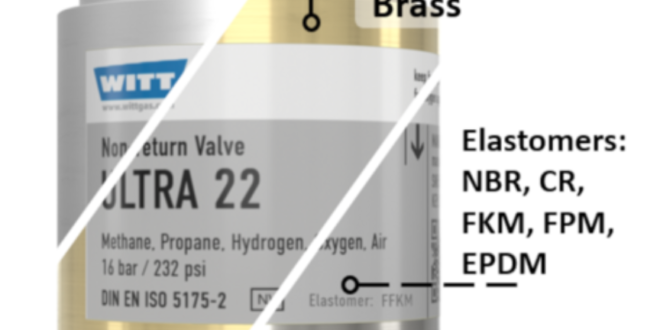
WITT Gas Controls’ engineering team collaborated closely with the customer to map out operational parameters and performance targets. The resulting solution was a specialized iteration of WITT’s established non-return valve: the ULTRA 22.
To minimize pressure drop and allow unrestricted airflow, the ULTRA 22 modifies WITT’s ULTRA 20 model by removing the inlet filter. Key advantages include:
● Flow-Optimised for Minimal Pressure Drop: Central to the ULTRA 22 is a valve assembly designed for an exceptionally low opening pressure of approximately mbar (0.058PSI). This design enables the ambient air to flow with minimal resistance, enhancing the fuel cell system’s efficiency and extending forklift run times.
● Leak-Proof Architecture: The valve’s mechanism, combined with high-quality elastomer sealing, delivers a robust barrier against reverse flow and leakage. Each batch of the supplied valves underwent comprehensive testing to ensure consistent safety and reliability.
● Material Flexibility and Durability: The modular system allows for custom housing and sealing material selections to optimize hydrogen compatibility and ensure longevity in demanding industrial environments. Available materials include aluminum, brass, and stainless steel (1.4305 / AISI 303).
Through this tailored engineering, WITT Gas Controls offered more than a standardized component — it provided a solution precisely adapted to the manufacturer’s performance and operational requirements.
Supporting efficiency and growth
The implementation of WITT ULTRA 22 non-return valves delivered immediate operational benefits, starting with enhanced system performance. The valve’s ultra-low pressure drop maximized fuel cell output, allowing the material handling equipment to run longer, while its leak-proof design ensured the high safety standards required for major retail distribution environments.
This dependable component enabled the manufacturer to meet ambitious production goals and facilitate large-scale deployment across North America. It reliably provided over 10,000 units per year with a reliable supply of consistently high-quality valves, supporting high-volume production and market growth.
Building a path to sustainable operations
The adoption of hydrogen fuel cells in material handling systems points to a future of higher productivity and a reduced environmental footprint. Progress at scale in advanced energy technologies depends on the reliability and suitability of every component. Through the custom design and supply of the ULTRA 22 non-return valve, WITT Gas Controls meets the critical demands of safety, efficiency, and reliability. As demand for fuel cell-powered equipment accelerates, application-specific components such as the ULTRA 22 will play an essential role in enabling safe, cost-effective, and sustainable operations.
Norm Phelps is President, WITT Gas Controls.