Engineer News Network The ultimate online news and information resource for today's engineer
In data centres, direct-to-chip liquid cooling relies on fast-acting valves to regulate coolant flow and protect servers from overheating. Yet across server racks operating 24/7, the cumulative energy demand of continuously energised solenoid valves presents cost and sustainability challenges. However, Kick & Drop coil technology offers a solution to this inefficiency by using a high-power ‘kick’ to actuate the valve, followed by a low-energy ‘drop’ to hold position. The design can reduce energy consumption by up to 80%. Greg Wainhouse explains
In data centre management, cooling technology is essential to prevent servers from overheating, enabling them to optimise performance and maintain uptime. To achieve this, direct-to-chip cooling is the preferred method; heat passes from the server’s microchips into cold plates that sit directly on the surface of each chip. Coolant, typically a water-glycol mixture, flows through each cold plate, removing the heat through forced convection. It then flows via a manifold to a chiller or heat exchanger, and once cooled, it returns to the cold plate.
To prevent overheating, adequate flow of the coolant is essential, and to make this happen, solenoid valves are the typical choice. With the central processing units’ (CPU) load accelerating from idle to high demand in milliseconds, rapid flow reaction is vital to prevent overheating, and the quick response of a solenoid valve is vital to this process. While the electrical control integration of a solenoid valve enables an automatic response to a temperature sensor’s signal, their compact size also enables a close fit within the confines of a cold plate’s manifold.
Energy demands
Within a typical enterprise-level server, there could one or two CPUs per motherboard, plus up to eight graphics processing units (GPU), each requiring individual cooling. More complex servers could include tens of chips, each requiring cooling with their own dedicated cold plate and valves, while entire racks could host hundreds of valve manifolds. Across a large array of valves, energy use becomes a critical factor in cost management and sustainability.
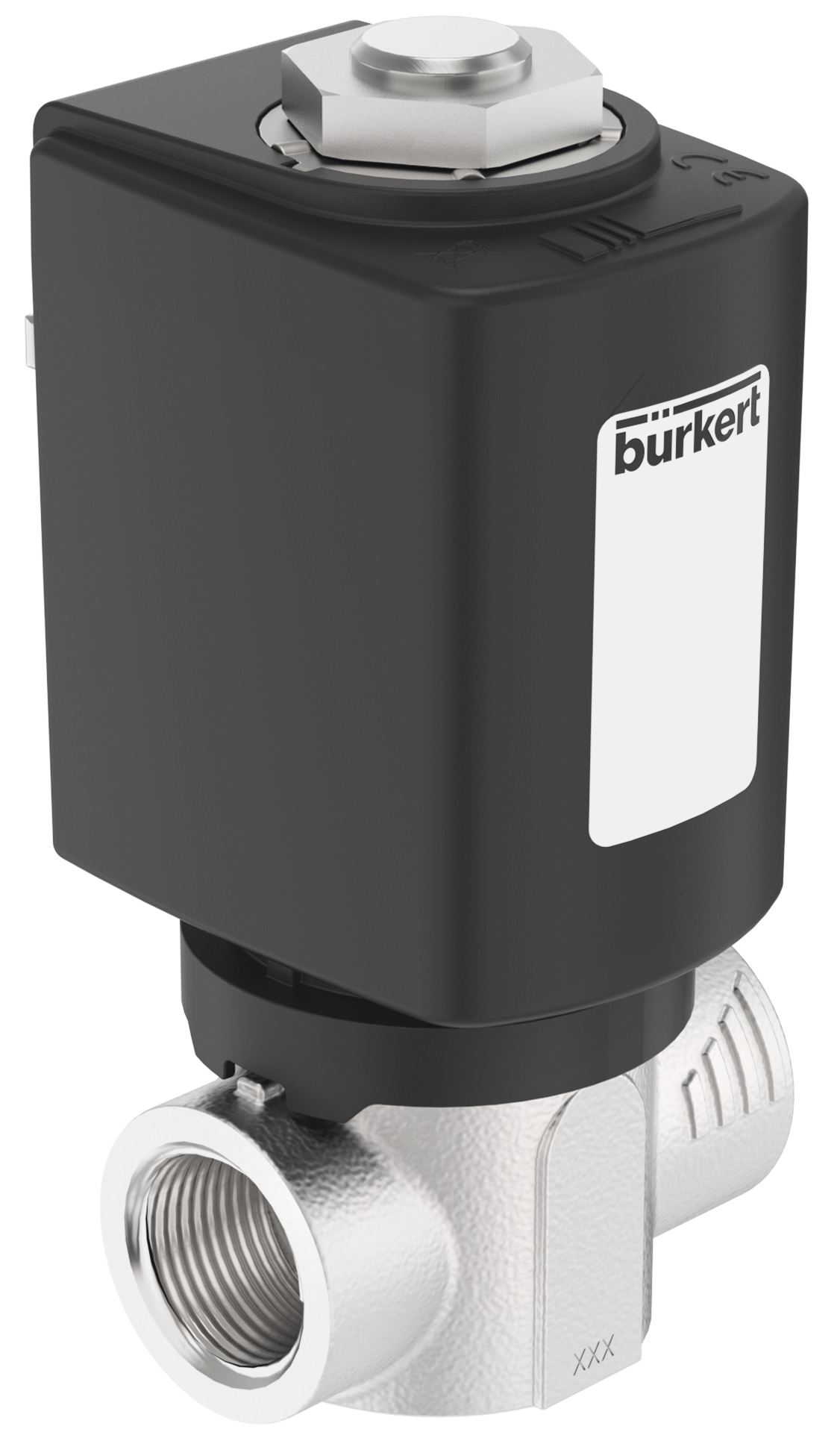
A standard solenoid valve comprises a single coil, producing a continuous magnetic field to move the valve into position and hold it in place. The valve must counteract forces to maintain its position, including the spring that would push the plunger back to its default position, as well as liquid pressure that could do the same. As a result, the valve must be continuously energised, relying on continuous power – and cost.
Kick & Drop
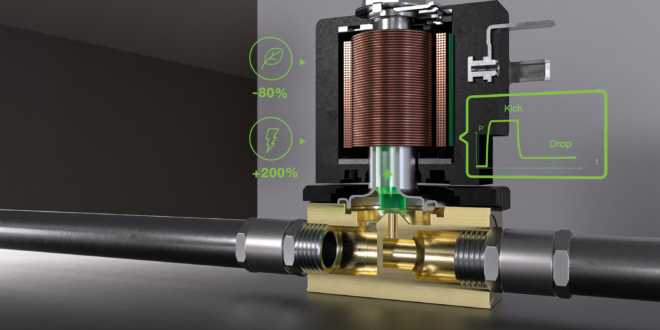
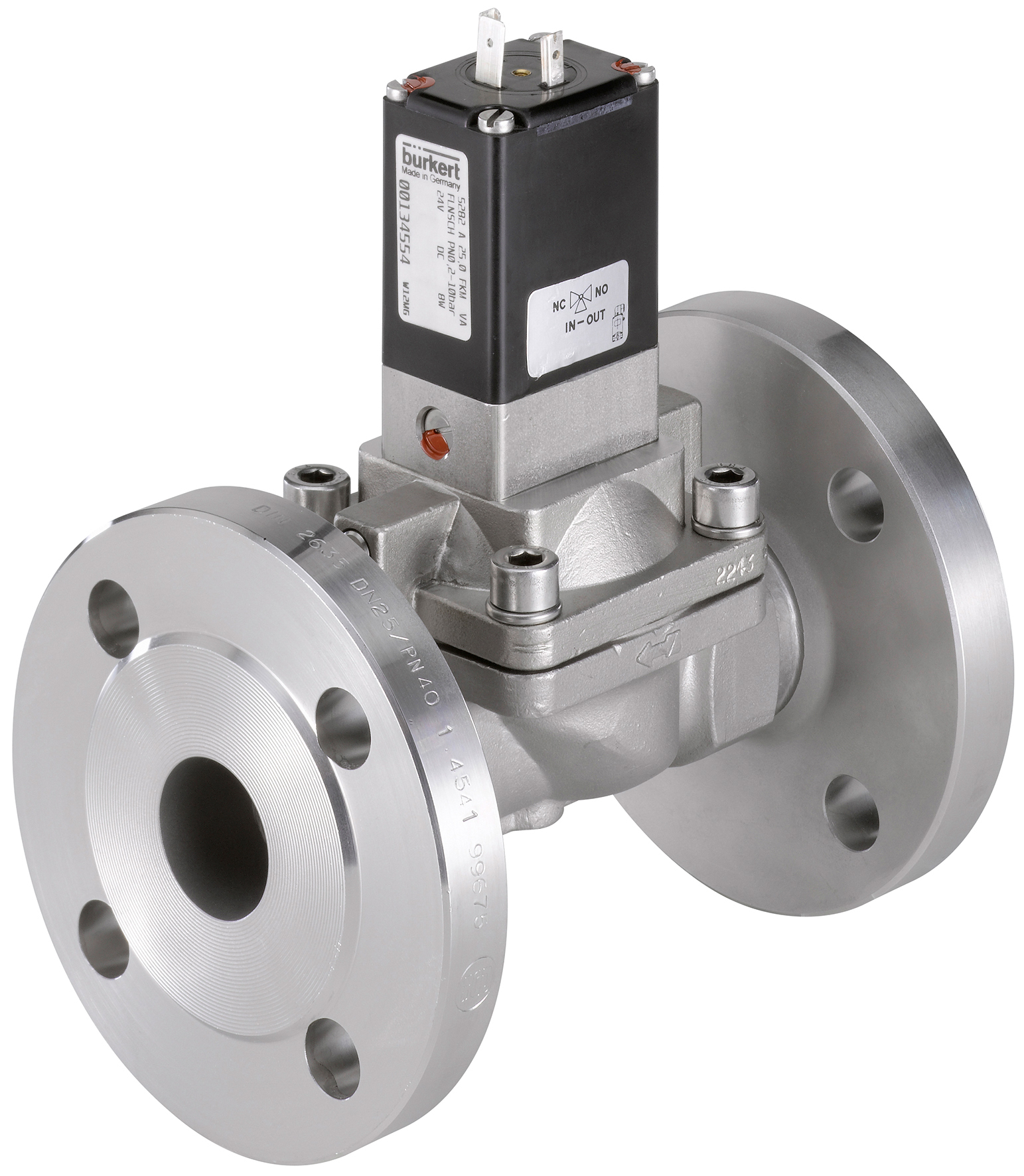
However, Bürkert’s Kick & Drop technology is an alternative that can cut the energy demand per valve by as much as 80%. The design includes two coil windings encapsulated in a single epoxy coil, with both coils powered in series. The device optimises energy efficiency by utilising a high initial voltage to move the valve into position: this is the ‘kick’. After just 500 milliseconds, a reaction quick enough to respond to the rapidly accelerating temperature load on a server chip, the required valve position is reached.
At this point, the second winding achieves the ‘drop’, holding the plunger in position. Crucially, it achieves this with a significantly lower voltage. In fact, the overexcited inrush winding generates a very high starting power, creating a strong magnetic field using 85% power to quickly move the plunger, but just 15% to hold it in position. This overexcitation can also achieve higher pressures compared to standard solenoid valve designs, delivering up to 200% more activation power.
Across racks of servers, each in operation 24/7, the potential for energy savings with Kick & Drop valve technology is significant. An effective way to determine a cost savings figure, as well as the carbon reduction that can be achieved, is via the Kick & Drop Energy and CO2 Calculator.
Increased durability
Importantly for valves managing server cooling, the Kick & Drop design is also more durable than standard solenoid valves as a result of improved thermal management, with the lower energy demand also meaning reduced heat emissions. With Kick & Drop coils, media heating is reduced with a maximum reachable temperature of 55°C. This is significant if preventing calcification is important, though purified water typically used in direct-to-chip systems, will prevent this. Crucially, though, this lower operating temperature also results in reduced thermal demand on critical valve components, increasing service lifetime and removing the potential for overheating.
An alternative to a Kick & Drop solenoid valve is proportional control, which is achieved with pulse width modulation (PWM). This system creates rapid on/off switching of the solenoid valve to control the average current and regulate the force applied to the plunger. While this set-up also reduces energy use compared to a constantly energised solenoid valve, it adds cost in hardware, and it’s more complex to set up. More significantly, the rapid switching can add vibration and audible noise. As well creating a less comfortable working environment for engineers on site, these effects can reduce system smoothness, and vibration is a challenge to long-term durability.

Long-term solution
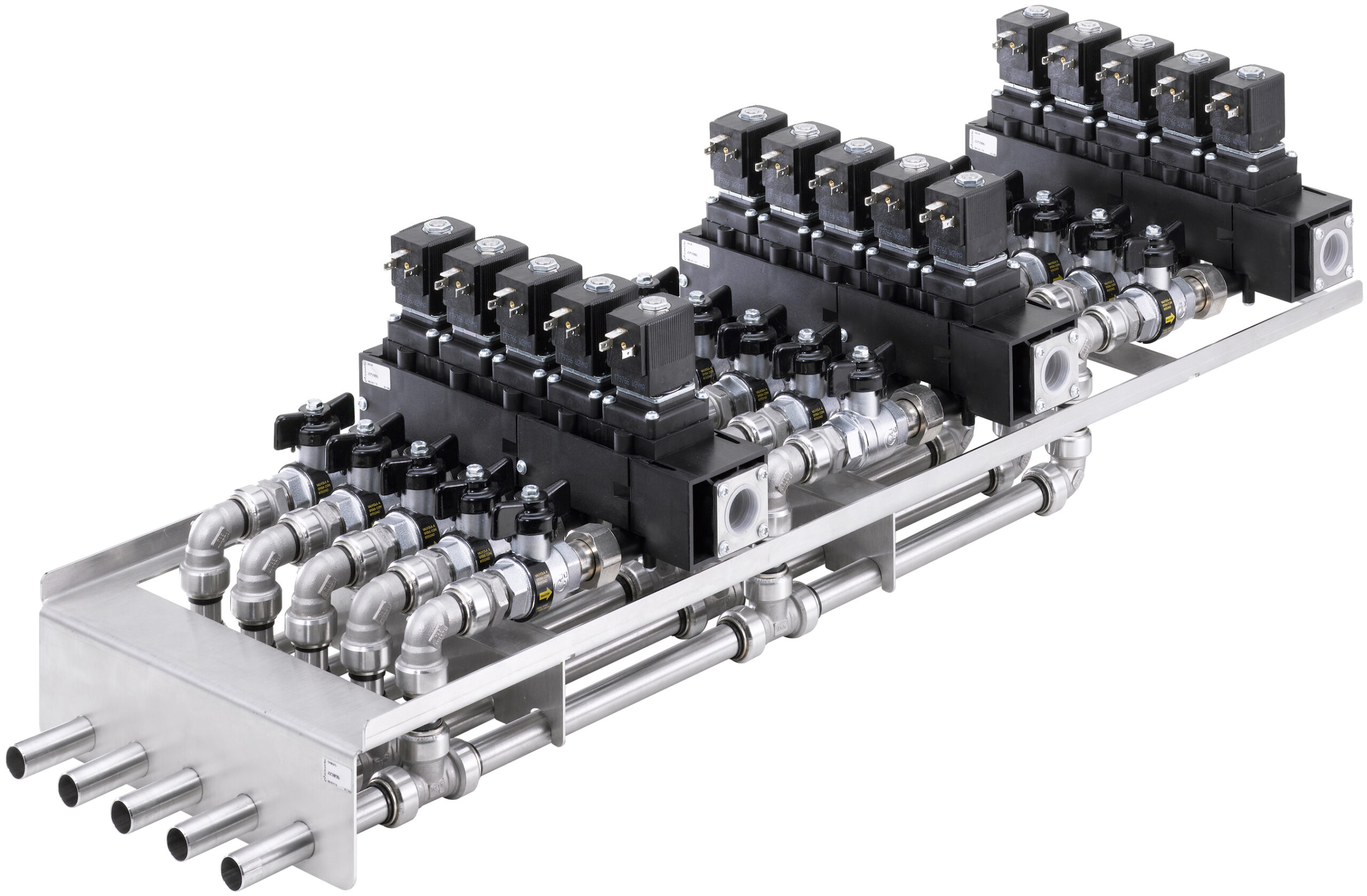
To host the valves, manifold integration is also required. Bürkert’s engineering team can create custom manifolds, including designs that integrate directly with a cold plate and direct-to-chip cooling system. Integrating valves directly into a customised manifold ensures a precise fit for optimised performance, while also enabling a more compact design. Streamlining the development process, manifold and valve integration also achieves a faster time to market rather than managing the coordination of two different partners.
As the global data centre market continues to expand, driven by AI workloads, cloud computing and society’s constant demand for digital connectivity, the need for efficient, direct-to-chip cooling is intensifying. To achieve this, solenoid valve technology will continue to play a critical role, delivering the automated, fast, and reliable flow control required to protect high-value processors operating under rapidly fluctuating loads. Yet with energy efficiency central to cost management and sustainability targets, Kick & Drop technology offers an effective way to reduce energy consumption, while also improving long-term reliability.
Greg Wainhouse is Bürkert’s Regional Business Development Manager for Industrial Water, North Europe.