Engineer News Network The ultimate online news and information resource for today’s engineer
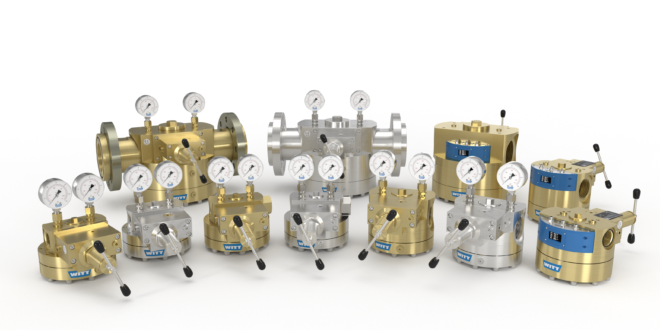
WITT Gas Controls has upgraded its proven dome pressure regulator product line with a next-generation design featuring optimized pilot pressure regulators. Engineered to maintain stable working pressure under widely varying flow rates and inlet pressures, the new regulators help operators maximise process reliability, ensure consistent product quality, and easily upgrade existing systems through simple retrofitting for demanding industrial gas applications.
Many conventional pressure regulators experience a drop in outlet pressure when flow rates increase. This can become a significant issue in industrial environments where multiple machines or workstations draw gas intermittently. When several consumers access the gas supply simultaneously, the available pressure can drop, and production processes may not be adequately supplied, potentially disrupting production and affecting product quality. WITT dome pressure regulators are designed to prevent this effect and now deliver even greater pressure stability through their enhanced design.
The integrated control pressure regulator has been redesigned to keep outlet pressure stable even under highly dynamic operating conditions. Users benefit from reliable, predictable gas pressure, while fluctuations caused by load peaks are minimized, even when consumers are switched on or off. As a result, machines and systems can continue operating consistently at their intended performance levels.
A key advantage: existing WITT dome pressure regulators can be upgraded with these improvements through retrofitting, allowing customers to improve performance without replacing their existing systems.
Unlike conventional spring-loaded regulators, WITT dome pressure regulators use the pressure of a control gas. This design enables a particularly sensitive and rapid response to pressure changes. Over many years, WITT has continually refined and advanced this already superior technology.
The result: precise control with a nearly flat pressure curve across the full flow range. The set pressure stays constant despite changes in flow rate, temperature, or inlet pressure, even with a differential of just 1 bar. This ensures stable operation without continuous adjustments.
WITT dome pressure regulators are also available in a SMART version. This combines the mechanical precision of the regulators with modern sensor technology and electronics. The systems continuously record and transmit key operating parameters such as pressure, temperature, and flow, enabling real-time monitoring.
This integration makes the regulators a key component of modern connected production environments, enhancing safety, efficiency, and supporting predictive maintenance strategies.
WITT offers dome pressure regulators made of brass or stainless steel for almost all industrial gases such as oxygen, nitrogen, argon, hydrogen, carbon dioxide and mixed gases. They are available individually or as a fully assembled set including control pressure regulators, pressure gauges and connections. The sets are delivered fully assembled, tested, and ready to use.
The regulators can be used for inlet pressures up to 40 bar and offer control ranges from 0.5 to 30 bar with maximum flow rates up to 15,000 Nm³/h for N₂ and Kv values up to 30. The special high-pressure models are designed for a maximum operating pressure of 300 bar and working pressures from 0.5 to 60 bar. Threaded and flanged connections from G 3/4″ to G 3″ / DN100 (DIN or ANSI) are available.
WITT dome pressure regulators comply with relevant standards and regulations, are CE-marked (except model 737), and meet the requirements of the Pressure Equipment Directive PED 2014/68/EU. An ATEX 2014/34/EU manufacturer’s declaration is also available upon request.