Engineer News Network The ultimate online news and information resource for today's engineer
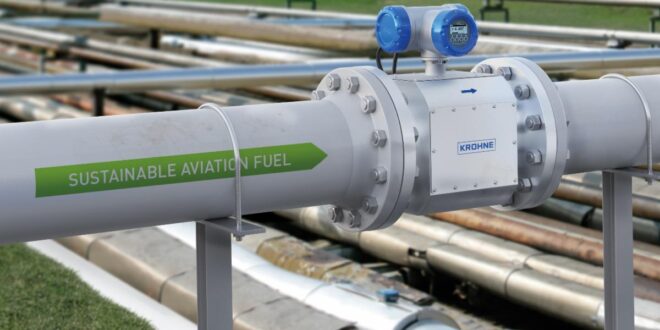
KROHNE‘s process instrumentation portfolio is engineered for the sustainable aviation fuel (SAF) market. The portfolio enables producers to manage challenging feedstocks, hydrogen service, and demanding process conditions ranging from pretreatment through the final downstream process. As SAF projects move from first-of-a-kind plants toward larger-scale deployment, engineers are under pressure to upscale the process while maintaining reliable, economically viable production assets.
The SAF value chain brings together two distinct domains: conventional oil and gas refining and the production of renewable feedstocks such as used cooking oil, edible oils, ethanol and biogas. This combination introduces process complexity across the entire process chain, including feedstock pretreatment, hydrotreatment and isomerization, hydrogen management and custody transfer. Each stage requires robust, application-specific measurement solutions to ensure safe, reliable and efficient operation.
“The SAF industry brings together two very different worlds,” says Yannick Farine, Industry Manager Biofuels and Bioenergy at KROHNE. “Success depends on understanding the behaviour of renewable feedstocks upstream while also meeting the demands of downstream refining. Our goal is to help customers optimise processes, reduce maintenance and build SAF plants they can rely on for years to come.”
KROHNE offers a full range of standard instrumentation for flow and level, complemented by specialized devices for the most demanding SAF applications. Building on its installed base in edible oils, ethanol, biogas, and its extensive experience in oil and gas, the company is combining its experiences that aligns instrument selection with the specific challenges of the SAF process at every stage.
A central element of this concept is the wider use of ultrasonic flowmeters in SAF service. Unlike many traditional technologies, ultrasonic flowmeters have no internal restrictions, capillaries or moving parts and are well suited to abrasive feedstocks, hydrogen-rich streams, high-pressure steam and other critical services. And as the cherry on top, remain affordable. Their ability to operate at temperatures up to 600C and at high pressures for both liquids and gases makes them one of the few technologies capable of delivering accurate measurement across a broad envelope of SAF conditions. Advanced noise-filtering in ultrasonic gas flowmeters also supports reliable hydrogen measurement, which can be challenging due to the gas’s high velocity of sound and demanding operating environment.
Where maximum accuracy and direct mass measurement are required, KROHNE emphasises single straight tube Coriolis mass flowmeters for abrasive feedstock and two-phase flow applications. Classic bent-tube designs can be susceptible to wear and tear, and risk performance issues under these conditions. Whereas straight tube configurations boast a full-bore design, which results in significantly less wear and so extend service life. Entrained gas management technology allows these meters to operate reliably under two-phase conditions at temperatures up to 400C, helping operators to maintain mass balance and yield monitoring even under challenging flow regimes. These capabilities are directly aligned with the mass-balance and yield-optimisation priorities identified for renewable diesel and SAF units in the attached measurement guidance.
KROHNE’s SAF approach also addresses the cost side of plant operation. Feedstock variability, hydrogen utilisation and maintenance needs are identified as major cost drivers in the SAF production chain, and the company’s strategy is to use robust, well-matched instrumentation to reduce unplanned interventions, extend equipment life and lower overall operating expenditure.