Engineer News Network The ultimate online news and information resource for today's engineer
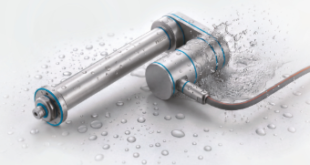
With an IP67 ingress protection rating, the new Rx3000-series incremental shaft encoders from ifm electronic can be used even in the wet environments that are often encountered in the process, pharmaceutical and food manufacturing sectors.
In addition, they offer a superb price/performance ratio and feature a design based on advanced magnetic sensing technology which means that they are exceptionally robust yet easily able to match the accuracy of photoelectric encoders.
Rx3000 encoders have been designed with versatility, ease of selection and ease of use in mind. They can be readily programmed with resolutions from 2 to 10,000 pulses per revolution and can provide outputs at either TTL or HTL logic levels. They also incorporate an IO-Link interface which allows efficient capture of data and diagnostic information as well as straightforward and intuitive parameterisation.
To ensure suitability for the widest possible range of applications, the encoders use standard fittings and are available in both solid- and hollow-shaft versions.
A choice of standard M12 connector, which can be positioned radially or axially, or a pre-wired connection is also offered.
Operating voltage range is from 4.75 to 30 V DC, and the maximum switching frequency is 1,000 kHz.
Accessories available to complement and further extend the versatility of Rx3000 series encoders include spring-disc and flexible couplings, synchro flange fastening clamps, measuring wheels and mounting brackets.