Engineer News Network The ultimate online news and information resource for today’s engineer
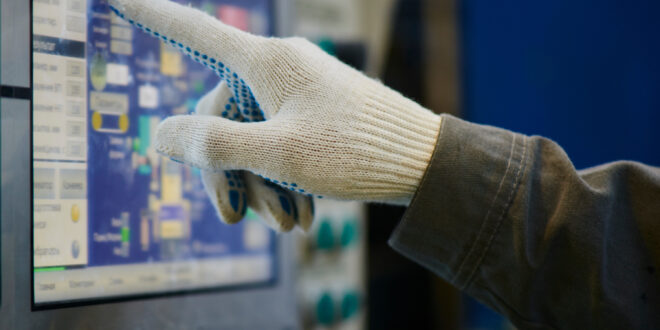
Ross Turnbull explains how haptic technology powered by custom silicon is bringing the sense of touch back to digital human-machine interfaces, helping operators work faster, safer and with less cognitive load. It is relevant right now as factories continue replacing physical controls with flat screens and it applies across industrial automation, transport and manufacturing
“To touch is to give life,” said Michelangelo. Though spoken in Renaissance Italy, the idea still resonates in the Digital Age. Across industry, traditional controls are being replaced by sleek digital interfaces, removing the tactile cues that once guided human action. Haptic technology, powered by custom ICs, is now restoring touch to human-machine interfaces.
In the earliest industrial machines, operators controlled equipment using physical inputs such as levers, knobs, buttons and switches. These are the first human-machine interfaces (HMIs). Acting as a direct link between humans and machines, they allowed users to guide operations, monitor responses and make adjustments in real time.
Over time, traditional controls have been replaced by digital panels and touchscreens. These modern interfaces allow for flexible layouts and programmable controls; however, this evolution has largely removed the tactile cues that mechanical interfaces provided.
Without this feedback, users must rely solely on visual or auditory signals. In demanding industrial environments, this can impact performance and safety, increasing cognitive load, slowing reaction times and making high-precision tasks more error-prone.
The digital revolution and industrial modernisation show no signs of slowing. This presents a key challenge for designers: how can they maintain intuitive, responsive and safe human-machine interaction?
Restoring the sense of touch
Haptic technology allows digital systems to recreate physical sensations, generating tactile responses that signal when an input has been recognised or when a machine has changed state. These effects range from a sharp, button-like click to more nuanced pulses or vibrations that guide user behaviour.
These sensations are created by actuators such as piezo elements, linear resonant actuators or electrostatic drivers that convert electrical signals into controlled motion. However, the quality of feedback depends not just on the actuator itself, but on how precisely these signals are generated and delivered. Even small deviations in amplitude, frequency or pulse shape can make sensations feel unnatural, reducing operator confidence and precision.
To maintain natural, responsive feedback, haptic systems often rely on closed-loop control, precise waveform shaping and real-time adjustment. These features ensure that each tactile pulse aligns with human expectations, even under varying conditions or in demanding environments.
As digital interfaces replace mechanical controls, this capability is becoming increasingly important. Traditional levers, knobs and switches communicated through movement and resistance; flat touch panels do not. Haptics restore that missing layer of communication, providing users with a physical confirmation of their actions and a clearer sense of how the machine is responding.
In industrial operations, this has immediate benefits. Inputs can be confirmed without relying entirely on visual cues, which helps reduce cognitive load and keeps attention on the task rather than the screen. It can also help improve reaction times and enable operators to perform high-precision actions with increased confidence.
Yet, creating reliable, expressive haptic feedback is still technically challenging without the right expertise. It demands low-latency signal generation, precise actuator control and consistent performance in harsh industrial environments. These requirements can push conventional electronics to their limits, calling for a more specialised approach.

Custom solutions
Delivering precise, reliable haptic feedback requires electronics that can generate signals with exact timing, amplitude and frequency, while remaining robust to temperature fluctuations, electrical noise, and continuous operation.
Standard, off-the-shelf components often struggle to meet these demands. This is because they typically rely on multiple discrete chips to perform the necessary functions, which increases latency, complicates circuitry and makes it difficult to integrate haptics into compact, space-constrained panels.
To overcome these limitations, application-specific integrated circuits (ASICs) provide a unique solution. These purpose-built chips consolidate waveform generation, signal conditioning, actuator control and power management onto a single silicon die. Consolidating these critical functions onto a single chip allows ASICs to eliminate inter-chip communication delays and synchronisation issues.
Integration ensures that signals can be delivered with millisecond-level precision, keeping amplitude, frequency and pulse shape carefully controlled; while minimising even subtle deviations that could make feedback feel unnatural or inconsistent.
It also enables advanced on-chip features. Memory and processing resources can implement sophisticated waveform-shaping algorithms, closed-loop feedback and real-time error compensation. This allows the system to continuously adjust tactile outputs in response to actuator variation, temperature shifts or electrical interference, without compromising latency or precision.
For operators, the benefits are significant. Consolidated into sleek digital panels, these systems deliver a new level of tactile feedback far beyond the use of mechanical controls, allowing users to confirm inputs directly through touch. This reduces cognitive load, sharpens reaction times and supports more precise, confident operation. By tightly synchronising signal generation, actuation and monitoring, ASICs ensure consistent, reliable performance even in demanding industrial environments with heat, vibration or electrical noise.
ASICs bridge the gap between human intent and machine response, giving digital interfaces a sense of touch that feels natural and immediate. They enable operators to interact with machines confidently, safely and efficiently, even under demanding conditions, transforming technology from a purely visual tool into an extension of human action and perception
Ross Turnbull is Director of Business Development at application-specific integrated circuit (ASIC) specialist Swindon Silicon Systems.