Engineer News Network The ultimate online news and information resource for today's engineer
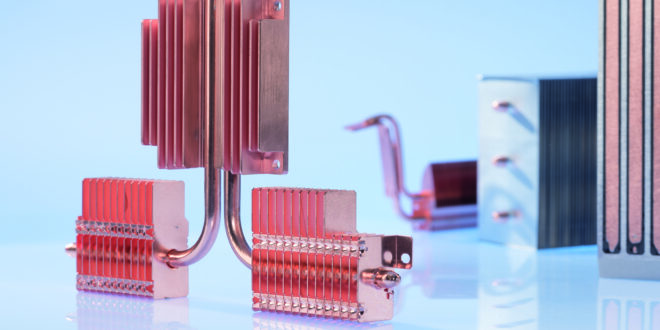
More is not always more. As CPUs grow more powerful, high-density cooling becomes increasingly important. Heat pipes are a sought-after solution in this area. Heat sink manufacturer CTX Thermal Solutions shows that their performance can only be increased by keeping an eye on the overall system.
In industry, PCs have become important pillars of automation. In addition to high clock speeds, they require robust performance from their CPUs (Central Processing Units). They must be durable enough to last ten to twenty years, function in ambient temperatures of -40 to +85°C, and withstand stresses exerted on them by, for instance, vibrations. The quick dissipation of the power losses, which can reach between 35 and 65 W, is therefore of vital importance. CTX Thermal Solutions manufactures heat pipes for cooling CPUs used in industrial PCs. When given the right design, their performance can be optimally exploited in the tightest of installation spaces.
Heat pipes are an well-established heat conductor, especially in industry. They dissipate high power losses from the hotspot at a very fast rate. They are low-maintenance and work as a passive cooling solution in a dust-proof closed IPC housing. These properties are derived from their principle of operation. A heat pipe is a closed system consisting of a copper tube holding a cooling medium. Where this medium heats up, evaporative heat is generated, lowering the pressure inside the tube. The pressure gradient causes the steam to flow to the colder part of the heat pipe, where it condenses and releases the heat to a heat sink. The inner capillary structure of the tube transports the liquid back to the CPU against the force of gravity. Working independently, the passive cooling system does not require external water pumps, piping or fans.
Heat pipes offer a high degree of design freedom. This makes them suitable for the tight installation spaces commonly found in PCs. More powerful CPUs do not necessarily require additional heat pipes. It is an interplay of several factors which CTX tailors precisely to the available space. The first decisive factor is how much heat a single heat pipe can transport. This is largely determined by their diameter, length, and capillary structure as well as by their design for unhindered heat transport. CTX names the installation position of the heat pipe as the second decisive factor. A vertical arrangement can improve the performance of a heat pipe: If its evaporator is seated below the condenser, it supports the return flow of the operating fluid through gravity. Regardless of this, the crucial factor in minimizing thermal resistance is to achieve the best possible thermal contact between the heat pipe, heat source, and heat sink.
More pipes usually also mean an increase in the number of heat transfers and a rise in thermal resistance. Consequently, such an expansion always requires an adjustment of the heat sink and the routing of the airflow. In this way, evaporation, heat transport, condensation and return flow remain in balance.
CTX takes charge of the application-specific design of heat sinks according to heat dissipation requirements, installation space, and ambient conditions. In a thermal simulation, the manufacturer reviews the performance data and, if necessary, optimizes the cooling performance by tweaking the design or material. Aside from these heat pipes, the manufacturer makes all other standard heat sinks such as extruded profile and liquid-cooled heat sinks. What is more, CTX also develops and manufactures customized cooling solutions.