Engineer News Network The ultimate online news and information resource for today's engineer
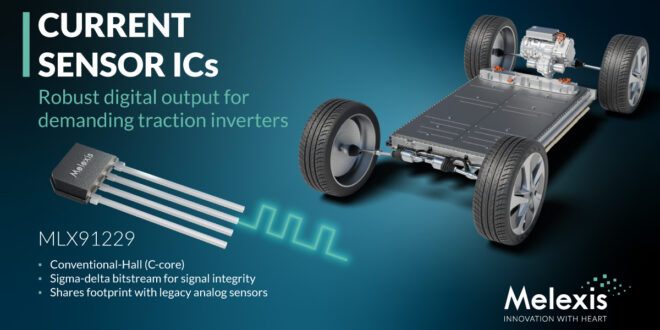
Melexis unveils the MLX91229, a conventional-Hall current sensor featuring a sigma-delta digital output to improve signal integrity in electrically noisy environments. Supporting current sensing from 200A to 2000A, the new IC is optimised for traction inverters and other automotive systems where local power electronics typically disrupt standard sensor transmissions.
As electrified powertrains continue to evolve toward higher voltages and faster switching technologies such as silicon carbide (SiC) and gallium nitride (GaN), the electromagnetic environment within vehicles is becoming more challenging. These conditions can introduce disturbances along the signal path between the sensor and the microcontroller (MCU), particularly in systems where longer PCB traces or wiring are required. While analog current sensing remains widely used and effective, ensuring signal integrity in these environments can require careful design and multiple development iterations.
The MLX91229 addresses these challenges by shifting the signal transmission from the analog domain to a digital domain. In conventional analog implementations, the measured current is represented by small voltage variations, meaning any disturbance coupled into the signal path directly translates into measurement error. By contrast, the MLX91229 encodes the measured current into a sigma-delta bitstream, where information is carried through the density of digital pulses rather than absolute voltage levels. This creates an inherent noise margin, allowing the signal to tolerate disturbances during transmission without significantly impacting the reconstructed measurement at the MCU.
By maintaining signal integrity between the sensing element and the receiving MCU, the device helps reduce the impact of noise introduced along the signal path. This is particularly relevant in traction inverter systems, where high currents and fast switching events generate significant electromagnetic interference (EMI) and place increased pressure on PCB design and signal routing.
Furthermore, as the MLX91229 shares the same footprint as existing analogue Hall-effect solutions, it allows engineers to easily evaluate digital output sensing without significant changes to system layout. The sigma-delta output also provides flexibility at the system level, enabling engineers to select demodulation strategies that balance bandwidth, noise, and response time according to application requirements.