Engineer News Network The ultimate online news and information resource for today's engineer
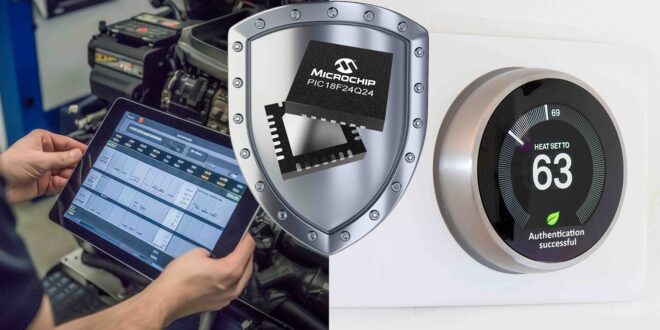
More and more everyday items are connected to the cloud — from cellphones and vehicles to smart thermostats and home appliances. With this rise in connectivity, the need for advanced security measures at the chip level, protecting both firmware and data, is critical. To defend against current and ever-expanding security threats, Microchip Technology has launched the PIC18-Q24 Family of Microcontrollers (MCUs).
To counter the threat of maliciously reprogramming a device in an embedded system, PIC18-Q24 MCUs introduce the Programming and Debugging Interface Disable (PDID) feature. When enabled, this enhanced code protection feature is designed to lock out access to the programming/debugging interface and block unauthorised attempts to read, modify, or erase firmware.
“System security is only as strong as its weakest link. Any programmable component can be vulnerable, and it is essential to implement enhanced protection features to prevent potential hacks,” said Greg Robinson, corporate vice president of Microchip’s 8-bit MCU business unit. “The PIC18-Q24 family of MCUs from Microchip are designed with advanced security in the forefront, to help customers combat threats at the system’s foundation.”
Because many secure systems often connect and communicate with a wide variety of sensors, memory chips and processors, the PIC18-Q24 MCUs feature Multi-Voltage I/O (MVIO). This feature eliminates the need for external level shifters and allows the MCUs to interface with digital inputs or outputs at different operating voltages. In addition to reducing board complexity and Bill of Material (BOM) cost, MVIO makes PIC18-Q24 MCUs especially well-suited as system management processors, performing monitoring and telemetry for a larger processor. These seemingly routine tasks are typically most vulnerable to potential hackers as they try to gain access to embedded systems.
The PIC18-Q24 family is also enabled with the option to have an immutable bootloader for applications that want a secure way to upgrade firmware.