Engineer News Network The ultimate online news and information resource for today’s engineer
As the robotics sector steadily moves from science fiction to factory floor, a new generation of humanoid robots is emerging to reshape industry, healthcare, and daily life. These machines are designed to do more than automate – they are built to move like us, work alongside us, and, at times, even stand in for us
Yet replicating human motion is not just a question of software and AI. It starts at the core components that enable this movement, with actuators and motors that combine compact size, lightweight design, and remarkable performance.
The rise of humanoid robotics
The idea of a humanoid machine has fascinated engineers, scientists, and storytellers for over a century, appearing in literature and early cinematic visions of the future long before the technology existed to make them real. Early attempts at humanoid robots in the mid-to-late 20th century were largely experimental, often limited to slow, rigid movements and basic programmed routines.
Since the turn of the millennium, however, a combination of breakthroughs in AI, computing, motion control, and materials science has brought the concept within reach. Today, humanoid robots are being developed with increasingly sophisticated capabilities: they can walk, balance, manipulate objects, and respond to voice commands or sensory feedback.
The purpose of this form factor is not simply to mimic the human body for its own sake. It allows these robots to interact with human environments, designed around our size, tools, and workflows, without needing extensive changes to infrastructure. That makes them well-suited to working alongside people, whether on production lines, in warehouses, in healthcare settings, or in the field.
Preparing for harsh environments
Many of today’s robotics applications are destined for highly controlled environments like warehouses or hospitals. However, as the technology matures and its capabilities grow, there’s a very good chance that tomorrow’s systems may need to walk the ocean floor, enter radioactive zones, or carry out maintenance in the vacuum of space.
In many of these environments, human workers would face unacceptable risks from heat, pressure, radiation, or isolation. Humanoid robots and exoskeletons offer a way to extend human capability into these hazardous zones, performing tasks remotely, reliably, and – vitally – without exposing human operators to danger.
These scenarios demand more than smart AI; they require mechanical systems engineered to endure the extremes. Portescap is already well-prepared for these scenarios, however, as it has extensive experience in building motors for extreme conditions, such as high heat, chemical exposure, vibration, and more.
While many robotic applications are still pre-commercial, Portescap is already developing solutions that can handle these tough operating conditions. With sealing, insulation, and specialised materials, the company is ready to support OEMs as their applications move off the lab bench and into the field.
Making hands work
One of the key requirements of any humanoid robot is the ability to interact with its environment in the same way a human would. As such, it’s vital that they have functional hands.
Achieving this, however, is not necessarily a simple task.
Although we often take it for granted, the human hand is a marvel of engineering, one that’s capable of delicate manipulation, strong grip, and complex motion, all in a compact, adaptable form. This means that any robotic replica must be small enough to fit inside human-like form factors, strong enough to grip and lift weight, and smart enough to know just how much of that strength to use.
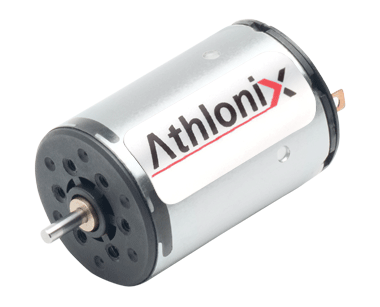
To meet this challenge, Portescap offers a wide portfolio of motor topologies and technologies. Cylindrical motors, shaped like slim batteries, can be embedded in fingers or palm area. Flat motors, meaning with short axial distance, offer high torque in compact packages for wrists or arm integration. Crucially, the company also provides brushed DC, hybrid stepper, and brushless DC options (including both slotted and slotless designs), helping developers strike the right balance of speed, torque, smoothness, and efficiency for each axis of motion.
But components alone do not make a system. The company works directly with roboticists, guiding design teams through motor selection, integration with gearheads and encoders, and performance optimisation to achieve specific motion goals. Whether an OEM needs fast, high-volume gripping or smooth, multi-articulated gestures, Portescap can configure a solution that fits the form and delivers the function.
Bringing bionics to life
Humanoid robots are not the only application for this kind of solution, however. Perhaps the most immediate and transformative impact of robotic hand development instead lies in prosthetics.
Portescap’s technology is already powering a new generation of bionic limbs that combine functional grip with intuitive control. These solutions go beyond raw motor specs, drawing on a deep understanding of cost, weight, and patient ergonomics.
Prosthetic developers often target around 80% of human hand dexterity, with 10-20 basic motion patterns. These designs must be lightweight, durable, and efficient, while remaining affordable for cost-sensitive markets. Portescap’s experience in both premium and value-engineered designs makes it well suited to this space.
From proof-of-concept to scaled production
Across the industry, OEMs are racing to prove the value of next-generation robotics. Demonstrator units and pilot projects are being used to unlock funding, attract strategic partners, and secure long-term market positions. That means motion system partners must be able to deliver quickly, reliably, and flexibly.
Portescap supports this full journey. The company can provide small quantities for R&D testing and validation, then take advantage of Regal Rexnord’s global reach and engineering expertise to scale seamlessly to support commercial launches, with lead times and production infrastructure already proven in demanding sectors like medical devices and aerospace. This makes it not just a component provider, but a long-term platform partner.
This scalability also enables cost-effective iteration. Customers can test several configurations or gear ratios in parallel, then down-select based on actual test data. A global support network helps manage this process efficiently, reducing development risk and time to market.
As robotics moves toward real-world deployment, success will come down to more than innovation. It will require motion solutions that are engineered precisely, delivered reliably, and scaled effectively.
From form-fit options and technical expertise to production agility and application support, Portescap offers everything OEMs need to bring humanoids and exoskeletons to life. In a field where form follows function, the company is ready to power what’s next. And as part of Regal Rexnord, it does so with the strength and support of a global organisation, combining local expertise with worldwide reach to help OEMs turn ideas into fully realised, market-ready solutions.