Engineer News Network The ultimate online news and information resource for today’s engineer
Epoxy grout plays a critical structural role in industrial equipment foundations by enabling effective load transfer, absorbing vibration, and maintaining alignment, which helps reduce wear, prevent failures, and extend machinery life. Proper selection and installation are essential, as high-performance epoxy grouts significantly improve vibration control, reliability, and long-term operational efficiency compared to traditional materials. Dr Pegah Faria shows how advanced epoxy grout solutions improve equipment reliability, reduce vibration-related wear, and minimise costly downtime in heavy machinery operations
Precision epoxy grouting is a critical element in the long-term reliability of rotating equipment foundations. Acting as the structural interface between machinery and its supporting concrete, epoxy grout enables effective load transfer, vibration control, and alignment stability. Rather than functioning as a rigid filler, the grout–foundation–equipment assembly must be treated as an integrated load-transfer system if predictable vibration performance and long service life are to be achieved. Understanding common vibration challenges, material behaviour, and the role of epoxy grout is essential for mitigating vibration-related degradation over time.
Common vibration challenges in heavy machinery foundations
The foundation system governs how static loads, dynamic forces, and thermal movement are transmitted from rotating equipment into the supporting structure. Even minor deficiencies at the foundation level can amplify vibration throughout the machine, accelerating wear and reducing reliability. In industrial environments, vibration often acts as a force multiplier, intensifying bearing wear, seal damage, bolt loosening, and structural fatigue.
Typical vibration-related challenges include micro-movement at the grout–baseplate interface, gradual loss of alignment, anchor bolt loosening, and fatigue cracking caused by continuous dynamic loading. While equipment may be properly aligned at startup, vibration can progressively degrade foundation interfaces when bearing area is inconsistent or when grout deforms under sustained load. The result is higher maintenance demand, reduced operating efficiency, and increased risk of unplanned outages.
Uncontrolled vibration rarely causes immediate failure. Instead, damage accumulates over time, eroding precision, increasing mechanical stress, and shortening equipment life. For this reason, foundations should be viewed as performance-critical elements in an asset reliability strategy rather than passive supports.
How foundation materials absorb vibration
Rotating equipment foundations typically consist of steel, concrete, and epoxy grout, each with distinct vibration-response characteristics.
Steel, with its high modulus of elasticity, transmits vibration efficiently but absorbs very little energy. Concrete provides modest damping capability, improving slightly on steel. Epoxy grout, however, dissipates vibratory energy far more effectively — approximately 30 times that of steel and six to ten times that of cementitious materials. This ability to attenuate vibration reduces the transmission of dynamic forces into the foundation and surrounding structure, stabilizing the system and slowing vibration-related degradation.
The structural role of epoxy grout in foundation reliability
Effective vibration control relies on several interrelated principles:
- Uniform load transfer to eliminate point loading
- High bearing area to limit micro-movement
- Low creep to preserve dimensional stability
- Controlled stiffness to absorb dynamic loads
Creep resistance is particularly important because alignment loss is almost always progressive. Small dimensional changes at the grout–baseplate interface can gradually push machinery outside tight tolerances, increasing vibration, heat generation, and maintenance requirements.
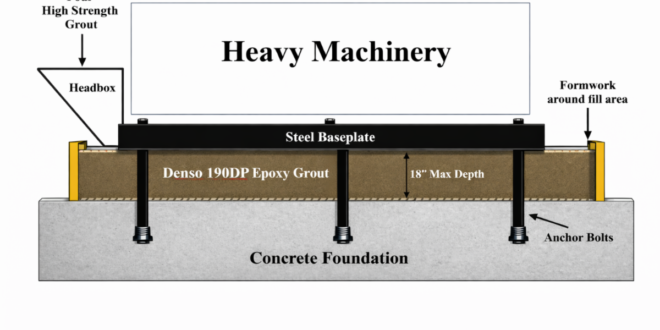
Epoxy grout functions as the structural interface between the baseplate and concrete foundation. When properly selected and installed, it maintains equipment position, transfers static and dynamic loads, and protects the foundation from vibration, chemicals, and environmental exposure.
Conversely, improper grout selection or installation can introduce voids, uneven bearing, excessive vibration transmission, and premature cracking — issues that can lead to misalignment, anchor failure, or structural damage.
Industry standards reflect this importance. API 686, the American Petroleum Institute’s recommended practice for machinery installation, states: “Unless otherwise specified, all machinery shall be grouted using epoxy grouts.” This guidance underscores the superior dimensional stability, bond strength, vibration control, and chemical resistance of epoxy grouts compared to cementitious alternatives.
Installation quality: a one-time, high-impact activity
While epoxy grout chemistry provides inherent advantages, performance depends entirely on proper installation. Epoxy grouting is a one-time, high-consequence activity — deficiencies cannot be corrected after placement.
Surface preparation and formwork are especially critical. Concrete must be sound, clean, and properly profiled, while steel surfaces should be abrasively prepared to remove contaminants. Formwork must be rigid and liquid-tight to ensure full grout contact and maximum bearing area. Inadequate preparation can result in voids, uneven load transfer, and long-term vibration amplification that may not be immediately visible but will surface as increased maintenance and reduced reliability.
Best practice includes holding a pre-job grout meeting to align stakeholders, clarify responsibilities, and review application-specific requirements. When epoxy grout fully fills the interface and bonds properly to prepared substrates, it preserves alignment and ensures uniform transfer of static, dynamic, and vibratory loads throughout the equipment’s service life.
Vibration-intensive applications
Denso 190DP Epoxy Grout was developed to maintain long-term alignment and foundation stability in heavy, vibration-intensive installations, particularly where deep pours, dynamic loading, and thermal exposure intersect. Unlike conventional epoxy grouts that emphasize compressive strength alone, 190DP is engineered around properties that directly influence vibration control and dimensional stability.
Key performance attributes include low-exotherm cure behaviour, deep-pour capability, high bearing area, and high creep resistance. The low-exotherm resin system and engineered aggregate blend allow monolithic pours up to 18 inches in a single lift without thermal cracking, eliminating cold joints and internal stress associated with multi-lift placements. High bearing area and strong bond to concrete reduce micro-movement at the grout–baseplate interface, minimising vibration-related wear and alignment loss.
Denso 190DP is also formulated for resistance to chemicals, oils, moisture, and corrosive industrial environments, protecting both the grout and the substrate from degradation that can amplify vibration over time. By addressing the root causes of foundation-related failures — vibration, thermal stress, long-term deformation, and environmental exposure, the product functions as a reliability tool rather than a commodity installation material.
Market drivers for advanced vibration-dampening grout solutions
Trends in rotating equipment design continue to increase demands on foundation systems. Larger and faster machinery, tighter alignment tolerances, and heightened focus on lifecycle cost are pushing engineers to prioritise long-term vibration control and foundation stability. As downtime becomes more expensive, even small efficiency losses caused by misalignment or excess vibration can significantly reduce mean time between failure (MTBF) and increase operating costs.
Although epoxy grout represents a small fraction of total project cost, it has a disproportionate impact on reliability, energy efficiency, and asset lifespan. Treating grout as a performance-critical structural material — rather than a commodity — helps control vibration growth, preserve alignment, and reduce total cost of ownership.
Conclusion: epoxy grout as a strategic reliability investment
For applications requiring long-term alignment precision, resistance to dynamic loading, and durability in harsh environments, high-performance epoxy grouts such as Denso 190DP provide measurable reliability benefits. When paired with proper foundation design and installation practices, advanced epoxy grout technology helps limit vibration-driven wear, reduce unplanned outages, and extend equipment service life.
When the objective extends beyond supporting equipment on day one to maintaining alignment and vibration control over decades of operation, epoxy grout should be specified as a structural, performance-critical component of the foundation system — not merely an installation material.
Dr. Pegah Faria is Technical Manager, Denso.