Engineer News Network The ultimate online news and information resource for today’s engineer
Electric motors are the workhorses of modern industry. From packaging and assembly to robotics and material handling, almost every motion depends on them. Studies suggest that motors account for around two-thirds of all electricity consumed in industry. Even small gains in efficiency therefore have a measurable impact — not only in energy costs but also in meeting wider environmental and regulatory goals.
Servo systems, however, present a distinct challenge. Unlike fixed-speed induction motors that run at a steady rate and can be easily classified and assigned a rating, servo motors operate dynamically. They accelerate, decelerate, reverse, and hold position thousands of times per hour. Their operating conditions vary constantly, making it difficult to assign a single efficiency rating.
Understanding where losses occur, and how to minimise them, is key to improving performance across the system.
Efficiency, at its simplest, is the ratio between electrical input and mechanical output. For servos, this value changes continuously with torque, speed, and duty cycle. To visualise this, engineers often use efficiency maps, which plot efficiency contours across the motor’s range. These clearly show that efficiency peaks around the rated operating point and drops sharply at low speeds and high torque.
While a jump from 94% to 97% efficiency may seem minor, this improvement effectively halves the energy lost. In multi-axis systems running around the clock, that difference can translate into significant savings over time – especially in regions facing rising electricity prices.
Of course, motor efficiency is only part of the story. The drive, cabling, gearing, and even the control strategy all influence how effectively electrical power becomes mechanical work.
The role of materials and design
A motor’s efficiency begins with its materials. High-grade silicon steels and segmented laminations help reduce magnetic losses, while advanced permanent magnets deliver strong torque density.
Of course, it isn’t practical to specify every servo to deliver the maximum possible efficiency. Rather, designers must balance several competing priorities. Low-loss materials can raise efficiency but may slightly reduce the ability to deliver peak torque. Similarly, finer laminations lower losses but can increase production complexity.
The challenge lies in optimising these factors to achieve reliable, cost-effective performance without over-engineering the product. For most applications, the best results come from focusing on the operating region where the motor spends most of its life, rather than chasing incremental gains at the extremes.
Practical steps to improve efficiency
Improving servo-system efficiency is rarely about a single change. A few core practices can deliver strong results:
Size motors and drives correctly. An oversized motor wastes power accelerating its own mass, while an undersized one runs hotter and less efficiently. Proper sizing requires realistic load data and duty cycles, not just safety margins. Using simulation or load testing to find the true operating profile can reveal where energy is being lost.
Match the winding and gearing to the application. Every motor has an optimal efficiency zone defined by speed and torque. Adjusting the gearbox ratio or choosing an alternate winding can move the operating point into that region.
Minimise electrical and control losses. Long cable runs cause voltage drops and heat generation, particularly in high-current systems. Keeping cables short, well-rated, and correctly shielded preserves power and signal integrity. Accurate drive tuning also matters: poorly tuned systems waste energy in oscillations or instability, especially in highly dynamic applications.
Simplify wherever possible. Complex systems are harder to optimise. Reducing unnecessary features and control layers can improve efficiency simply by cutting overhead. Systems that are easier to configure and maintain tend to stay closer to their designed performance over time.
Balancing performance, cost, and efficiency
Beyond a certain point, pursuing the last few percentage points of efficiency yields diminishing returns. The move from 70% to 90% can be achieved through sound design and materials; pushing from 95% to 97% often requires highly customized components, specialised cooling, or expensive materials. For many machine builders, that level of refinement adds cost and complexity without providing a proportionate benefit.
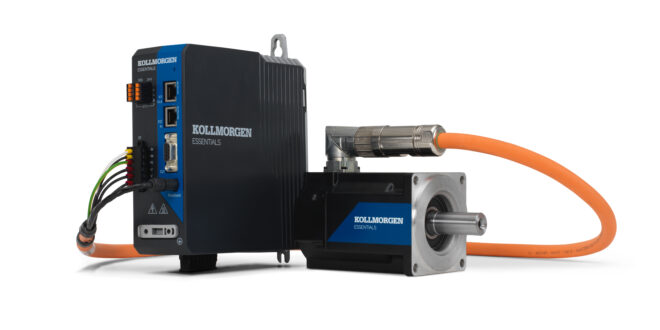
The practical goal is not absolute efficiency but optimal efficiency, where performance, reliability, and cost align. This principle shaped the development of Kollmorgen’s Essentials Motion System, which provides high-quality, high-efficiency motion technology in a streamlined format suited to the majority of applications.
The range focuses on a curated selection of pre-validated motor and drive pairings. Each combination is engineered to operate within high-efficiency zones under typical industrial loads, using the same premium materials found in Kollmorgen’s advanced platforms.
Simple setup also contributes to real-world efficiency. The Essentials drives automatically detect connected motors and load the correct parameters. Combined with auto-tuning and clear software guidance, this helps users reach optimal performance quickly, even without extensive servo experience.
Looking ahead
Energy efficiency in motion systems will only grow in importance over the coming years. Rising energy prices, stricter sustainability targets, and expanding international standards mean manufacturers can no longer treat efficiency as optional. It will increasingly define competitiveness, particularly as servo technology spreads into new sectors such as intralogistics and compact automation.
Future regulations may eventually extend to cover servo and variable-speed systems, encouraging more consistent measurement and comparison. Until then, engineers who adopt efficiency-driven design principles will be ahead of the curve – reducing costs and environmental impact while improving the reliability and performance of their machines.
Achieving that balance requires a clear view of both the technical and practical aspects of energy use. By applying sound design practices, using efficient materials wisely, and avoiding unnecessary complexity, machine builders can deliver systems that perform strongly, use less energy, and remain accessible to maintain and scale.