Engineer News Network The ultimate online news and information resource for today’s engineer
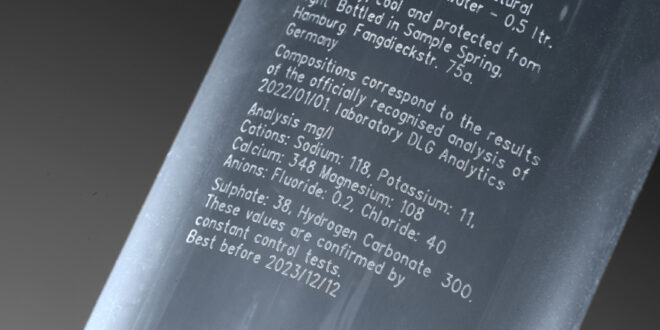
As sustainability pressures grow, the beverage industry is exploring new packaging strategies, including label-less bottles. With the ability to print logos, product details, and compliance information directly onto a bottle’s surface, brands can balance sustainability with visibility, explains Nitin Mistry
Consumer demand for eco-friendly packaging is surging, with the market for solutions designed to reduce environmental impact across their entire lifecycle expected to grow from USD 277.32 billion in 2026 to USD 536.16 billion by 2035.
While innovation in areas such as sustainable materials and recycling continue – accelerated by global regulations including the EU’s Packaging and Packaging Waste Regulation (PPWR) – brands face challenges in fulfilling eco-friendly goals. Labels are a prime example: often made from mixed materials, they complicate recycling streams.
With escalating demands for both brand engagement and regulatory information, the quality and durability of labels is critical. So how can brands balance visibility with sustainable objectives.
Label-free experience
By eliminating labels and printing directly onto PET, HDPE, or glass bottles, brands can simplify recycling and reduce material use. Critically, these goals can be achieved without sacrificing regulatory marking requirements.
Several beverage producers have already introduced bottles made from 100% recycled PET with embossed logos and laser-engraved product information, demonstrating that brand visibility can coexist with sustainability goals.
The label-free format is facilitated by direct-to-container coding technologies – including laser or inkjet. These technologies enable manufacturers to apply branding, traceability, and compliance information directly onto containers. Laser offers durable, near consumable-free coding, while inkjet provides flexibility for colour and contrast requirements where needed.
However, pilot programs have revealed challenges. It can be difficult to achieve high contrast and consistent legibility on PET under condensation. Furthermore, high-speed beverage lines require precise coding at thousands of bottles per hour.
While these technical hurdles shape the pace of adoption, it is important for brands to consider the new demands of label-less designs. Labels have traditionally been the canvas for storytelling, design, and regulatory text. Moving to direct coding and embossed features means rethinking how logos, typography, and design elements appear on the container itself. Some early adopters have experimented with embossed artwork and coloured caps to maintain brand recognition while eliminating labels. These creative solutions show that branding doesn’t have to disappear with the label.
Opportunities for brand owners
While challenges remain, the shift to direct-to-container – also referred to as direct-to-shape – branding is an opportunity for brand owners to lead on sustainability and differentiate in a crowded market. In the short term, hybrid solutions that combine partial labelling and direct coding provide the benefit of reduced material use and improved recyclability.
Building on this foundation by investing in improved coding technologies will enable brands to fully digitalise packaging. This will deliver premium aesthetics and enhanced customisation and serialisation, while maintaining speed, sustainability, and reducing manufacturing costs.
In the long term, brands can embrace smart packaging innovations – such as digital watermarks and smart QR codes – to enhance consumer engagement and traceability while eliminating labels entirely.
Forward-thinking brands can use this transition to strengthen sustainability credentials, build consumer trust, and future-proof packaging strategy.

Begin the evolution
Direct‑to‑container coding is beginning to redefine the way brands can balance identity with sustainability. Recent trials have shown that removing labels can significantly reduce carbon footprint and improve recyclability while also lowering manufacturing costs. In some cases, switching to embossed branding and direct coding saved several kilograms of CO₂ per thousand bottles, proving that sustainability gains are tangible.
Brands that delay investment could fall behind as regulatory requirements tighten and sustainability expectations continue to rise. Early adopters gain credibility, achieve compliance readiness sooner, and strengthen their sustainability positioning as consumers increasingly favour brands that lead on eco innovation.
Conclusion
Label-free packaging represents more than a design trend. It marks the start of a new era of brand communication and identity and underpins the next generation of environmental responsibility.
The tension between brand visibility and sustainability is real, but it’s also an opportunity for innovation. Direct-to-container coding technologies are advancing rapidly, and while the challenges of speed, readability, and aesthetics remain, the trajectory is clear.
For beverage producers, the question is not whether label-free packaging will become mainstream, but when. Brands have the chance to gain competitive advantage by exploring direct-to container coding and branding today.
Nitin Mistry is Global Account Manager, Domino Printing Sciences.