Engineer News Network The ultimate online news and information resource for today’s engineer
Hybrid vehicles are often seen as a smart compromise for the modern driver. They promise lower emissions, improved fuel efficiency and quieter running – especially in urban environments. For many buyers, they feel like a sensible step towards electrification without giving up the familiarity of a petrol engine.
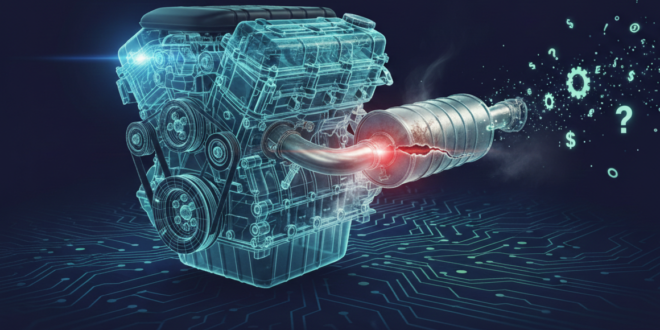
However, while hybrid technology brings clear advantages, it also introduces some less obvious challenges, especially when it comes to exhaust systems. In fact, garages and aftermarket manufacturers are increasingly seeing exhaust-related issues on hybrids appearing much earlier than many owners expect.
The impact of hybrid driving on exhaust systems
The key factor in these early exhaust issues is not exactly an issue with the hybrid technology itself, but rather its application. In most hybrid set-ups, the vehicle is designed to use the electric motor at low speeds and then activate the petrol engine when more power is needed – such as when accelerating heavily or moving at higher speeds.
One of the consequences of this is that in stop-start traffic and low-speed urban driving, hybrid engines frequently cycle off and on over the course of a journey. As a result, the exhaust system rarely reaches full operating temperature, and even if it does it rarely maintains it for very long.
That lack of sustained heat can have some unexpected consequences. Exhaust systems rely on reaching high temperatures to evaporate the moisture that inevitably builds up inside them. When they stay cooler for longer, condensation builds up inside pipes, silencers and catalytic converters. This isn’t a matter of a few droplets, either, but rather anywhere between 200ml and 500ml of water depending on the vehicle and the conditions. Over time, that moisture settles in the lowest points of the system, where it can sit and begin to slowly corrode the metal from the inside out.
This corrosion is not always obvious at first. Many drivers only discover the problem during a routine service or MOT, when thinning metal, weakened joints or patchy corrosion becomes visible underneath the vehicle.
Same issues, faster failures
The types of failures seen on hybrid exhausts aren’t new, as they are mostly just variations on the same issues engineers have dealt with for decades. What has changed, however, is the speed at which they occur.
Corrosion remains the most common culprit, but hybrids also place greater stress on flexible joints, welds and connection points. Frequent hot-cold cycling causes materials to expand and contract more often, leading to fatigue over time. Flex sections, in particular, can fail earlier as they cope with increased vibration and thermal movement.
Catalytic converters are also more vulnerable in hybrid applications. These components perform best when they operate at consistently high temperatures. In a hybrid, repeated heating and cooling cycles put additional strain on the internal ceramic substrate, increasing the risk of cracking or breakdown. When a catalyst fails, repairs can be unexpectedly costly.
The price of just the replacement part typically coming in at hundreds of pounds and potentially stretching into over a thousand pounds for more premium models. Once you add on labour and other costs, owners can be left with a rather unpleasant bill.
This issue is compounded even further by the fact that availability of original equipment parts is not always guaranteed. Several years of global supply chain issues and economic uncertainty means that some manufacturers can take months to deliver new parts. These kinds of delays can be especially painful for garages, as not only is it likely to result in irritated customers, but it can also result in a vehicle taking up valuable ramp space while waiting for parts to arrive.
How the aftermarket makes a difference
This is where the aftermarket plays a crucial role.
Klarius replacement exhaust components are developed and launched ahead of demand, ensuring that when hybrid vehicles begin to experience common failure points, parts are already available. Fast, reliable delivery helps keep vehicles on the road and prevents workshops from losing valuable ramp time while waiting for back-ordered OE components.
Just as importantly, the aftermarket can offer cost-effective repair options. In many cases, a full catalytic converter replacement is not necessary. Targeted repairs, such as flex sections or associated pipework, can restore function and compliance without the expense of replacing the entire assembly. This is useful at any time, but in the current economic climate, that flexibility matters more than ever.
Quality without compromise
There is still a perception that aftermarket parts are a step down from OE. In reality, quality comes down to engineering, materials and testing rather than branding alone.
That is why Klarius is always producing an industry leading quantity of new parts, with 300+ introduced each year. The R&D process includes benchmarking every new exhaust product directly against the Original Equipment design, investing more than £1m in R&D, vehicle testing and certification every year. Type approval (where applicable), ISO-9001 certified manufacturing, and rigorous quality control and CoP (Conformity of Production) Audits, all work together to ensure that durability, performance and compliance are built into Klarius’ products from the outset.
Despite worries over the impact electrification might have on the garage industry, it’s becoming increasingly clear that hybrid vehicles – sales of which are currently outpacing conventional electric vehicles in the UK – will require just as much or even greater support in terms of exhaust components. Rather than reducing demand, they simply change the way exhaust systems behave, and the way they need to be supported.
With the right parts, the right expertise and a trusted aftermarket partner, hybrid exhaust issues do not have to mean unexpected downtime or excessive cost.