Engineer News Network The ultimate online news and information resource for today's engineer
As global demand for printed circuit boards (PCBs) accelerates, thanks to greater automation in industry and the miniaturisation of devices, electronics companies are being reminded about the workplace health risks associated with certain production processes.
The manufacture and assembly of PCBs can result in harmful emissions being released into the working environment, so BOFA International is urging businesses to check that their extraction systems remain fit for purpose during this period of rapid growth.
“According to a recent analysis, the global PCB market is predicted to reach around USD80 billion by 2024 – this presents significant opportunities for companies but can also put pressure on production capacity,” says David Thompson, Business Development Manager at BOFA.
“So when businesses are planning for growth, we would advise them to ensure that their existing fume extraction systems are maintained in optimal condition and that any new investment in manufacturing includes the latest technology to remove airborne contaminants. In this way, extraction technology will help workplace environments stay safe for employees while contributing to achieving productivity goals.”
While the health risks associated with manual and automated soldering are widely understood, there are other processes in PCB manufacture and assembly that can also be a cause of concern.
For example, the batch marking by laser of PCB boards is key in traceability for the electronics sector, but the emissions resulting from lasering can include solid particles, liquid droplets or vapours/gases, and can be particularly hazardous to respiratory function, depending on the substrate and laser parameters.
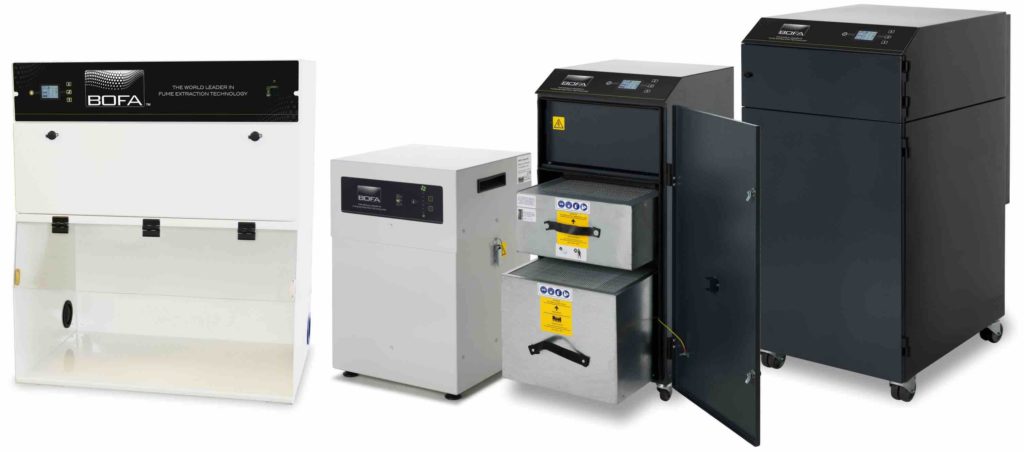
Another example is conformal coating, which protects PCBs from ingress of dust and moisture. This process is likely to involve organic chemicals (eg, cyclohexane, xylene, etc), which will give off hazardous fume and mist, but which can be properly controlled by BOFA filtration technology.
Many businesses apply coatings by means of aerosol sprays which use a propane/butane propellant, which aren’t particularly harmful, but can mask the smell of more harmful chemicals.
Said David Thompson: “BOFA solutions combat all these risks through multi-stage filtration technology that includes specialist activated carbon filters designed to capture specific chemical emissions.
“HEPA filters ensure a particulate filter efficiency of near 100% (99.997%) is achieved, contributing to compliant health protection while helping deliver the productivity gains that come from fume and dust free process lines.”
In the company’s experience, manufacturers are also embracing portable extraction technology alongside, or in place of, vent-to-air or centralised exhaust systems, to satisfy the requirements of agile working practices increasingly driving improved productivity.