Engineer News Network The ultimate online news and information resource for today's engineer
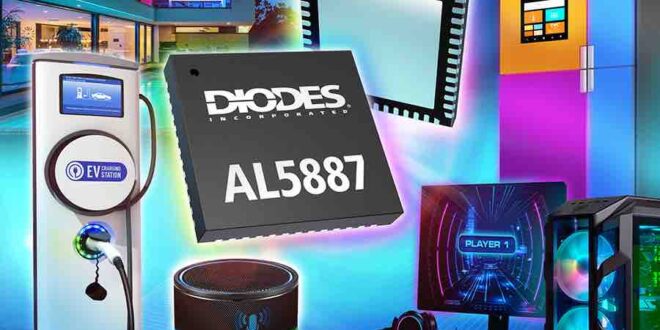
Diodes Incorporated announces its latest linear current LED driver, the DIODES AL5887. This product offers a simple way of driving numerous LEDs to enable complex colour mixing and different lighting patterns. It integrates both I2C and SPI interface options, providing maximum system design flexibility. Delivering a wide colour range and an extensive dynamic range of brightness levels, this device can be used in smart home appliances, electric vehicle charging stations, infotainment displays, IoT information indicators, and computing hardware.
The AL5887 has a total of 36 independent programmable channels and can drive up to 12 RGB LED modules or 36 single-colour emitters. It features an internal 12-bit pulse-width modulation (PWM) for color and 6-bit analog brightness control, which can be accessed through either SPI or I2C interfacing.
There are three programmable banks for software control of each colour, making it easier to program and set RGB lighting module patterns. Having an independent colour-mixing and brightness register per channel enables better colour-mixing schemes. The dimming function relies on a PWM duty cycle from 3% to 100%. Once the duty cycle goes below 3%, internal circuitry converts the output to analog dimming, maintaining linearity. By combining PWM and analog dimming functions, a dimming ratio greater than 100K to 1 can be achieved.
The AL5887 incorporates advanced diagnostics with fault-reporting functions. Its comprehensive set of built-in protection capabilities ensures reliable operation and continued safety—including both short-circuit and open-LED protection, as well as overtemperature shutdown. The pre-event overtemperature shutdown warning also results in earlier system protection.
Using the two external hardware address pins, up to four of these devices can be connected together in I2C mode. Inclusion of an internal 16MHz oscillator avoids the need for an external high-precision clock, reducing the overall bill-of-materials (BOM) cost.