Engineer News Network The ultimate online news and information resource for today's engineer
Tim Wischeropp makes the point that additive manufacturing (AM) has earned its place in production. Now it needs the quality infrastructure to match. Not more complexity. Not more dashboards. A backbone. A discipline. A simpler, more industrial way of proving (and improving) quality
Metal additive manufacturing has crossed an important threshold. It is no longer ‘promising’. It is working. Real parts. Real supply chains. Real responsibility.
And yet, in far too many production environments, the way we prove quality still looks like an early-stage experiment. Not because engineers are careless, but because they’re doing heroic work with tools that were never designed for industrial AM.
The best engineers I meet are not short on knowledge. They are short on time. They are trapped in a loop of manual documentation, spreadsheet archaeology, and post-mortem investigations. When a part fails, the first question is not ‘why did it happen?’ It is ‘where is the data?’.
This is not a small inconvenience. It is one of the main reasons AM still struggles to scale smoothly into serial production.
The quality myth AM needs to drop
There is a myth that keeps resurfacing in AM. If we add enough sensors, quality becomes automatic. It is an attractive idea. In-situ monitoring, AI, digital twins, all powerful concepts. But they do not solve the core production problem on their own which is reproducibility. Reproducibility is not a dashboard. It is a system.
In mature industries, quality management is not a ‘project’. It is infrastructure. It lives in the way data is captured, linked, controlled, analysed, and turned into decisions. AM will not become a dependable production technology by collecting more data. It will become dependable by making the right data usable, and by embedding disciplines like SPC into daily work.
Excel is not the enemy – it is the warning light
Let us be fair, Excel has been one of AM’s most important accelerators. It let teams move fast when software ecosystems were immature. The problem begins when Excel becomes the backbone. Spreadsheets are great for analysis, but they are terrible for relationships:
- this powder batch to that build job,
- this parameter set to that inspection trend,
- this post-processing route to that failure mode.
Those relationships are the heart of AM quality, and they simply do not survive scale when they live in human convention rather than a structured system. So, when I see a factory using spreadsheets to prove quality, I do not see incompetence. I see a signal: the operation has outgrown its information infrastructure.
Monitoring is not quality management
Another pattern I see repeatedly is organisations investing in process monitoring systems, then expecting monitoring to become quality management. Monitoring can be valuable. It can alert you to anomalies. It can support development. It can provide additional signals for process understanding. But monitoring alone does not give you:
- a controlled, auditable data model across powder → process → inspection,
- stability evidence over time,
- repeatable reporting for customers and auditors,
- or rapid root-cause analysis anchored in the full process chain.
In other words, monitoring can tell you ‘something happened’. Quality management tells you ‘it matters, here is why, and here is what we do next.’
If you use monitoring as your quality system, you often end up with the worst of both worlds, huge data volumes and still no consistent, queryable story of the part.
Make AM simpler with SPC
If there is one discipline AM needs to embrace more aggressively in production, it is Statistical Process Control (SPC). SPC is not glamorous, and that is kind of the point. It is how mature manufacturing stops reacting to defects and starts controlling variation. It is how you detect drift early, quantify stability, and improve processes based on evidence (not intuition and emergency meetings).
In AM, SPC becomes powerful when the data is not trapped in silos. When powder lots, builds, machine events, post-processing steps and inspection results are connected at part level, SPC stops being a quarterly analytics exercise and becomes a daily operating rhythm.
This is the future I am evangelical about, AM that feels less like a research lab and more like a reliable production line, not because we reduced complexity in the physics, but because we reduced complexity in how we manage evidence.
Why AM needs a digital quality backbone
In amsight we use a phrase that captures the shift, digital quality backbone.
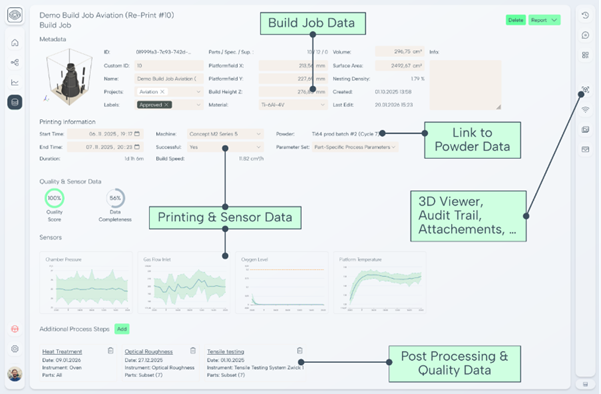
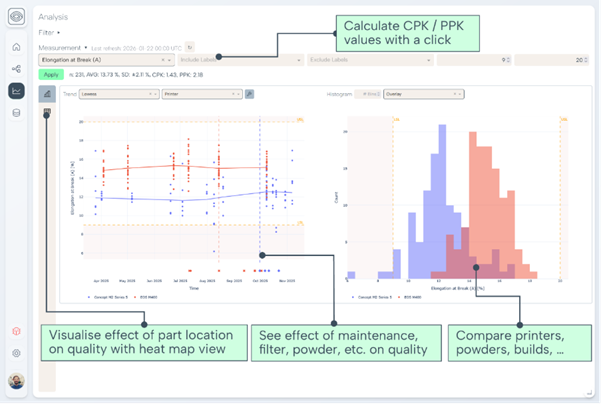
What we mean is simple. Production-level quality software that connects powder, process, and inspection data into one structured, reusable asset, so traceability, compliance reporting, SPC, and root-cause analysis stop being manual heroics.
Through our Production Monitoring, we facilitate the practical outcome: ‘catch problems before they become scrap’, with live KPIs, built-in SPC, and root-cause analysis in minutes.
On Reports & Analytics, the message is equally pragmatic: stop rebuilding reports from scratch; define templates once and generate them anytime, with analytics built in.
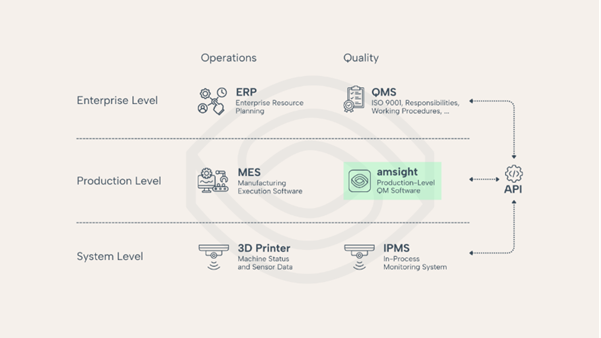
This isn’t about replacing ERP or MES. It’s about doing one thing exceptionally well, owning the production-level quality data model for AM so the rest of the stack can breathe.
The strategic advantage most people miss
Here is the non-obvious point. A quality backbone is not only about compliance, it is about competitiveness. When your AM quality data is structured:
- audits become faster and less disruptive,
- scrap reduction becomes systematic, not accidental,
- qualification moves from a painful ritual to a repeatable process,
- and scaling from five machines to 50 becomes a matter of expanding a system, not expanding chaos.
In high-stakes sectors (space, aerospace, medical, semiconductor supply chains) this is the difference between ‘AM is interesting’ and ‘AM is dependable’. And dependability is what unlocks volume.
Start small, but start properly
The mistake some organisations make is treating ‘digital quality’ as a multi-year transformation. It does npt have to be. A sensible approach is:
- Choose one product family or machine cluster.
- Connect the essential data sources (powder, build, post-process, inspection).
- Automate the boring pain first (documentation, standard reports, traceability).
- Add SPC and drift detection.
- Use real wins (fewer hours, fewer surprises, fewer scrapped builds) to justify scaling.
The goal is not digital for digital’s sake. The goal is production confidence.
Summary
If you take one provocation from this article, let it be this. If your AM quality story is still assembled in spreadsheets, you do not have a quality system, you have a coping mechanism.
That’s not a criticism. It is a call to maturity.
AM has earned its place in production. Now it needs the quality infrastructure to match. Not more complexity. Not more dashboards. A backbone. A discipline. A simpler, more industrial way of proving (and improving) quality.
And that is the shift we’re committed to driving.
The software covers the entire AM production chain – from powder to final part – enabling reproducibility, traceability, statistical process control, and efficient root-cause analysis. amsight supports manufacturers and AM service providers in meeting the stringent quality and documentation requirements of regulated industries such as space, aviation, defense, and medical technology.
Tim Wischeropp is CEO & Co-Founder, amsight. amsight develops software for data-driven quality assurance and analytics in industrial additive manufacturing.