Engineer News Network The ultimate online news and information resource for today's engineer
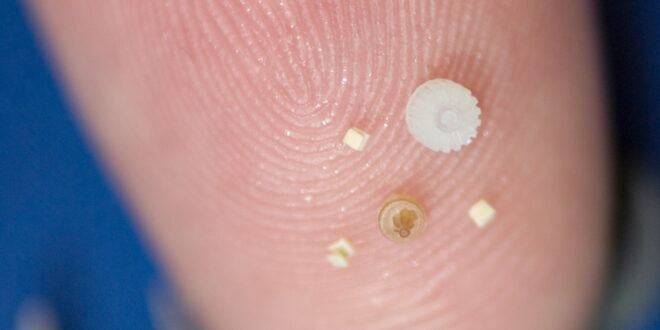
Brett Saddoris describes what is involved in making parts repeatably in their millions. The key in micro moulding is repeatability, and this is more than just the product of a good micro mould
In micro moulding, it is tempting to treat automation as something you ‘add later’. You make the tool, you dial in the process, you ship parts, and when volumes rise (or labour becomes a bottleneck) you start thinking about robotics, vision inspection, or packaging lines. That sequence works for many conventional moulded parts. For micro parts, it often fails.
At micro scale, the part is not the product, the system is the product. The mold and the press are necessary, but they are rarely sufficient. If you’re producing components measured in millimetres (or in fractions of millimetres) then how you handle the part, inspect it, orient it, and package it can be as critical to quality as the cavity itself. The smallest amount of static can turn a micro component into a projectile. A barely visible scuff can become a functional defect. A slight shift in handling can create a false inspection failure, or worse, a real one that goes undetected.
So when we talk about automation at Accumold, we are not talking about gadgets. We are talking about manufacturing architecture such as automation, inspection, and packaging designed as part of the process from the start, built specifically around the part and its end-use requirements. That ‘built from the ground up’ mindset is increasingly what separates micro molding that scales from micro molding that struggles.
Automation as a design solution
The most important idea to grasp is that micro moulding success is not just about ‘making parts’. It is about making parts the same way every time, at volume, while protecting the features that actually matter. And those features are often too small, too delicate, or too sensitive to survive a manufacturing flow that was designed for larger components.
That is why automation has to start early (often during part design and DfMM discussions), not after a line is already running. If a part will ultimately need to be inspected by camera, the geometry needs stable datums and reliable presentation. If it must be tape-and-reeled, it needs features that allow repeatable orientation and safe pick-and-place. If it’s insert molded, the insert needs controlled presentation, cleanliness, and confirmation of position before overmoulding.
None of that is nice to have. It is fundamental.
In practice, the right question isn’t ‘Do we need automation?’ It’s ‘What does the part require to be manufactured reliably?’
Handling becomes quality
In many manufacturing environments, part handling is treated as logistics. In micro moulding, it’s quality control.
Micro parts behave differently. They can cling, float, flip, or disappear. Static attraction can defeat gravity. Vibration can mis-orientate parts that were placed perfectly. A tiny speck of debris can become a reject in a system that must be clean. And once you move from hand handling to automation, you also introduce speed. Automation increases throughput, but it also increases the speed at which problems replicate. That’s why the best automation strategies don’t merely move parts faster. They move parts predictably.
At Accumold, that means building systems that control orientation, manage static, protect critical surfaces, and create a repeatable pathway from moulding to inspection to packaging. It also means designing the pathway with the same seriousness as the mold itself. Micro moulding does not scale cleanly unless the whole chain is engineered.
Vision inspection
If you cannot inspect reliably, you cannot scale confidently. Vision inspection is one of the most important automation building blocks in micro molding because it provides the feedback loop that prevents variation from becoming waste. But vision inspection only works well when it’s engineered properly. ‘Point a camera at it’ is not a strategy.
To inspect micro parts at speed, you need stable presentation, consistent lighting, defined acceptance criteria, and calibration that holds over time. You also need an understanding of what you’re actually trying to detect. Some features matter to function, others are cosmetic, and others are artifacts of processing that may be acceptable or unacceptable depending on the application.
A common mistake is to inspect everything and treat every deviation as equal. That can choke throughput and generate false rejects. The smarter approach is to design inspection around critical-to-quality features (CTQs) and define how variation translates to real-world function.
In-house automation design makes this easier, because the inspection strategy can be developed in parallel with the part and the process, not as an afterthought. When inspection is integrated from the start, it becomes more reliable, more relevant, and more efficient.
Packaging as part of the manufacturing system
If you work with micro parts, you already know that packaging can make or break a program. You can mould a perfect micro component and still ship scrap if packaging introduces damage, contamination, misorientation, or mixing.
In some applications, especially medical or optics, packaging is not just protective, it is also functional. It may need to support automated downstream assembly. It may need to preserve cleanliness. It may need to prevent part-to-part contact. It may need to control orientation for the next process step.
That’s why packaging choices (tray, tape-and-reel, custom carriers, bulk methods) need to be engineered as part of the end-to-end system. At Accumold, packaging is often designed in lockstep with automation and inspection, because the handoff between these steps is where issues can hide. The principle is simple, if you design packaging after you’ve solved molding, you’ve solved only half the problem.
Insert moulding automation
Micro insert moulding is one of the clearest cases where automation and molding must be engineered together.
When inserts are delicate as in leadframes, electrodes, micro meshes, and tiny metal elements, manual handling introduces variability and risk. Inserts must be clean, correctly oriented, and precisely located. Then they must stay put during injection. If you don’t control those steps, you cannot control positional tolerance, and in many medical and sensing applications, positional tolerance is the product.
Automation can manage this choreography, presenting inserts consistently, confirming presence and position via vision inspection, overmoulding in a controlled sequence, and then inspecting the final part before packaging. But again, it must be designed as a system. Insert handling, mould design, and inspection criteria must all align. When they do, micro insert molding becomes scalable and repeatable. When they don’t, it becomes an ongoing firefight.
Built from the ground up
Accumold builds customer systems from the ground up. That is a powerful story, but it’s most compelling when framed as what it really is, a strategy to reduce risk and increase confidence.
Customers do not just need parts, they need outcomes such as assembly yield, predictable throughput, validated inspection, stable packaging, and repeatable performance over time. When automation is built into the manufacturing architecture, these outcomes become more achievable. When automation is bolted on later, it often becomes a patch for problems that should have been designed out earlier.
This is where a micro moulder’s maturity shows. Mature micro moulding organisations do not treat automation as a department. They treat it as a core capability that interfaces with design, tooling, production, quality, and customer requirements.
What OEMS should ask
If you’re evaluating a micro moulding partner and automation matters (and for many high-volume micro programs it absolutely does) there are a few questions worth asking early:
- How will parts be handled without damage, loss, or misorientation?
- How will inspection be performed at production speed, and what CTQs are monitored?
- How will packaging preserve quality and support downstream assembly?
- If inserts are involved, how is insert placement controlled and verified?
- What changes when volumes scale, does the system get stronger or more fragile?
These questions shift the conversation from ‘Can you mould it?’ to ‘Can you manufacture it reliably?’ That is the difference between a supplier and a true production partner.
The future belongs to systems builders
Micro molding is moving toward higher volumes, higher expectations, and tighter tolerances. In that future, the winners won’t be the companies that can make a beautiful part once. They will be the companies that can manufacture that part as a repeatable, inspectable, package-ready output at scale.
That is why automation matters, and why it has to be treated as part of the design and manufacturing architecture, not an add-on. The mould is only half the story. The real story is the system that makes micro moulding dependable, scalable, and production-ready, every day, over millions of parts.
Brett Saddoris is Technical Marketing Manager, Accumold.