Engineer News Network The ultimate online news and information resource for today's engineer
The war between Israel and Iran has sharply weakened economic outlook across the Gulf, with disruptions in the Strait of Hormuz driving significant downward revisions to 2026 GDP growth forecasts. Rising shipping risks, higher costs, and delayed trade flows are affecting multiple sectors, undermining business confidence and investment decisions across the region, according to the latest macroeconomic update by GlobalData.
Heightened security risks in the Strait of Hormuz, including vessel seizures, shipping disruptions, and damage to key infrastructure across key GCC economies, have tightened logistics capacity, raised insurance and freight costs, and delayed essential supplies. The impact has spread across energy, transport, aviation, trade, tourism, and construction, increasing costs and uncertainty, and weakening business confidence and overall economic activity.
Ramnivas Mundada, Director of Economic Research and Companies at GlobalData, comments: “The impact is highest in economies highly exposed to regional trade, shipping corridors, and reliable energy-export logistics. Supply-chain disruptions, postponed investment decisions, and tighter financial conditions are weighing on major corporates operating across the region.
“These pressures are cascading through business activity, leading firms to slow hiring, scale back capital spending, and delay project delivery. As execution timelines lengthen and costs rise, the effects are spreading beyond affected sectors, weakening near-term growth prospects and increasing uncertainty for investors and policymakers.”
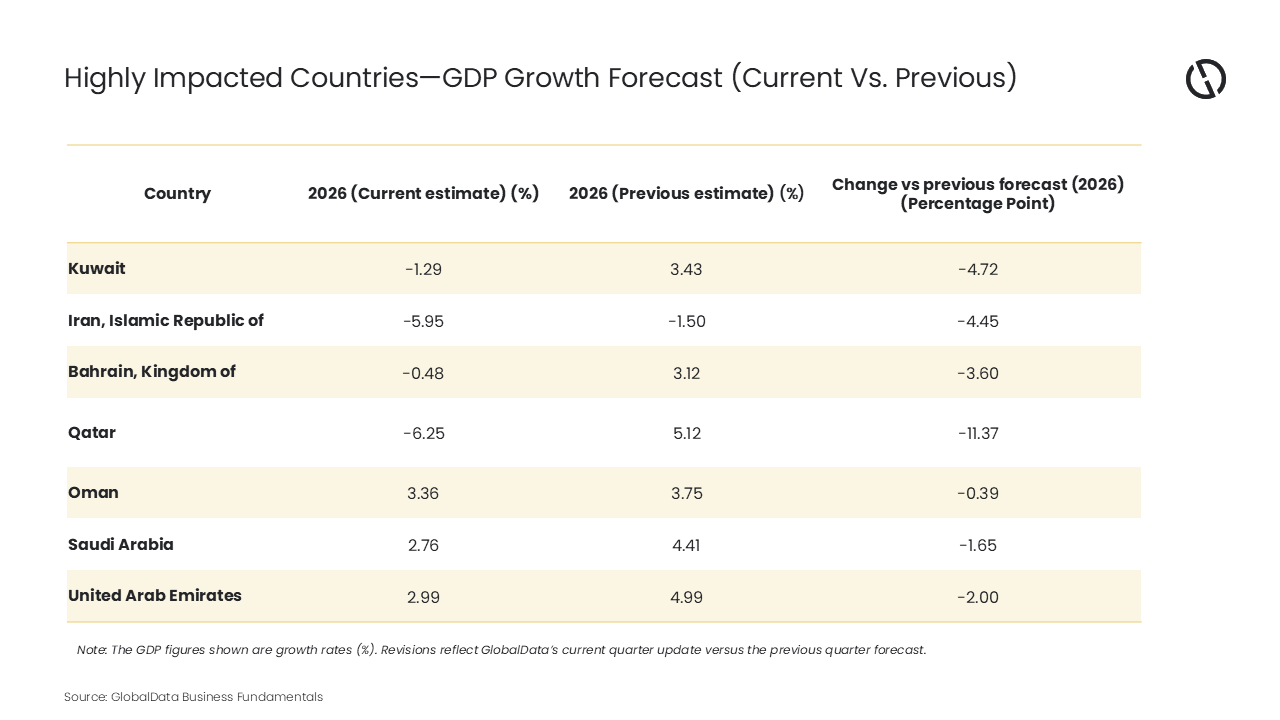
Largest downgrades concentrated in Qatar, Kuwait, Bahrain and the UAE
GlobalData expects Qatar to see the largest cut, down 11.37 percentage points (pp) versus the previous forecast, followed by Kuwait (down 4.72pp), Iran (down 4.45pp), and Bahrain (down 3.60pp). Oman, the UAE, and Saudi Arabia have also been downgraded as regional spillovers intensify, driven by trade links, mobility, investment flows, and higher risk premia.
Iran faces a pronounced growth contraction
GlobalData’s revised projections incorporate both direct and indirect impacts from the war on Iran, worsening expectations for activity across 2026. As a result, the forecast now calls for a deeper GDP contraction of 5.95%, versus an estimated 1.50% decline projected in the previous quarter, reflecting more severe disruptions to commerce, access to financing, business and consumer confidence, and cross-border economic activity.
Outlook remains highly conditional
Mundada concludes: “The outlook is contingent on how long the war persists, the degree of disruption in maritime routes through the Strait of Hormuz, and the pace at which confidence returns. De-escalation and a sustained normalisation of shipping activity could limit further downside; however, continued disruptions would keep pressure on non-oil activity, raise import costs, and delay project pipelines.”