Engineer News Network The ultimate online news and information resource for today's engineer
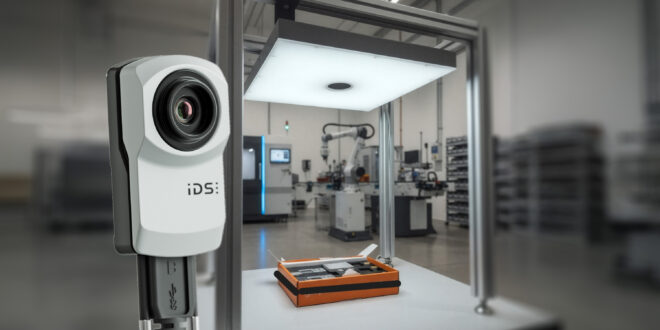
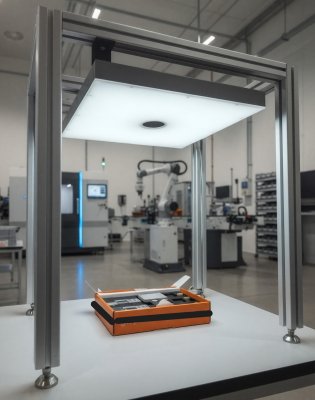
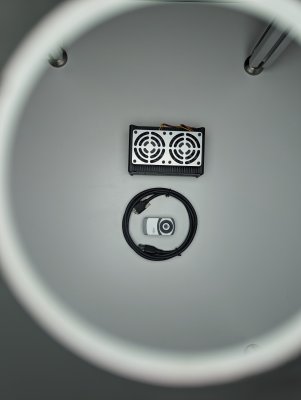
Quality control is under more pressure today than ever before: It must operate flexibly, precisely and economically. Industries such as automotive, mechanical engineering and electronics manufacturing test a growing variety of components – often under changing conditions and with minimal time for complex integrations. This is where preML’s inspection solution comes in. It can be quickly integrated, is intuitive to use and enables even users without image processing knowledge to create AI-supported inspection models. Their modular design has proven itself in electronic assemblies, plastic parts and many other industrial applications. The system is supplied as a complete, modular kit – with camera, lighting, edge computing and pre-installed Software. This makes it a genuine plug-and-play solution for industrial quality control.
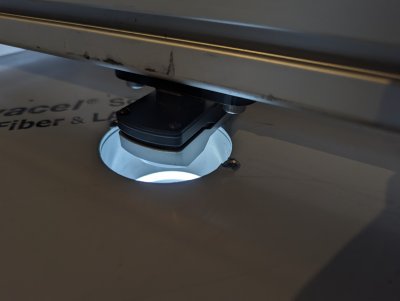
At the heart of the system is the IDS uEye XC industrial camera. Its 13-megapixel sensor delivers detailed images, while the autofocus ensures consistent sharpness – even with changing component heights, variable working distances or different surfaces.
Practical inspection – from plastic parts to circuit boards
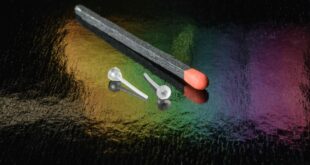
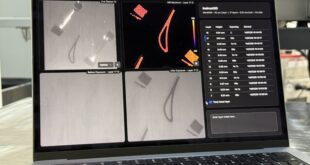
In live operation of the preML Vision Lab software, the uEye XC captures a plastic dowel, for example, and automatically checks it for deviations. Test models can be created, managed and evaluated in real time directly on the device.
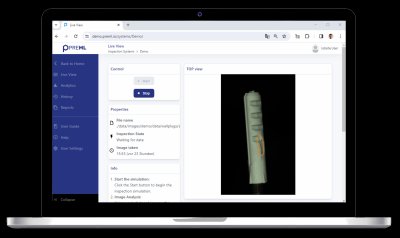
Electronics manufacturing provides a practical example: TOP. Thomas Preuhs GmbH uses the flexible inspection system to check manually assembled printed circuit boards. The combination of powerful camera technology and an AI-based inspection model opens up a new level of automation with minimal operating effort. David Fehrenbach, founder of preML, emphasises its ease of use: “Our solution fills a crucial gap in the market. For the first time, skilled personnel without knowledge of image processing or AI can independently, intuitively and directly teach, manage and perform visual quality inspections on the device itself.”
The uEye XC combines the ease of use of a webcam with the reliability of an industrial camera. A single cable connection is all that is needed for installation and commissioning – an advantage in manufacturing environments where systems are frequently converted or expanded. Inside, the 13MP sensor AR1335 from onsemi delivers high-resolution images for reliable fault detection. The autofocus sharpens automatically and maintains consistent image quality, even with varying object distances.
Software and edge computing – no code, self-sufficient, ready to use in minutes
The system is supplied with a compact edge computing unit. It operates completely independently, requires no internet connection and is therefore ideal for isolated production environments. The pre-installed preML Vision Lab software runs as a web application directly on the device. It is designed as a no-code solution and enables the training and execution of test models without programming knowledge. Models can be adapted to new products in just a few minutes, which saves time, especially in production with many variants.
TOP GmbH & Co. KG uses the system to inspect manually assembled printed circuit boards – an environment in which a wide variety of variants, different surfaces and changing lighting conditions are commonplace. “For over two decades, TOP has been assembling components and end devices of all kinds, from prototypes to small and large series. Production follows the principles of lean production. Many assemblies are produced by hand, followed by inductive soldering. Because TOP stands for the highest quality, all manufactured parts undergo a 100% inspection. To this end, the company uses the preML GmbH system, among other things,” explains Emil Kurowski, TOP Managing Director.
The solution can be adapted to new products in just a few minutes; test models can be created and expanded without any programming knowledge. Fehrenbach explains: “Our solution combines the best of both worlds: the performance of turnkey inspection systems with the flexibility of customisable software functions. At the same time, it impresses with the operating logic and cost-effectiveness of a smart camera.”
The system thus opens up new possibilities not only for today’s testing processes. It also lays the foundation for future, even more flexible inspection solutions, ranging from automated series testing to fully self-learning quality control. The next step in development is integration into robotics and automation solutions in order to further network testing processes and fully automate them.