Engineer News Network The ultimate online news and information resource for today's engineer
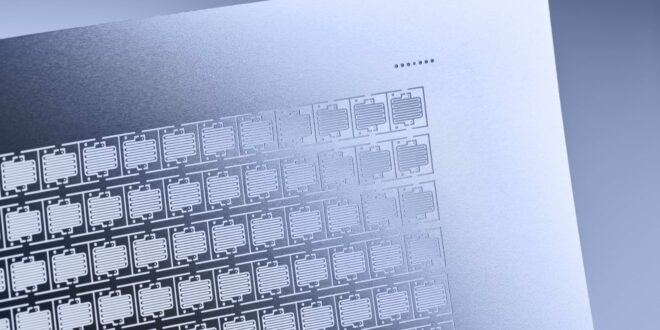
Jochen Kern looks at how photo-chemical etching (PCE) drives scale-up because it behaves like a digitally defined process rather than a mechanically forced one. When you pattern metal photo-lithographically and remove material chemically, you eliminate many variables that creep into stamping, punching, and thermal cutting as production ramps, at industrial scale
‘Scale-up’ is where good ideas go to die. A component that performs flawlessly in a lab build can become unstable, expensive, or impossible to qualify once volumes climb. In precision metal parts, the failure mode is rarely dramatic. I is subtle. Maybe a burr that becomes a contamination trap, a tolerance that drifts as tools wear, a surface that changes with heat input, a supplier handover that forces requalification. The lesson is uncomfortable but liberating, scalable supply is not a purchasing task. It is an engineering discipline.
Photo-chemical etching (PCE) has become a backbone for that discipline because it behaves like a digitally defined process rather than a mechanically forced one. When you pattern metal photo-lithographically and remove material chemically, you eliminate many variables that creep into stamping, punching, and thermal cutting as production ramps. That is why PCE is increasingly used not only to make thin, intricate parts, but to make them the same way, repeatedly, at industrial scale.
Manufacturing phases
Most products go through at least three manufacturing ‘phases’. Early prototypes are made one way, pre-series parts another way, and volume parts a third way. Each phase change introduces new tooling, new process windows, and new failure modes. In regulated or safety-critical industries, it also introduces new documentation burdens. The result is a paradox, the closer you get to production, the less freedom you have to fix what you learned.
A better approach is to design a supply architecture that is continuous from day one. PCE lends itself to this because the same core physics (mask definition, resist, chemistry, etch control) can span prototypes and production. Tooling is digital. Complexity is ‘in artwork’, not in a die set. The earliest parts you make can be representative of the parts you will ship, which makes learning cycles meaningful rather than misleading.
Reel-to-reel
This is where reel-to-reel matters. Many engineers are comfortable with sheet-based etching for prototypes, but high-volume success depends on controlling variability and handling. Reel-to-reel PCE processes continuous strip rather than discrete panels, reducing touches and flattening the variation that comes from ‘lots’ behaving slightly differently. In practical terms, it means fewer handling defects, tighter repeatability across long runs, and a lower cost per part once volume scales. More importantly, it lets you claim something that is difficult in most metalworking, the first and the millionth part can be produced under essentially the same process conditions.
If you have never used PCE, you may assume its value is simply ‘fine features’. Fine features are part of the story, but the more strategic advantage is predictable manufacturing behaviour. In PCE, there is no tool wear changing edge condition over time. There is no heat-affected zone altering microstructure. There is no mechanical deformation that must be corrected later. That stability cascades with less post-processing, less rework, fewer inspection surprises, and more reliable assembly performance. In other words, yield becomes an engineered outcome, not a statistical hope.
Four layers
To architect scalable supply, product teams should think in four layers.
Layer one is geometry that supports scale. PCE rewards functional integration. Instead of designing three separate parts (spring, filter, locator) you can often design one etched component that does all three. Fewer parts means fewer interfaces, fewer suppliers, and fewer opportunities for variability. The best DfPCE work does not merely replicate stamped geometry, it uses the process to remove assembly steps.
Layer two is tolerance strategy. Many scale-up problems are self-inflicted by over-tolerancing. If every dimension is specified to the tightest possible limit, you inflate inspection cost and create false rejects. PCE can hold tight tolerances, but the smarter move is to apply tight control to the dimensions that drive function (such as flow, sealing, contact force, impedance) and relax the rest. This not only improves yield, it improves robustness when your part is assembled into a real product where variation exists elsewhere.
Layer three is qualification and change control. Digital tooling is faster, but it must be disciplined. If you treat artwork changes casually, you risk uncontrolled variation. The right model is ‘software with governance’, controlled revisions, traceability, and a clear link between design changes and process validation. PCE makes this easier because fiducials, identification marks, and inspection datums can be built into the same digital workflow.
Layer four is capacity and resilience. Scalable supply is not only about throughput, it is about the ability to keep shipping when conditions change. A multi-site, multi-technology platform provides options, sheet routes for agility, continuous routes for volume, and complementary processes such as electroforming or laser micromachining when a specific geometry, thickness, or material pushes you beyond one method.
In practice, this also strengthens supply chains. Multi-region production and local engineering support shorten feedback loops, reduce logistics shocks, and make second-source planning realistic. It is a pragmatic response to today’s demand for resilience, not just simply low unit cost.
PCE as an innovation engine
Seen this way, PCE is not just a manufacturing process, it is an innovation engine. When you remove the cost and time penalty of hard tooling, designers iterate more intelligently. They explore geometry that improves function because they can test it quickly. They do not have to freeze a suboptimal design early simply to avoid tool investment. And because the path to volume is continuous, those design improvements are not lost during industrialisation.
Consider how this plays out across applications. In medical devices, burr-free parts reduce finishing steps and contamination risk, and process continuity reduces requalification surprises. In automotive and EV systems, millions of identical parts are required with stable electrical and thermal performance; reel-to-reel consistency and low handling defect rates directly affect warranty risk. In consumer electronics and wearables, design cycles are fast and cosmetic defects are expensive; rapid iteration plus stable scale-up protects time-to-market. In semiconductors and precision industrial systems, tolerances and edge quality can sit beyond what standard methods sustain; stable etch control becomes a performance requirement.
Culture Shift
There is also a cultural shift required inside OEM organisations. Many teams still separate ‘design’ from ‘supply’. They treat manufacturing partners as vendors rather than co-engineers. In a scalable supply model, that separation becomes a liability. PCE performs best when process specialists are engaged early, because small changes in web widths, feature spacing, or nesting strategy can improve yield dramatically without changing function.
The headline claim of scalable supply is simple. Prototype today, produce millions tomorrow, without changing the rules of the game. Achieving it demands a system view including geometry, tolerances, governance, capacity, and resilience. PCE is not the answer to every part. But for thin, intricate metal components where repeatability and volume are mission-critical, PCE offers an unusually coherent pathway from concept to mass production, one that turns scale-up from a painful transition into a designed capability
Jochen Kern is Head of Sales & Marketing, Micro Component Group.